Amy-Jill Levine, Answered

The new president of the Catholic Biblical Association on Jesus, the Pharisees, Paul and the Church, in her own words. Each point sits beside Robert Sungenis's answer, quoted exactly.

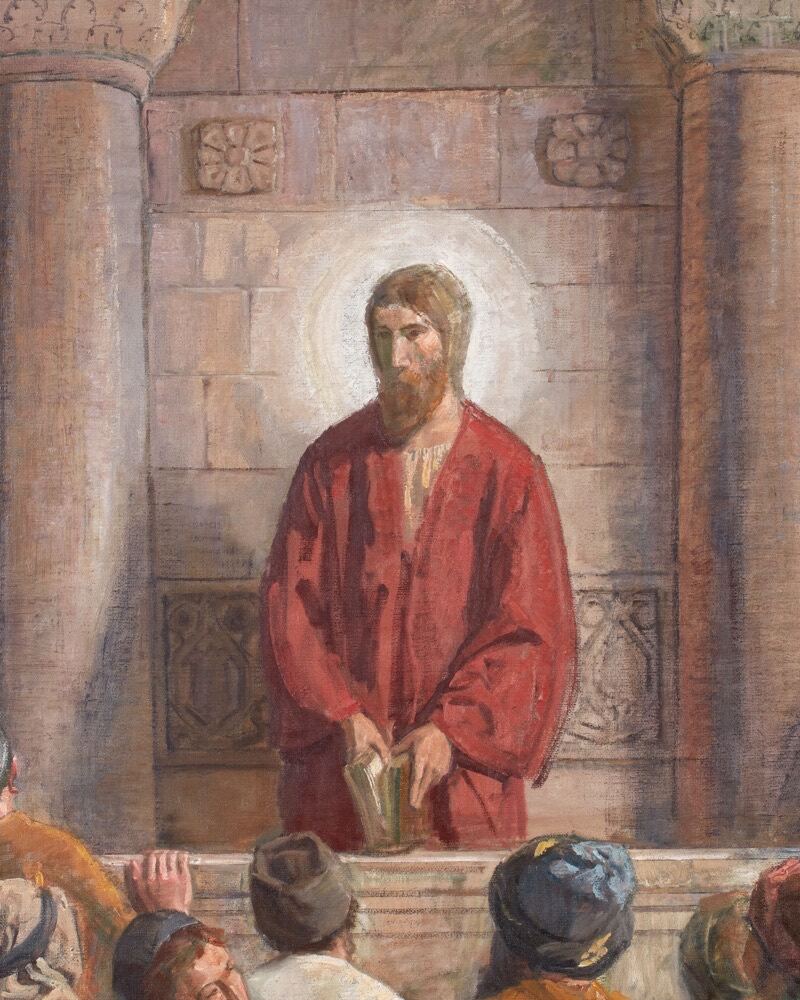
Jesus in a red robe stands at the reading desk of a synagogue, a book in His hands, as men in caps listen
Joakim Skovgaard, Jesus in the Synagogue, 1914. Public domain.

Amy-Jill Levine is University Professor Emerita at Vanderbilt Divinity School and, for 2026-2027, president of the Catholic Biblical Association of America, its first Jewish president.

Levine's words come from 19 videos of her own lectures, sermons and interviews, quoted from YouTube's captions. The words are exactly as captioned; only the capital letters the automatic captions drop have been restored. Hosts' questions are never quoted as hers.

Robert's answers are passages from his books, commentaries and articles, quoted exactly. One of them answers Levine by name. Where his work agrees with her, that is said. Where it does not meet her argument, the page says so instead of answering for him.

The Catholic Biblical Association of America elected Amy-Jill Levine its president for 2026-2027 at its 88th annual meeting, on July 20, 2026. She is the first Jewish president in the society’s history. Source: Catholic Biblical Association, “Amy-Jill Levine Announced as New CBA President,” August 7, 2026.

Answered
14
Partly answered
8
Robert agrees
2
Not answered in Robert’s work
0

Jesus, the Law and first-century Judaism

Levine says Jesus never loosened the Law of Moses: He kept the commandments, and the “you have heard it said” sayings of the Sermon on the Mount extend them rather than overturn them.

Partly answered
Levine: National Cathedral Sermon by Amy-Jill Levine, March 7, 2021

Plays here. Any time on this card jumps the video to that moment; the pop-out keeps it playing while you read.

Levine, in her words

“Jesus does not abrogate the commandments he extends them”
2:09Washington National Cathedral, National Cathedral Sermon by Amy-Jill Levine, March 7, 2021
“Jesus observed the ten commandments and the other six hundred and three commandments as Jews traditionally numbered them and he taught his followers to do the same”
3:42Washington National Cathedral, National Cathedral Sermon by Amy-Jill Levine, March 7, 2021
“So if we want to talk about somebody as being legalistic, it's Jesus doubling down on the commandments rather than rather than loosening them up.”
14:28Bible & Archaeology, Who Were the Pharisees Really? Debunking Misconceptions with AJ Levine
“So, what he's doing is he's actually making the law more rigorous rather than less.”
9:52The Bible Uncut and Unfiltered, 126. The Jewish Jesus Christians Forgot (ft. AJ Levine)

Robert’s answer

Robert agrees that the sayings of Matthew 5:21-48 are not set against the Law itself: in his reading Jesus is correcting what the Pharisees taught about the Law and showing the Law’s full intent. He parts company with Levine on what follows from that. For Robert the Law is “fulfilled” in the sense that its principles pass into the New Covenant while the Old Covenant Law, as a system, is replaced.

Robert, like Levine, denies that the “you have heard it said” sayings oppose the Law of Moses.

“Jesus is not contrasting His teaching against the teaching in the Law, but strictly against what the Pharisees taught about the Law”
CASB 1: The Gospel of St. Matthew

He reads the sayings as revealing the Law’s original intent, close to Levine’s “extensions.”

“In Mt 5:21-48, Jesus reveals what He means by “fulfilling” the Law. He shows, for example, that whereas the Law commanded men not to murder (Mt 5:21), this also means that whoever denigrates his brother has broken the Fifth Commandment (cf., Jm 2:6-11). The Law is thus “fulfilled” because its original intent is now made evident.”
CASB 1: The Gospel of St. Matthew

But he holds that the Old Covenant Law, as a system, did not continue.

“Conversely, it must also be maintained that Jesus is not teaching that the Old Covenant Law, as a system in itself, was to continue in the New Covenant. The Old and New Covenants are entirely separate covenants, such that the latter replaced the former, totally and completely (Hb 7:18; 10:9).”
CASB 1: The Gospel of St. Matthew

What Robert’s work does not answer here

These passages do not take up Levine’s claim that Jesus Himself kept all 613 commandments and taught His followers to keep them.

Levine says Christians paint first-century Judaism as legalistic and graceless to make Jesus look good, and that “grace versus law” is a false reading of both Testaments.

Partly answered
Levine: 126. The Jewish Jesus Christians Forgot (ft. AJ Levine)

Plays here. Any time on this card jumps the video to that moment; the pop-out keeps it playing while you read.

Levine, in her words

“It's made out of historical ignorance to make Judaism look bad in order to make Jesus look good. And Jesus looks perfectly fine on his own embedded in his context.”
7:02The Bible Uncut and Unfiltered, 126. The Jewish Jesus Christians Forgot (ft. AJ Levine)
“One way of trying to make Jesus look good is to make Judaism look bad and the worst one can make Judaism look the better Jesus looks”
8:40The United Church of Canada, The Texts of Advent: Finding Good News and Avoiding Antisemitism
“The first thing to know is that first century Judaism was not legalistic.”
8:44The Bible Uncut and Unfiltered, 126. The Jewish Jesus Christians Forgot (ft. AJ Levine)
“The idea of grace versus law is just a false reading of both texts.”
9:21The Bible Uncut and Unfiltered, 126. The Jewish Jesus Christians Forgot (ft. AJ Levine)

Robert’s answer

Levine’s view of first-century Judaism follows E. P. Sanders, whom she names. Robert treats that school, the “New Perspective on Paul,” as a novelty and rejects it, and he holds that the Pharisees kept only the parts of the Law that suited them. He does not answer her charge that Christian preaching invents a Judaism hostile to women, Gentiles and the sick.

Robert states the view Levine holds, as the New Perspective scholars put it.

“Rather, Dunn, et al, say that the Jew of the first century A.D. believed he was within the grace of God, and thus a struggle between grace and works was not the Jew’s concern.”
Not By Faith Alone

He judges it a suspect novelty.

“All in all, the “New Perspective” on Paul is just what it says, a “new” perspective whose novelty qualifies it as a suspect interpretation of Holy Writ.”
The Old Covenant: Revoked or Not Revoked? (article)

He holds that the Pharisees’ teaching only appeared to obey the Law.

“Although some of the Pharisees’ reiterations match the wording in the Law, this was merely to give the appearance of obedience, since they invariably left out important qualifications in the Law.”
CASB 1: The Gospel of St. Matthew

What Robert’s work does not answer here

Robert’s work does not address Levine’s specific examples: that women, Gentiles and disabled people were already welcomed in first-century Judaism, so that crediting Jesus with inventing that welcome misrepresents Judaism.

Levine says the idea of an Old Testament God of wrath and a New Testament God of love is not only wrong but heretical: it is the same God.

Robert agrees
Levine: National Cathedral Sermon by Amy-Jill Levine, March 7, 2021

Plays here. Any time on this card jumps the video to that moment; the pop-out keeps it playing while you read.

Levine, in her words

“This view is wrong and those who hold it are not only misguided their heretics the God who created the world the God who called Abraham spoke to Moses covenanted with David and chose the people Israel is the same God”
5:32Washington National Cathedral, National Cathedral Sermon by Amy-Jill Levine, March 7, 2021

Robert’s answer

Robert agrees with her. He names the error she describes as Marcion’s, who held that the angry God of the Old Testament was a lesser god, and he notes that the Church opposed him.

Robert identifies the “God of wrath” contrast as Marcion’s teaching.

“Since Marcion taught that the God of the Old Testament was cruel, warlike, inconsistent, merciless, and consumed with the passion of anger, then he was inferior to the God of the New Testament.”
The Immutable God Who Can Change His Mind

And he says the Church rejected it.

“Unlike Marcion who said we can dispense with anything written in the Old Testament and don’t need to learn anything from its “terrible” God or its various covenants, the Church opposed him”
Supersessionism is Irrevocable

The Pharisees and Paul

Levine says the Gospels were written by the Pharisees’ rivals and exaggerate against them; Matthew even writes a Pharisee into a scene where Mark had a friendly scribe.

Partly answered
Levine: Jesus the Misunderstood Jew and the Pharisees: Correcting Stereotypes!

Plays here. Any time on this card jumps the video to that moment; the pop-out keeps it playing while you read.

Levine, in her words

“We're looking at literature written by the rivals of the Pharisees. Um, I think some of those statements, those hyperstatements are are not historical.”
17:02History Valley, Jesus the Misunderstood Jew and the Pharisees: Correcting Stereotypes!
“So what Matthew has done is dropped a Pharisee in where the Pharisee was not originally in order to provide yet another negative categorization of the Pharisees.”
7:02Bible & Archaeology, Who Were the Pharisees Really? Debunking Misconceptions with AJ Levine

Robert’s answer

Robert reads the Gospels’ disputes with the Pharisees as history. He says their oral tradition was used to justify moves against Jesus, and that Jesus exposed its hypocrisy. He does not engage her method of comparing parallel Gospel scenes to find where an evangelist added a Pharisee.

Answering David Klinghoffer’s defence of the Pharisees, Robert takes John’s account of the conflict as history.

“A day or so prior to this the Jews tried to kill Jesus in the temple, and they were relying on their oral tradition as justification (John 5‐8:59). There was no better way of exposing their hypocrisy than by demonstrating how ridiculous their oral tradition was.”
A Review of David Klinghoffer’s Why the Jews Rejected Jesus (article)

He accepts the Gospels’ charge against the Pharisees’ teaching.

“The Pharisees taught only those things from the Law which they countenanced, but rejected the rest, thus perverting even that which they accepted (see Mt 15:1-14).”
CASB 1: The Gospel of St. Matthew

What Robert’s work does not answer here

Robert’s work does not take up her comparison of Mark 12:28-34 with Matthew 22:34-40, in which the scribe Jesus praises in Mark becomes a Pharisee testing Him in Matthew.

Levine says Paul never stopped being a Jew or a Pharisee; he was a Jew who believed the Messiah had come, and he never knew the word “Christian.”

Partly answered
Levine: 126. The Jewish Jesus Christians Forgot (ft. AJ Levine)

Plays here. Any time on this card jumps the video to that moment; the pop-out keeps it playing while you read.

Levine, in her words

“Paul doesn't know the word Christian. So to talk about him changing from being a Jew to being a Christian is just kind of silly. He never gives up being a Jew.”
10:14The Bible Uncut and Unfiltered, 126. The Jewish Jesus Christians Forgot (ft. AJ Levine)
“And Paul does not cease being a Pharisee after he has his what? road to Damascus experience.”
1:09Bible & Archaeology, Who Were the Pharisees Really? Debunking Misconceptions with AJ Levine
“Paul has rather moved from a non-messianic form of Judaism to the movement that proclaimed Jesus Lord”
8:35Washington National Cathedral, National Cathedral Sermon by Amy-Jill Levine, March 7, 2021

Robert’s answer

Robert agrees that Paul was a Pharisee of strict observance. Where Levine hears Paul boasting of his credentials in Philippians 3, Robert’s commentary heads the passage “Jewish Rituals Count as Loss for Christ” and reads it as Paul setting his law-keeping aside for Christ.

Robert affirms Paul’s Pharisaic background.

“not only was Paul a Pharisee, his father was a Pharisee, the strictest Jewish sect of that day who sought to obey the letter of the law.”
Douay-Rheims Commentary, Volume 3

His heading for Philippians 3:7-8, where Levine hears Paul boasting of his credentials.

“Jewish Rituals Count as Loss for Christ”
Douay-Rheims Commentary, Volume 3

What Robert’s work does not answer here

Robert does not address her point that the word “Christian” appears in none of Paul’s letters, or her view that Paul changed from one form of Judaism to another rather than from Judaism to a new religion.

Levine says Paul’s warnings against keeping the Law were addressed to Gentiles, not to Jews; read that way, Paul “sounds a whole lot different.”

Answered
Levine: 126. The Jewish Jesus Christians Forgot (ft. AJ Levine)

Plays here. Any time on this card jumps the video to that moment; the pop-out keeps it playing while you read.

Levine, in her words

“So, when Paul says, "Listen, don't follow the law. You can't do it." We have to remember he's talking to Gentiles.”
10:50The Bible Uncut and Unfiltered, 126. The Jewish Jesus Christians Forgot (ft. AJ Levine)
“If we read Paul with the idea that he's writing to Gentiles which means not Jews not Samaritans he sounds a whole lot different than if we think he's writing to everybody”
55:28Grace Cathedral San Francisco, Amy-Jill Levine Forum
“Paul does not want them converting to Judaism”
10:17Washington National Cathedral, National Cathedral Sermon by Amy-Jill Levine, March 7, 2021

Robert’s answer

Levine gives the “Paul within Judaism” reading, and Robert answers it. He points to Galatians 2, where Paul tells Peter, a Jew, that Jews too are justified by faith in Christ and not by works of the Law. He names the scholars behind the view that Jews and Gentiles have separate ways to salvation and rejects it.

Robert’s text: Paul says this to Peter, and he includes Jews by birth.

“Paul says in Galatians 2:14-15, “…How is it, then, that you force Gentiles to follow Jewish customs? We who are Jews by birth and not ‘Gentile sinners’ know that a man is not justified by works of the law, but by faith in Jesus Christ.””
How Can I Get to Heaven?

He names the school Levine speaks for and states its conclusion.

“other Protestants such as Lloyd Gaston (“Paul and the Torah,” in Antisemitism and the Foundation of Christianity, 1987) and Stanley Stowers (A Rereading of Romans: Justice, Jews and Gentiles, 1994) have taken the theory so far as to say that Jews and Gentiles have “separate but related ways” to salvation, with Israel continuing to live by the law as the means to procuring its salvation.”
The Old Covenant: Revoked or Not Revoked? (article)

He argues that if the Mosaic covenant still bound Jews, it would bind Christians too.

“The term "Jewish covenant" will naturally be taken to mean Mosaic or Sinai covenant. If the Jews were to give continuing “fidelity” to the Mosaic law, then they be required to obey every law in the Mosaic code, and so would we Christians.”
Supersessionism is Irrevocable

The death of Jesus

Levine says human sin killed Jesus, that God the Father handed Him over, and that “the Jews have nothing to do with it.”

Answered
Levine: Dr. Amy-Jill Levine, Understanding Jesus and Paul Means Understanding Judaism

Plays here. Any time on this card jumps the video to that moment; the pop-out keeps it playing while you read.

Levine, in her words

“The theological answer to to who killed Jesus is human sin killed Jesus Jesus dies because of human sin”
1:28:28Saint Leo Center for Catholic-Jewish Studies, Dr. Amy-Jill Levine, Understanding Jesus and Paul Means Understanding Judaism
“The one who hands Jesus over is God the Father God the Father hands Jesus over and Jesus through his own fidelity goes goes willingly to the cross and the Jews have nothing to do with it”
1:29:07Saint Leo Center for Catholic-Jewish Studies, Dr. Amy-Jill Levine, Understanding Jesus and Paul Means Understanding Judaism
“Keep John the way it is in the lectionary because those Jews really did kill Jesus. Well, I don't think that's helpful either. I wasn't there.”
48:19Boston College Ctr for Christian-Jewish Learning, Christian Privilege, Christian Fragility, and the Gospel of John (John Paul II Lecture, 2018)

Robert’s answer

Robert has answered Levine on this point by name. Quoting her claim that Jesus “is not killed by Jews” but by the Roman state for sedition, he replies that the New Testament says Pilate tried to release Jesus while “the Jews insisted” on crucifixion. He also holds, with Nostra Aetate, that the Church never taught that all Jews then, or any Jews now, bear that guilt.

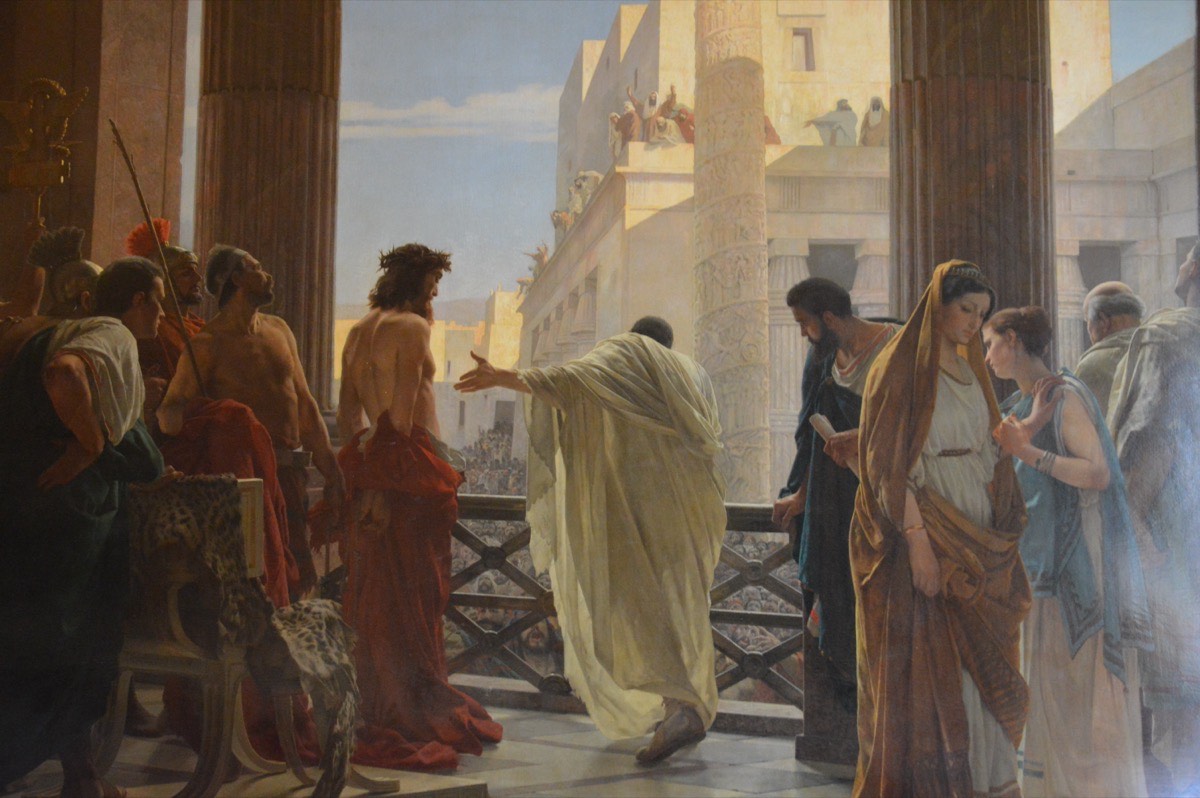
A painting: on a palace balcony Pilate, in a pale robe, gestures toward the scourged Jesus, crowned with thorns, before a crowd below

Robert, answering Levine by name

“the New Testament clearly says that Pilate sought to release Jesus but the Jews insisted that he be crucified”

Levine

“God the Father hands Jesus over and Jesus through his own fidelity goes goes willingly to the cross and the Jews have nothing to do with it”

Antonio Ciseri, Ecce Homo, 1871 to 1888; public domain, via Wikimedia Commons. Sources: The Old Covenant: Revoked or Not Revoked? (article).

Answering Levine by name, on her lecture “Preaching and Teaching the New Testament: Promoting Anti-Judaism?”

“the New Testament clearly says that Pilate sought to release Jesus but the Jews insisted that he be crucified, and (b) no Gospel writer mentions a Roman charge of sedition against Jesus.”
The Old Covenant: Revoked or Not Revoked? (article)

Robert reads the Passion accounts as placing responsibility on the Jewish authorities.

“It is obvious from a rational and fair reading of the Gospels that the Jewish authorities hated Jesus and wanted him dead.”
The 2015 Vatican Commission Statement on Relations with the Jews (article)

He limits that responsibility to those involved, not to all Jews.

“Moreover, the Catholic Church prior to Vatican II had never officially taught that “all” Jews committed deicide or that “all” Jews, apart from the rest of the world, are to be held responsible for the death of Christ.”
The Old Covenant: Revoked or Not Revoked? (article)

What Robert’s work does not answer here

Robert’s work quoted here does not discuss her reading of 1 Corinthians 11:23, that the one who “handed over” Jesus was God the Father.

Levine says that from Mark to Matthew to Luke to John, Pilate looks better and better and “the Jews” look worse and worse.

Partly answered
Levine: Dr. Amy-Jill Levine, Understanding Jesus and Paul Means Understanding Judaism

Plays here. Any time on this card jumps the video to that moment; the pop-out keeps it playing while you read.

Levine, in her words

“As you go from Mark to Matthew to Luke to John Pilate looks nicer and nicer and the Jews look more and more heinous more and more evil more and more corrupt”
1:27:36Saint Leo Center for Catholic-Jewish Studies, Dr. Amy-Jill Levine, Understanding Jesus and Paul Means Understanding Judaism
“Pilate, once he condemns Jesus, is, in fact, a Jew. In fact, he's the quintessential Jew.”
46:33Boston College Ctr for Christian-Jewish Learning, Christian Privilege, Christian Fragility, and the Gospel of John (John Paul II Lecture, 2018)

Robert’s answer

Robert’s commentary on John does not make Pilate look good: he calls him cowardly and notes that the Creed holds his name “in infamy.” But he reads John’s account of Pilate trying to release Jesus as history, not as a late softening, and he does not take up her claim of a steady trend across the four Gospels.

Levine's claim, in her words: “as you go from Mark to Matthew to Luke to John”

MarkMatthewLukeJohnPilatethe Jews
  • Pilate “looks nicer and nicer”
  • “the Jews” look “more and more heinous”

Robert, on John 19

Pilate “seeks to have him released,” in “his cowardly mind,” and “to this day his name is held in infamy in the Nicene Creed.”

Sources: CASB 6: The Gospel of St. John.

Robert takes John 19 at face value.

“We can safely say that Pilate is moved by Jesus and, however flawed in his method, seeks to have him released since he is convinced he has committed no crime worthy of scourging, much less death.”
CASB 6: The Gospel of St. John

He does not whitewash Pilate.

“Pilate’s governorship would have been in jeopardy, at least so he thought in his cowardly mind.”
CASB 6: The Gospel of St. John

Pilate still bears the blame the Creed gives him.

“Pilate succumbs to the Jewish ploy; and to this day his name is held in infamy in the Nicene Creed: “crucified under Pontius Pilate.””
CASB 6: The Gospel of St. John

What Robert’s work does not answer here

Robert does not address the four-Gospel comparison itself, or Melito of Sardis, whom Levine names as the endpoint of the trend.

Levine says Matthew 27:25, “His blood be on us and on our children,” is one of the New Testament’s problem passages, that its historicity is doubtful, and that reading it of all humanity does not remove the harm.

Answered
Levine: Jewish Jesus: Amy-Jill Levine Extended Interview

Plays here. Any time on this card jumps the video to that moment; the pop-out keeps it playing while you read.

Levine, in her words

“The blood cry in Matthew 27 where all the people are said to to proclaim let his blood be on us and on our children”
12:00Religion & Ethics NewsWeekly, Jewish Jesus: Amy-Jill Levine Extended Interview
“Here, they presume historical accuracy despite how bizarre such a comment from all the Jews at the time would have been.”
25:51Boston College Ctr for Christian-Jewish Learning, Christian Privilege, Christian Fragility, and the Gospel of John (John Paul II Lecture, 2018)
“This universalizing usually doesn't work.”
1:02:26Boston College Ctr for Christian-Jewish Learning, Christian Privilege, Christian Fragility, and the Gospel of John (John Paul II Lecture, 2018)

Robert’s answer

Levine and Robert agree on the Greek: the verse says “all the people.” They draw opposite conclusions. Levine doubts the crowd could have said it; Robert holds that the text means what it says and faults Pope Benedict XVI’s Jesus of Nazareth for denying it is history. He adds that Nostra Aetate itself says the Jewish authorities incited the crowd.

Robert, on the same Greek words Levine cites.

“The passage is very clear. It says the “whole people” (which is literally and correctly translated from the Greek πᾶς ὁ λαὸς).”
Review of Jesus of Nazareth, Part Two, by Joseph Ratzinger (article)

He reads the cry as history, prompted by the authorities.

“They incited the people against Jesus and made them cry, “Let his blood be upon us and our children.””
The 2015 Vatican Commission Statement on Relations with the Jews (article)

He limits the guilt to those who took part.

“Nostra Aetate only excuses, and rightly so, other Jews of that time who were not involved in his death”
The Old Covenant: Revoked or Not Revoked? (article)

Levine says the New Testament, read without its context, promotes hatred of Jews, and that churches should add warning notes and revise lectionary readings.

Partly answered
Levine: 126. The Jewish Jesus Christians Forgot (ft. AJ Levine)

Plays here. Any time on this card jumps the video to that moment; the pop-out keeps it playing while you read.

Levine, in her words

“Does the New Testament promote hatred of Jews? Yeah, of course it does.”
24:44The Bible Uncut and Unfiltered, 126. The Jewish Jesus Christians Forgot (ft. AJ Levine)
“Sometimes texts need a warning label sometimes lectionaries and not just for Holy Week need to be revised”
16:58Washington National Cathedral, National Cathedral Sermon by Amy-Jill Levine, March 7, 2021
“Put in a little note saying this lectionary reading has been misinterpreted to say X and then fix it.”
35:56ST. BART'S, Understanding Jesus and Paul means Understanding Jewish Practice and Belief

Robert’s answer

Robert reads the same passages as true history that must be preached as written. He sees efforts to soften Matthew 27:25 as the product of decades of dialogue, and he reads Nostra Aetate as keeping, not correcting, what the Gospels say about the Jewish authorities. In a 2026 exchange he asks for a working definition of “antisemitism,” and he calls the insults in an anonymous student letter at Benedictine College examples of “the tropes that Jews have had to tolerate for a very long time.”

Robert’s comment on Nostra Aetate 4.

“R. Sungenis: Here Nostra aetate does not white wash the truth.”
The 2015 Vatican Commission Statement on Relations with the Jews (article)

He expects that readings shaped by dialogue will blunt the text.

“it is almost inevitable that passages such as Mt 27:25 will somehow be neutralized of their first century impact.”
Review of Jesus of Nazareth, Part Two, by Joseph Ratzinger (article)

He also rejects reading these passages as a curse on the Jews.

“It only reminds us that we are not to take this truth to the extreme and make the illogical jump that Jews are accursed or that God has decided not to save any of them.”
The 2015 Vatican Commission Statement on Relations with the Jews (article)

Replying in 2026 to Gideon Lazar, a speaker at a Benedictine College conference on antisemitism.

“Unfortunately, Mr. Lazar’s response is immediately undercut by the casual use of the word “antisemitism” without a working definition.”
Response to Gideon Lazar’s Response to the Coalition of Catholics Against Jewish Supremacy (exchange, 2026)

On the critics he writes alongside.

“Most, if not all of my colleagues who have concerns about the political or religious aims of the Jews at large do not have any visceral hatred of the Jews as a people.”
Response to Gideon Lazar’s Response to the Coalition of Catholics Against Jewish Supremacy (exchange, 2026)

He wrote that Benedictine College “acted appropriately” in disciplining the students behind an anonymous letter, and called its insults:

“a perfect example of the tropes that Jews have had to tolerate for a very long time.”
Response to Gideon Lazar’s Response to the Coalition of Catholics Against Jewish Supremacy (exchange, 2026)

What Robert’s work does not answer here

Robert’s work does not address her specific proposals: printed notes beside readings, changes to the Revised Common Lectionary, or training preachers to avoid anti-Jewish readings.

Messiah, Son of God and the resurrection

Levine says Jesus cannot be the Messiah because the Messiah and the messianic age were a “package deal”: no general resurrection, no end to war, no universal peace, and no first and second coming in Israel’s scriptures.

Answered
Levine: 126. The Jewish Jesus Christians Forgot (ft. AJ Levine)

Plays here. Any time on this card jumps the video to that moment; the pop-out keeps it playing while you read.

Levine, in her words

“So the reason most Jews don't follow Jesus is because there's no general resurrection of the dead. And there's no end to war or disease or poverty. There's no universal peace.”
37:12The Bible Uncut and Unfiltered, 126. The Jewish Jesus Christians Forgot (ft. AJ Levine)
“Therefore, by definition, Jesus can't be the Messiah because the Messiah and the messianic age were a package deal. And if you go back to the scriptures of Israel, there's nothing about a first coming and a second coming, let alone a 2,000-year gap in between them.”
37:28The Bible Uncut and Unfiltered, 126. The Jewish Jesus Christians Forgot (ft. AJ Levine)
“Jews had various views of the Messianic age or the Messiah but they all looked at the Messianic age and the Messiah is a package deal”
25:45History Valley, The Historical Jesus in Context

Robert’s answer

Robert met this argument in his review of David Klinghoffer’s Why the Jews Rejected Jesus. He says Isaiah 53, Daniel 7 and 9 and Psalm 22 require the Messiah first to atone for sin, so His work comes in two stages. He answers the “wolf and the lamb” objection by asking when Israel ever had such peace, and he reads the promised blessings as fulfilled spiritually.

First

“atonement of mankind’s sin”

Isaiah 53; Dan. 7:13‑14; 9:24‑27; Psalm 22

Then

“the glory of the ‘messianic future’”

Robert

Without those passages “it certainly would be difficult to see that the Messiah’s mission had to occur in two stages.”

Sources: A Review of David Klinghoffer’s Why the Jews Rejected Jesus (article).

Robert finds the two stages in the Hebrew Bible itself.

“Of course, if one insists on disassociating all the references in the Hebrew Bible to the need for an atonement of mankind’s sin before the glory of the “messianic future” could take place (Isaiah 53; Dan. 7:13‐14; 9:24‐27; Psalm 22, etc.), it certainly would be difficult to see that the Messiah’s mission had to occur in two stages.”
A Review of David Klinghoffer’s Why the Jews Rejected Jesus (article)

On Isaiah 11:6, the wolf lying down with the lamb.

“Nothing new? When did Israel ever enjoy peace with the nations surrounding it, except in the days of Solomon, a brief interlude of 40 years out of 2000 years?”
A Review of David Klinghoffer’s Why the Jews Rejected Jesus (article)

He reads the promises as fulfilled spiritually rather than politically.

“Christ’s “seed” was fulfilled heavenly, divinely, spiritually and eternally (cf. Ps. 22:30; Mt. 12:50; Gal. 3:29).”
A Review of David Klinghoffer’s Why the Jews Rejected Jesus (article)

He sees the expectation Levine describes as the stumbling block of 1 Corinthians 1:23.

“The Jews expected the Messiah to come in glory as a divine conqueror of the nations and allow the Jews to reign supreme over the world (cf. Is 19:20; Is 45:15-17; 49:26).”
Douay-Rheims Commentary, Volume 3

Levine says “Son of God” was not a special title in early Judaism, since all people are children of God, and that it was His followers who proclaimed Jesus the Messiah.

Answered
Levine: Who Did They Say He Was? Jesus in Text and Context

Plays here. Any time on this card jumps the video to that moment; the pop-out keeps it playing while you read.

Levine, in her words

“Son of God, well, but son of we're all children of God. That's not actually a special title in early Judaism.”
15:38westminstertownhall, Who Did They Say He Was? Jesus in Text and Context
“His followers proclaimed him Messiah. But in the first century, there was no messianic job description.”
17:03westminstertownhall, Who Did They Say He Was? Jesus in Text and Context

Robert’s answer

Robert grants that other Jews called themselves sons of God. His point is that Jesus claimed to be the unique Son, under oath before the high priest, which is a claim to divinity, and that God has no other divine sons, only adopted ones.

On Matthew 26:63-64.

“Jesus is saying that He is not merely a son of God (as all other Jews claimed) but He is taking an oath that He is the unique Son of God, and thus divine.”
CASB 1: The Gospel of St. Matthew

On monogenes, “only-begotten.”

“especially since God does not have any more divine sons in addition to Jesus, but has adopted sons, namely, Christians.”
Douay-Rheims Commentary, Volume 1

Jesus Himself made the claim, Robert says.

“Moreover, when Jesus stood before these Jewish leaders he emphatically affirmed that he was “the Christ, the Son of the Living God” (Mt 26:63-63) and they refused to accept it.”
CASB 6: The Gospel of St. John

Levine says she cannot vouch for the resurrection as history: she was not there, and she is more interested in what the belief did for Jesus’ followers, some of whom “saw something.”

Answered
Levine: The Historical Jesus in Context

Plays here. Any time on this card jumps the video to that moment; the pop-out keeps it playing while you read.

Levine, in her words

“I'm more interested in what their belief in resurrection did to them or for them than it than it uh did it happen or did it not happen um if it did happen terrific but again I wasn't there”
25:28History Valley, The Historical Jesus in Context
“I think that some people really saw Jesus now could you catch it on a camera right I don't know uh but I think they saw something”
1:22:04MythVision Podcast, The Bible With And Without Jesus - Dr. Amy-Jill Levine
“And because they experienced what to them was the resurrection of Jesus. And I'm not going to call their experience into question.”
37:56The Bible Uncut and Unfiltered, 126. The Jewish Jesus Christians Forgot (ft. AJ Levine)

Robert’s answer

Robert treats the resurrection as bodily history: the witnesses ate and drank with the risen Jesus, and no one ever found His body.

On Acts 10:41.

“And this was no phantom or illusion, for they “ate and drank with him” (vr. 41) before he ascended into heaven.”
Douay-Rheims Commentary, Volume 2

On John 15:24.

“The resurrection of Jesus is beyond dispute, since no one ever found his body.”
CASB 6: The Gospel of St. John

What Robert’s work does not answer here

Robert’s short statements here do not engage her distinction between a vision that changes lives and a bodily event a camera could record.

Levine says the Jewish scriptures do not point to Jesus: Isaiah 7:14 promises no miracle, and Jews do not read Isaiah’s suffering servant as Christians do.

Answered
Levine: The Bible With And Without Jesus - Dr. Amy-Jill Levine

Plays here. Any time on this card jumps the video to that moment; the pop-out keeps it playing while you read.

Levine, in her words

“So the Septuagint gives us virgin a virgin and it gives us the verb in the future okay we'll conceive but even then you have to ask is this a miracle right”
36:56MythVision Podcast, The Bible With And Without Jesus - Dr. Amy-Jill Levine
“And you might take a text and put it in like 50point font like Isaiah's suffering servant. Jews don't even read that stuff because it's not it's not part of our liturgy.”
33:15WPLN News - Nashville Public Radio, Jewish Jesus scholar Amy-Jill Levine and her lifelong quest to end anti-semitism
“So if we stop trying to fit the Old Testament to Judaism and the Tanakh into Christianity but we recognize that these are different texts with different meanings then we can begin to have a conversation”
13:31MythVision Podcast, The Bible With And Without Jesus - Dr. Amy-Jill Levine

Robert’s answer

Robert argues from the Hebrew itself. Almah occurs only seven times, and none of them describes a married or sexually active woman. Isaiah 53 describes an individual “without deceit” who dies as a guilt offering, which he says the nation of Israel never was.

almah, “only seven times in the Hebrew Old Testament”

Gn 24:43Ex 2:8Ps 68:25Pr 30:19Sg 1:3Sg 6:8Is 7:14

Robert: “None of the above passages suggest that almah refers to a woman who is married or has had sexual relations.”

Levine

“the Septuagint gives us virgin a virgin and it gives us the verb in the future okay we'll conceive but even then you have to ask is this a miracle”

Sources: CASB 1: The Gospel of St. Matthew.

On Isaiah 7:14.

“However, the word almah appears only seven times in the Hebrew Old Testament (cf., Gn 24:43; Ex 2:8; Ps 68:25; Pr 30:19; Sg 1:3; 6:8; Is 7:14), thus the evidence upon which to base such conclusions is rather limited. None of the above passages suggest that almah refers to a woman who is married or has had sexual relations.”
CASB 1: The Gospel of St. Matthew

On Isaiah 53.

“Of the many things that are not “cryptic” in Isaiah 53, the passage speaks of an individual who “did no violence” and was “without deceit” (53:9), and can thus atone for the sins of the people by being sacrificed as a “guilt offering,” the antitype to the sacrifice of unblemished lambs in Leviticus.”
A Review of David Klinghoffer’s Why the Jews Rejected Jesus (article)

Covenant, salvation and the Jews today

Levine says “hard” supersessionism, in which the Church takes over Israel’s promises and the Jews are disinherited, is dangerous and makes God unfaithful to His covenant.

Answered
Levine: Understanding Jesus and Paul means Understanding Jewish Practice and Belief

Plays here. Any time on this card jumps the video to that moment; the pop-out keeps it playing while you read.

Levine, in her words

“Hard supersessionism, sometimes called replacement theology, suggests that all the promises that were made to Abraham, that were made to Israel, have passed over from what Paul would call Israel according to the flesh or ethnic Jews over to the Christian church.”
30:58ST. BART'S, Understanding Jesus and Paul means Understanding Jewish Practice and Belief
“And that's where the replacement comes in that's the dangerous stuff um and I think it's also theologically problematic for those who believe in God because it says God is not faithful to the divine covenant”
1:11:45MythVision Podcast, The Bible With And Without Jesus - Dr. Amy-Jill Levine
“As long as you leave the original covenant in place I think it's okay don't disinherit the Jews”
32:11ST. BART'S, Understanding Jesus and Paul means Understanding Jewish Practice and Belief

Robert’s answer

Robert wrote a book on this subject, Supersessionism is Irrevocable. He defines supersessionism as the Church’s constant teaching that the Mosaic covenant has been replaced by the New, cites Cardinal Ratzinger for it, and calls the co-existence of the two covenants heresy. He also rejects the step Levine fears, from replacement to calling the Jews accursed. In a 2026 exchange he splits the Abrahamic covenant in two. Its spiritual side was never revoked and became the New Covenant. Its physical side took the form of the Mosaic covenant and was revoked at the death of Christ.

Robert

“If the two covenants cannot co-exist, then it would be heresy to say that the Old Covenant (understood as the Sinai covenant) co-exists with the New Covenant.”

Sources: Supersessionism is Irrevocable.

Robert's two theses on the Abrahamic covenant, 2026

The Abrahamic covenant

“The spiritual and salvific side”

“designed from the beginning to be perpetual”

“never revoked but became the New Covenant of Christ”

Gn 12:3; Gl 3:6-9; Rm 4:1-22

“The physical or temporal side”

“temporarily took the form of the Mosaic covenant”

“finally revoked at the death of Christ”

Gn 15:18-21; Dt 28:1-68; Hb 7:18

Robert

In the New Covenant “all baptized Jews and Christians become sons of Abraham in faith.”

Levine

Describing the “hard supersessionism” she rejects: “all the promises that were made to Abraham, that were made to Israel, have passed over from what Paul would call Israel according to the flesh or ethnic Jews over to the Christian church.”

Sources: Response to Gideon Lazar’s Response to the Coalition of Catholics Against Jewish Supremacy (exchange, 2026).

Robert’s definition.

“Supersessionism: The traditional Catholic doctrine that the Jewish covenant (otherwise known as the Mosaic, Sinai, or Old Covenant) has been superseded or replaced by the New Covenant in Jesus Christ and thus no longer operates for the Jewish people as a legitimate covenant.”
Supersessionism is Irrevocable

He cites Ratzinger’s 1999 book for the traditional view.

“the “Old Covenant” has been traditionally understood as the Mosaic covenant, which has been traditionally understood as revoked and superseded by the New Covenant in Christ, as stated, for example, by Cardinal Joseph Ratzinger”
Supersessionism is Irrevocable

He rejects Levine’s “leave the original covenant in place.”

“If the two covenants cannot co-exist, then it would be heresy to say that the Old Covenant (understood as the Sinai covenant) co-exists with the New Covenant.”
Supersessionism is Irrevocable

But he denies that supersession means the Jews are accursed.

“It only reminds us that we are not to take this truth to the extreme and make the illogical jump that Jews are accursed or that God has decided not to save any of them.”
The 2015 Vatican Commission Statement on Relations with the Jews (article)

On the phrase “the covenant was never revoked.”

“As long as the scholars and ecumenists insist on using the general and ambiguous proposition that “the covenant was never revoked,” and thereby refusing to follow their own directive to be “precise” and “critical” (which would require them to say unequivocally, “the Mosaic (Sinai) covenant has been revoked and superseded by the New Covenant of Christ”), then the discussion cannot advance.”
Response to Gideon Lazar’s Response to the Coalition of Catholics Against Jewish Supremacy (exchange, 2026)

Levine says Christians can follow Paul in holding that Jews are still under covenant and that “all Israel will be saved” at the end, after a temporary hardening.

Answered
Levine: 126. The Jewish Jesus Christians Forgot (ft. AJ Levine)

Plays here. Any time on this card jumps the video to that moment; the pop-out keeps it playing while you read.

Levine, in her words

“You can follow Paul and recognize that Jews are still under covenant.”
41:25The Bible Uncut and Unfiltered, 126. The Jewish Jesus Christians Forgot (ft. AJ Levine)
“All Israel will be saved. And that's not replacement theology.”
41:34The Bible Uncut and Unfiltered, 126. The Jewish Jesus Christians Forgot (ft. AJ Levine)
“I'm inclined to cite Romans a hardening has come upon Israel so you know like there's a temporary gap here and who knows what's going to happen at the end of time”
2:53lifetodaytv, Why Did Jesus Say That? - Dr. Amy-Jill Levine on LIFE Today Live

Robert’s answer

Robert has written a book on this verse, Why There Will Not Be a Mass Conversion of the Jews. He reads the Greek houtos in Romans 11:26 as “in this way,” not “then”: the hardening of part of Israel lasts to the end of the world, and “all Israel” is the remnant of believing Jews saved from Abraham to Christ’s return. He argues the same in a 2026 exchange, adding that the Church has no present dogmatic teaching that the Jews as a whole will convert near the end of time.

Robert, on Romans 11:26

“the verse does not say ‘and then all Israel shall be saved,’ but only ‘and thus all Israel shall be saved.’” The two are “happening simultaneously.”

Sources: Why There Will Not Be a Mass Conversion of the Jews; CASB 3: The Epistles of Romans and James.

On the word houtos in Romans 11:26.

“But the verse does not say “and then all Israel shall be saved,” but only “and thus all Israel shall be saved.””
Why There Will Not Be a Mass Conversion of the Jews

There is no temporary gap, in Robert’s reading.

“Rather, the hardening of one part of Israel and the saving of the other part of Israel are happening simultaneously, and both will continue while the “full number of Gentiles” is being added.”
CASB 3: The Epistles of Romans and James

Who “all Israel” is.

“the manner in which “all Israel will be saved” is thus fulfilled in “the remnant” of all the Jews saved from the time of Abraham, the first Jew, until the return of Christ when the last Jew is saved, while the rest remain hardened in their unbelief.”
CASB 3: The Epistles of Romans and James

On what the Church teaches, from a 2026 exchange.

“there is no present dogmatic teaching in the Catholic Church concerning an automatic conversion of the entire Jewish population sometime near the end of time.”
Response to Gideon Lazar’s Response to the Coalition of Catholics Against Jewish Supremacy (exchange, 2026)

On the Catechism, CCC 674.

“Even paragraph 674 of the Catechism of the Catholic Church does not teach a future conversion of the last generation of the Jews, although it is frequently cited as teaching such a doctrine.”
Response to Gideon Lazar’s Response to the Coalition of Catholics Against Jewish Supremacy (exchange, 2026)

Levine says she feels no gap that Jesus would fill: Judaism already gives her resurrection, mercy and forgiveness, and “not all Jewish thought requires blood sacrifice.”

Answered
Levine: Why Did Jesus Say That? - Dr. Amy-Jill Levine on LIFE Today Live

Plays here. Any time on this card jumps the video to that moment; the pop-out keeps it playing while you read.

Levine, in her words

“My heart is so full with my own Judaism that I'm not feeling any gap there for which I need Jesus to come in it's just not there”
20:07lifetodaytv, Why Did Jesus Say That? - Dr. Amy-Jill Levine on LIFE Today Live
“If the belief is I now have forgiveness of sin well Judaism already had that too and there are various mechanisms for atonement and not not all Jewish thought requires blood sacrifice”
25:34lifetodaytv, Why Did Jesus Say That? - Dr. Amy-Jill Levine on LIFE Today Live
“And Jesus responds well the gospel of John does have me saying that but if you flip back over to Matthew which does come first in the canon I make it very clear that it's not those who say lord lord but those who do the will of the father”
22:58lifetodaytv, Why Did Jesus Say That? - Dr. Amy-Jill Levine on LIFE Today Live

Robert’s answer

The last quote is from a story Levine tells in which Jesus admits her to heaven for her works. Robert’s answer is the Church’s traditional one: there is only one covenant now in force, the one in Christ, and there is no forgiveness without the shed blood of Christ’s sacrifice. He leaves room only for invincible ignorance.

On forgiveness without sacrifice.

“This is why, for example, Hb 9:22 states: “without the shedding of blood [propitiation] there is no remission of sin [expiation].””
Not By Bread Alone

On salvation apart from Christ.

“There is only one covenant existing today, and that one is in Jesus Christ, and Jews who refuse to accept Jesus Christ and his covenant cannot be saved, at least not without a heavy dose of invincible ignorance.”
“Catholic Zionism”: Contradiction in Terms (article)

Robert’s conclusion in Supersessionism is Irrevocable.

“In the end, there can be no substitution for the requirement of the Jews to convert to Christianity is they want to be saved.”
Supersessionism is Irrevocable

On Abraham’s covenant, from a 2026 exchange.

“And the only way a Jew can “still hold to the Abrahamic covenant” is if he forsakes his Mosaic religion and adopts the grace of the New Covenant in Jesus Christ, as Abraham did.”
Response to Gideon Lazar’s Response to the Coalition of Catholics Against Jewish Supremacy (exchange, 2026)

Levine says she has never felt the call to worship Jesus and is not about to convert, and that arguments will not bring her to faith.

Partly answered
Levine: AMDG Podcast: Meet the Jewish Scholar Elected to Lead the Catholic Biblical Association

Plays here. Any time on this card jumps the video to that moment; the pop-out keeps it playing while you read.

Levine, in her words

“Um, but I've never felt the call to worship Jesus as Lord and Savior. So, I'm not about to convert.”
30:32Society of Jesus (Jesuits), AMDG Podcast: Meet the Jewish Scholar Elected to Lead the Catholic Biblical Association
“So if somebody tries to argue me into faith, um the arguments are not going to work”
33:50WPLN News - Nashville Public Radio, Jewish Jesus scholar Amy-Jill Levine and her lifelong quest to end anti-semitism

Robert’s answer

Robert holds that the Church must still preach conversion to everyone, Jews included, and that Jesus gave the Jews of His day evidence enough in His miracles. He does not take up Levine’s account of faith as something like falling in love, which argument cannot produce.

On the Church’s mission, against Cardinal Kasper.

“The mission must be objectively taught, without reservation, that Jews, and everyone else in the world, must convert in order to be saved.”
Kasper the Friendly Ecumenist Teaching Spooky Doctrines (article)

On evidence and refusal.

“Jesus had done countless miracles for the Jews to prove his divine sonship, but the Jews resolutely refused to accept any of them.”
CASB 6: The Gospel of St. John

He treats unbelief as a choice.

“Jews at large have rejected Christ by their own free will.”
The 2015 Vatican Commission Statement on Relations with the Jews (article)

What Robert’s work does not answer here

Levine says faith is “more like love” than a conclusion reached by argument, and that her not believing is not a choice. Robert’s work does not address that account of faith.

The Church, Scripture and the parables

Levine says Vatican II’s Nostra Aetate declared that Jews of all times and places cannot be held responsible for the death of Jesus, and changed two thousand years of anti-Jewish Catholic preaching.

Answered
Levine: “Antisemitism in Christian Theology” with Amy-Jill Levine, Called to Be Bad Podcast

Plays here. Any time on this card jumps the video to that moment; the pop-out keeps it playing while you read.

Levine, in her words

“A document called Nostra Itat, Latin for in our time, proclaims that Jews at all times and places cannot be held responsible for the death of Jesus.”
21:08Called to Be Bad Podcast, “Antisemitism in Christian Theology” with Amy-Jill Levine, Called to Be Bad Podcast
“What what happened at Vatican 2 with Nostra Ite this proclamation that changed in effect 2,000 years of anti-Semitic Christian Catholic preaching it's extraordinary.”
30:57Society of Jesus (Jesuits), AMDG Podcast: Meet the Jewish Scholar Elected to Lead the Catholic Biblical Association

Robert’s answer

Robert reads Nostra Aetate 4 differently on both counts. The document, he notes, says the Jewish authorities pressed for Christ’s death and excuses only those not involved. And since the Church never taught that all Jews were guilty of deicide, he says, the document continues tradition rather than overturning it. Writing in 2026, he also holds that the document keeps its authority, and that the argument is about what it says.

What the document says, in Robert’s reading.

“Additionally, Nostra Aetate does not excuse the Jews for being involved in the death of Christ. It says without equivocation: “Jewish authorities…pressed for the death of Christ.””
The Old Covenant: Revoked or Not Revoked? (article)

He sees continuity with tradition.

“In short, Nostra Aetate is not teaching new doctrine. It is continuing the official teaching of Catholic tradition.”
The Old Covenant: Revoked or Not Revoked? (article)

He accepts the document’s authority and disputes how it is read.

“It is one thing to argue about what Nostra aetate actually said about the Jews, but it is quite another to claim that whatever Nostra aetate says it has no authority.”
Response to Gideon Lazar’s Response to the Coalition of Catholics Against Jewish Supremacy (exchange, 2026)

The readings of Nostra Aetate he rejects.

“Current modernist Catholics believe that Nostra aetate teaches that the Jews have their own covenant with God; that the Mosaic covenant has not been abrogated and replaced by the New Covenant in Christ; that the Jews do not need Christianity in order to be saved but can be saved by their own covenant with God”
Response to Gideon Lazar’s Response to the Coalition of Catholics Against Jewish Supremacy (exchange, 2026)

Levine says the Gospels, even if divinely inspired, are human products written by the historical winners, so historians may correct their picture of the Pharisees and the Jews, and that this is consistent with Catholic doctrine.

Answered
Levine: AMDG Podcast: Meet the Jewish Scholar Elected to Lead the Catholic Biblical Association

Plays here. Any time on this card jumps the video to that moment; the pop-out keeps it playing while you read.

Levine, in her words

“You can use history to to look at the text um the text are human products. They may be divinely inspired. They're still human products.”
16:00Society of Jesus (Jesuits), AMDG Podcast: Meet the Jewish Scholar Elected to Lead the Catholic Biblical Association
“And they're written by the historical winners in this case.”
16:09Society of Jesus (Jesuits), AMDG Podcast: Meet the Jewish Scholar Elected to Lead the Catholic Biblical Association

Robert’s answer

Robert’s The Demise of Catholic Scripture Scholarship is aimed at this approach. He does not forbid historical study of the text, but he holds that no Church teaching admits errors in Scripture, so historical-critical conclusions cannot correct what the Gospels affirm.

Robert’s summary of the historical-critical position.

“Essentially, historical critics claim that Scripture is replete with enough historical errors, human biases, religious prejudices and fictional stories that little of it can be taken as factual”
The Demise of Catholic Scripture Scholarship

On what Catholic doctrine allows.

“Since there is no Church teaching which says that there are errors in Scripture, then anyone, whether it based on historical-critical approach or not, who says that there are errors in Scripture, has made claims the Church has never taught.”
Does the Bible Contain Errors? (exchange)

Levine says Jesus ordained no one and chose only Jewish men as apostles, so if the Church could open that office to Gentile men it can open it to women.

Partly answered
Levine: 126. The Jewish Jesus Christians Forgot (ft. AJ Levine)

Plays here. Any time on this card jumps the video to that moment; the pop-out keeps it playing while you read.

Levine, in her words

“I said, "Well, first of all, Jesus doesn't ordain anybody. There's no ordination." And second, if we're going to go by, he picked 12 apostles. Well, he only picked Jews. So, how is it that the church can expand to Gentile men, but it can't expand to women? That's just bizarre.”
31:58The Bible Uncut and Unfiltered, 126. The Jewish Jesus Christians Forgot (ft. AJ Levine)

Robert’s answer

Robert met the “Jesus never ordained anyone” argument on CNN International and turned it back: if Jesus ordained no one, no one can be a priest. He holds that women are not permitted to be priests and points to Isaiah 3:12. He does not answer her analogy from Gentile men.

Against the same argument, made by Rea Howarth on CNN.

“SUNGENIS: Well, if he never ordained anyone, then you can't be a priest either. [What I was trying to do here was use her logic against her, not suggest that Jesus would have ordained women as priests!]”
Robert on CNN International (broadcast transcript)

His position on women priests.

“SUNGENIS: No. Because they're just not allowed to. I mean, the solution to the problem is not making women priests.”
Robert on CNN International (broadcast transcript)

What Robert’s work does not answer here

Her argument that the apostles were all Jews, so that ordaining Gentile men already set aside one of Jesus’ choices, is not answered in Robert’s work.

Levine says God is not interested in torturing anyone for eternity; the end of the wicked may be oblivion, and “we actually don’t know.”

Answered
Levine: 156: Amy-Jill Levine: A Jewish Take on Jesus (Best of NSE)

Plays here. Any time on this card jumps the video to that moment; the pop-out keeps it playing while you read.

Levine, in her words

“I don't think that God is interested in torturing us for all eternity that's not the Jewish God that's not the God of Jesus and that's not a God of grace and kindness oblivion maybe and when we get down to it we actually don't know”
29:01No Small Endeavor, 156: Amy-Jill Levine: A Jewish Take on Jesus (Best of NSE)
“A lot of this is not eternal pain but in fact oblivion”
28:12No Small Endeavor, 156: Amy-Jill Levine: A Jewish Take on Jesus (Best of NSE)

Robert’s answer

Robert holds the traditional teaching that hell is eternal separation and punishment, graded by each person’s sins. He adds that even if the wicked were annihilated after punishment, the result would still be eternal and irreversible.

The traditional teaching.

“suffice it to say that the traditional Christian teaching is that Hell involves eternal separation and punishment from God. The sins of the individual will determine the degree of punishment.”
CASB 5: The First Epistle to the Corinthians

On annihilation, the nearest thing to her “oblivion.”

“Whatever the punishment of hell consists, the results are eternal and irreversible, even if annihilation after punishment is considered a possibility, since the result of annihilation is eternal and irreversible.”
Douay-Rheims Commentary, Volume 4

Levine says the Church, “bless its heart,” made the parables nice: the lost sheep is not about repentance, since sheep do not repent and God does not lose us.

Answered
Levine: Who Did They Say He Was? Jesus in Text and Context

Plays here. Any time on this card jumps the video to that moment; the pop-out keeps it playing while you read.

Levine, in her words

“The church, bless its heart, came in and interpreted the parables in a very nice way.”
9:59westminstertownhall, Who Did They Say He Was? Jesus in Text and Context
“As if this parable is about repenting and forgiving. First century Jews aren't hearing that, among other things, cuz sheep don't repent.”
10:21westminstertownhall, Who Did They Say He Was? Jesus in Text and Context
“And moreover, the sheep owner lost the sheep and God doesn't lose us.”
10:38westminstertownhall, Who Did They Say He Was? Jesus in Text and Context

Robert’s answer

Levine calls the lesson about the repentant sinner Luke’s addition. Robert takes Jesus’ own conclusion in Luke 15:7 as the parable’s point: the Pharisees who grumble would search for their own lost sheep, and Jesus searches for sinners so that they may repent.

On Luke 15:4-7.

“Hence as Jesus’ critics would certainly seek for the lost sheep if it were theirs, so Jesus seeks for sinners to repent so he can receive them into his heavenly kingdom.”
Douay-Rheims Commentary, Volume 2

What Robert’s work does not answer here

Robert does not address her objection that in the parable the owner is the one who loses the sheep, while God does not lose anyone.

Levine says the Samaritan in Jesus’ parable was the enemy, not a model helper, and that the priest and Levite had no purity law excusing them.

Robert agrees
Levine: Dr. Amy-Jill Levine 6-minute lecture: Who Is My Enemy? The One Who May Save Me

Plays here. Any time on this card jumps the video to that moment; the pop-out keeps it playing while you read.

Levine, in her words

“That's not who Samaritans were in antiquity and they weren't the oppressed minority either they were the enemy”
6:02No Small Endeavor, Dr. Amy-Jill Levine 6-minute lecture: Who Is My Enemy? The One Who May Save Me
“Nonsense nonsense there's no law preventing a Levite from coming in touch with a corpse”
3:37No Small Endeavor, Dr. Amy-Jill Levine 6-minute lecture: Who Is My Enemy? The One Who May Save Me
“You're not the Samaritan you're the person in the ditch”
7:31No Small Endeavor, Dr. Amy-Jill Levine 6-minute lecture: Who Is My Enemy? The One Who May Save Me

Robert’s answer

On the Samaritan, Robert’s commentary says what Levine says: Jews and Samaritans despised each other, so he was the least likely of the three to help. Robert reads the lesson for the lawyer as obedience to the heart of the Law.

On Luke 10:33.

“who Jesus mentions as the third traveler since the Jews and Samaritans despise each other and thus a Samaritan would be the least likely of the three (i.e., priest, Levite, Samaritan) to help the destitute man.”
Douay-Rheims Commentary, Volume 2

On Luke 10:35.

“These extended actions showed his love was not a mere token to satisfy the outward requirements of the law but a deep heartfelt obedience to the essence of the law (cf. Lk 13:11-15; 14:5; Mt 12:11-12).”
Douay-Rheims Commentary, Volume 2

Sources

Videos