Bart D. Ehrman, Answered

28 positions Bart D. Ehrman has taken on the Gospels, the text of the New Testament, the divinity of Jesus, the resurrection and suffering. Each one is set beside what Robert Sungenis has written or said, quoted as he wrote it.

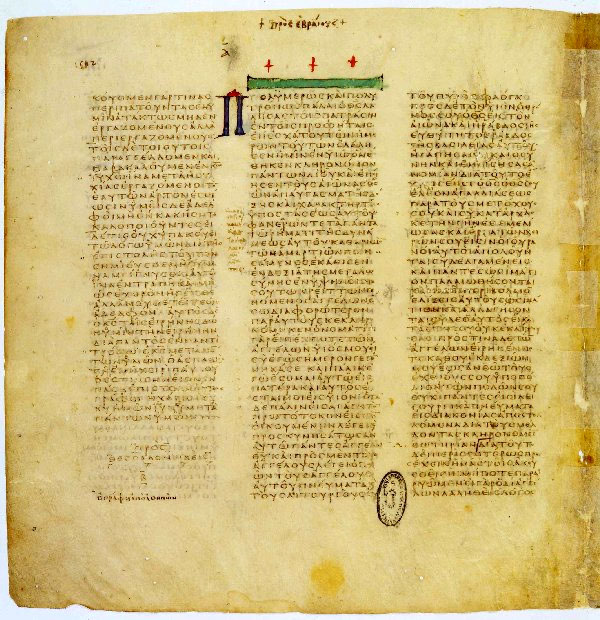
The first page of the Gospel of Matthew in Codex Sinaiticus: four columns of Greek capital letters on pale parchment
Codex Sinaiticus, the first page of Matthew. Public domain, via Wikimedia Commons

Ehrman's words come from 18 videos of him speaking. Video quotes are from YouTube's captions without correction; article quotes are as published.

Robert's answers are passages from his books and broadcasts, quoted exactly. Where his work agrees with Ehrman, that is said. Where it does not meet Ehrman's argument, the page says so instead of answering for him.

Answered
3
Partly answered
24
Robert agrees
1
Not answered in Robert’s work
0

The Gospels and their authors

Ehrman says the four Gospels are anonymous books that do not claim to be written by Matthew, Mark, Luke and John, and that their authors were later Greek-speaking Christians living outside Israel.

Partly answered
Ehrman: 8 Bible Myths Many Christians Believe

Plays here. Any time on this card jumps the video to that moment; the pop-out keeps it playing while you read.

Ehrman, in his words

“They they are they are anonymous books written in a different language by people who are not living in Israel, who say nothing about having any reliable sources.”
29:29Bart D. Ehrman, 8 Bible Myths Many Christians Believe
“Matthew Mark Luke and John do not claim to be written by people named Matthew Mark Luke and John this book actually claims to be written by Peter and so whoever's writing and saying I'm Peter yeah you're not it was written later”
23:31Bart D. Ehrman, Who Chose the Books of the New Testament?
“Scholars think that all the gospel writers are greek-speaking Christians from a from later generation a later generation living outside of Israel and uh Matthew doesn't claim to be Matthew the tax collector doesn't claim to be a disciple of Jesus doesn't claim to be from Israel and he he probably wasn't”
10:01Bart D. Ehrman, Who Says Mary Was a Virgin?

Robert’s answer

Robert names Matthew, Mark, Luke and John as the authors on the testimony of Irenaeus and other Fathers, and argues that Matthew, a tax collector, could write Greek. In another book he states that the Gospel texts themselves do not name their authors.

The early Church accepted the Greek Matthew as Matthew's own work, Robert argues, since a tax collector in Capernaum must have known Greek.

“Matthew himself is a known entity. It is more reasonable to assume the early Church accepted the Greek of his gospel because they knew it to be from his inspired pen alone. As a tax collector for the Romans in Capernaum, Matthew must have been conversant in Greek, otherwise he could not have functioned in that position.”
Douay-Rheims Commentary, Volume 1

Irenaeus, as Robert cites him, names Matthew, Mark as Peter's interpreter, Luke as Paul's companion, and John the disciple as the writers of the four Gospels.

“Irenaeus: “Matthew also issued a written Gospel among the Hebrews in their own dialect, while Peter and Paul were preaching at Rome, and laying the foundations of the Church. After their departure, Mark, the disciple and interpreter of Peter, did also hand down to us in writing what had been preached by Peter. Luke also, the companion of Paul, recorded in a book the Gospel preached by him. Afterwards, John, the disciple of the Lord, who also had leaned upon His breast, did himself publish a Gospel during his residence at Ephesus in Asia””
CASB 1: The Gospel of St. Matthew

Robert lists early witnesses to Luke's authorship and says Luke drew on John, Matthew and Mark as sources.

“That Luke did write his own gospel is testified by Justin Martyr, Irenaeus, Tertullian, Tatian, Celsus, Eusebius, Marcion, the Diatessaron and the Muratorian Canon. Luke’s gospel is not an entirely eyewitness composition; rather, it is the gospel “according to Luke” (κατά Λουκᾶν). The sources from which Luke drew to write his gospel are noted in vrs. 12. Of the more prominent, John was an eyewitness to all the events, while Matthew to most of them, and Luke drew the rest from Mark and his own experiences.”
Douay-Rheims Commentary, Volume 2

Here Robert states that the Gospel texts do not name their authors and are anonymous, a point he turns against the Protestant test of canonicity.

“although Matthew’s name in commonly ascribed to the writing of the first gospel, the text nowhere claims that Matthew is its author. The same is true of the other three gospels - they are all anonymous. Thus the Protestant does not even know if an “apostle, or one approved by an apostle,” wrote these gospels.”
Not By Scripture Alone

What Robert’s work does not answer here

In one book Robert calls all four Gospels anonymous, since the texts do not name their authors; elsewhere he names Matthew, Mark, Luke and John on the testimony of Papias, Irenaeus and later Fathers. Robert's books and broadcasts do not directly address the claim that the authors lived outside Israel, and he himself describes Luke as a Gentile convert.

Ehrman says the Gospels were written 40 to 60 years after Jesus by people who did not know Him, did not speak Aramaic, and do not claim to have talked to eyewitnesses.

Partly answered
Ehrman: Did Jesus Even Claim to be God? Bart Ehrman Says No...

Plays here. Any time on this card jumps the video to that moment; the pop-out keeps it playing while you read.

Ehrman, in his words

“The earliest gospel is probably Mark it's probably at least 40 years after jesus' death by somebody who wasn't there and Matthew and Luke are 50 60 years after Jesus death they they weren't there they weren't Aramaic speaking Jews in Israel they they spoke Greek”
40:39Alex O'Connor, Did Jesus Even Claim to be God? Bart Ehrman Says No...
“They're written 40 50 60 years later by people who did not know Jesus who did not live in Israel who didn't speak Jesus language Aramaic”
10:13Bart D. Ehrman, Did Jesus Even Exist?
“One of the most interesting features of the Gospels is that none of them claims that to have talked to any eyewitnesses for their information.”
28:31Bart D. Ehrman, 8 Bible Myths Many Christians Believe
“I absolutely don't think they're based on eyewitness testimony. Well I mean that the authors actually were getting eyewitnesses to tell them things. And also even if they were were if they weren't, they're not accurate in places.”
29:29Bart D. Ehrman, 8 Bible Myths Many Christians Believe

Robert’s answer

Robert dates Matthew to 60 AD and holds that the New Testament, apart from John and the Apocalypse, was written before 70 AD. He reads Luke 1:1-4 as Luke's own claim to have drawn on eyewitnesses who lived in his generation.

Robert, in years AD

70 AD60 ADMatthew66 ADMark, Luke

“The NT, except for John and the Apocalypse, was written before 70 AD.”

Ehrman, in years after Jesus' death

0Jesus' deathMark, at least 40405060Matthew, Luke

Two rulers, because the two men count differently: Robert gives years AD, Ehrman counts from Jesus' death.

Robert on Luke 1:1-4

Luke “received his information directly from eyewitnesses”

Ehrman

“none of them claims that to have talked to any eyewitnesses”

Sources: Douay-Rheims Commentary, Volumes 1 and 2; The Demise of Catholic Scripture Scholarship.

Matthew wrote his Greek Gospel in 60 AD, Robert states, and Mark and Luke each had a copy of it.

“NB: Matthew’s Hebrew logia is not to be confused with Matthew’s gospel that was written in Hebrew and later translated into Greek after 80 AD. Matthew wrote his inspired Greek gospel in 60 AD, of which both Mark and Luke had a copy and had collaborated until 66 AD.”
Douay-Rheims Commentary, Volume 2

The New Testament does not mention the fall of Jerusalem, Robert argues, because apart from John and the Apocalypse it was written before 70 AD.

“In this case, it continues the action because many apostles lived after 70 AD. Although there is no historical reference to 70 AD in the NT, that is because the NT, except for John and the Apocalypse, was written before 70 AD.”
Douay-Rheims Commentary, Volume 1

According to Robert, Luke says he received his information directly from eyewitnesses and lived in their generation.

“In fact, the only non-apostle to write a Gospel, Luke, makes it clear that he received his information directly from eyewitnesses, from which he then selected and synthesized for his gospel (Luke 1:1-4). We also know from the Pauline epistles that Luke lived in the same generation as the eyewitnesses of Jesus’ life (cf. Cl 4:14; 2Tm 4:11; Pm 1:24).”
The Demise of Catholic Scripture Scholarship

Robert reads the Greek of Luke 1:1 as referring to writings gathered from people who saw the events or heard them directly from witnesses.

“But πεπληροφορημένων’s neuter is objective and refers to all the writings gathered together from those who had seen it with their own eyes or heard it directly from those who had witnessed the events.”
Douay-Rheims Commentary, Volume 2

What Robert’s work does not answer here

Robert's work does not address the claim that the Gospel writers did not speak Aramaic; he holds that Matthew wrote in Greek. His commentary on Luke also gives two different datings, saying Luke probably began his Gospel in 65 AD and also that neither Luke nor Mark had written a Gospel when Paul died in 68 AD.

Ehrman says the Gospels contain much historically accurate information alongside material that is not, because stories about Jesus changed as they were retold and later storytellers put words on His lips.

Partly answered
Ehrman: Are the Gospels Historically Reliable? The Problem of Contradictions

Plays here. Any time on this card jumps the video to that moment; the pop-out keeps it playing while you read.

Ehrman, in his words

“It's easier just to say that the gospels are filled with information some of which is historically accurate of course a lot of it's historically accurate and it has information that's not historically accurate”
43:17Bart D. Ehrman, Are the Gospels Historically Reliable? The Problem of Contradictions
“My assessment is that uh a lot of the materials we have in the gospels uh are uh these materials are put onto his lips by later storytellers uh many of them promoted later Christian agenda which makes them a little bit uh suspicious”
4:24Alex O'Connor, Did Jesus Even Claim to be God? Bart Ehrman Says No...
“Traditions stories about Jesus that have been circulation for many for many years and as you know stories get changed when they when they get told and retold”
11:08Bart D. Ehrman, Did Jesus Even Exist?
“You're not going to remember uh you know the farewell discourse in the Gospel of John which is five chapters long just you're not going to do it and people are not sitting around memorizing things the way everybody says they they weren't”
40:17Bart D. Ehrman, Why Doesn't Bart Believe in God?

Robert’s answer

Robert holds that the Gospels are historically accurate throughout and that apparent discrepancies come from the writers selecting details under the Holy Spirit's guidance. He describes the late oral-tradition theory as an attempt to remove eyewitness testimony from the Gospels.

The Gospels contain no historical errors, Robert states, and their seeming conflicts are only apparent.

“As the other gospels, all of Matthew’s gospel is historically authentic and gives us completely accurate information. There are no historical errors in Matthew’s account, either in the first two chapters, or in any other part of his gospel. As Luke says in the opening of his gospel, giving an accurate account of the historical details of Jesus’ life was the very purpose for writing the gospel (Lk 1:1-4: “That you may know the truth of those words in which you have been instructed”). Although some of the historical details of the gospels seem to be incomplete or conflicting, these are only apparent discrepancies.”
Douay-Rheims Commentary, Volume 1

In Robert's account, critics proposed the theory of second- or third-generation redaction of oral tradition to keep the Gospels from being read as eyewitness accounts.

“Incidentally, the “Q” theory, or what is also known as the “twosource” theory, was proposed by historical critics in an effort to keep the Gospels from being understood as actual eyewitness accounts of what occurred in the life of Jesus, as they had been traditionally understood. “Q” was vitally important to the liberals, because if the Gospels can be fashioned into nothing more than second- or thirdgeneration redactions of a first generation oral tradition, then the incidence of foreign elements (e.g., fiction) creeping into the narratives would be quite high, and thus make the final document historically unreliable.”
The Demise of Catholic Scripture Scholarship

The quest for the historical Jesus, Robert argues, could not separate the miraculous from the history in the Gospels.

“The scholars found that no matter how hard they tried, the miraculous could not be separated from the Jesus of history. The history and the supernatural were so intertwined, and so meticulously detailed, interwoven, and overlapped, that to subtract the miracles 20 would be to erase the history. To their utter consternation, the Bible was written in such a way that if you eliminate the one you eliminate the other, and there was simply no escape from this reality.”
The Demise of Catholic Scripture Scholarship

On a broadcast Robert says the four evangelists wrote the Gospels, that second-century Christians did not redact them, and that they are true and trustworthy.

“All of the Bible was written by the evangelists Matthew, Mark, Luke and John. It was not redacted by second century Christians who had an animosity for the Jews. We accept the Bible as it is written by eyewitnesses, and if they weren't eyewitnesses, then they received divine revelation, as Saint Paul did about the issue with the Jews, so that at the end of the day we can say that everything that's written in the New Testament is true and trustworthy.”
30:59Robert Sungenis Live #125 Ask Your Question - Wed, May 4th, 2022, YouTube captions

What Robert’s work does not answer here

Robert's books and broadcasts affirm the Gospels' full accuracy and give his view of the motive behind the oral-tradition theory, but they do not work through the particular sayings or stories that Ehrman says changed in retelling or were placed on Jesus' lips later. Robert treats differences between accounts as selection under the Holy Spirit's guidance and does not examine them case by case.

Ehrman says John the son of Zebedee did not write the Gospel of John, that its portrait of Jesus is theological rather than historically accurate, and that sayings such as John 8:58 are not accurate accounts of Jesus' words.

Partly answered
Ehrman: Faking It: Is the Bible Full of Forgeries?

Plays here. Any time on this card jumps the video to that moment; the pop-out keeps it playing while you read.

Ehrman, in his words

“The premise that he has is John the son of Zebedee wrote the Gospel of John and today's Scholars don't think that's right either but but it is clear they are different different authors”
18:07Bart D. Ehrman, Faking It: Is the Bible Full of Forgeries?
“So this is not an unusual view among Scholars it's simply The View that that the Gospel of John is providing a theological understanding of Jesus that is not what was historically accurate”
3:04Bart D. Ehrman, If Jesus Never Called Himself God, How Did He Become One?
“I don't think there's any way it's an accurate account I mean if Jesus was going around claiming the name of God for himself uh as as in the Gospel of John then um he no he wouldn't have survived”
27:53Alex O'Connor, Did Jesus Even Claim to be God? Bart Ehrman Says No...
“I mean I don't agree that we know that it was earlier in the second century you and I can uh we can arm wrestle about that one over drink sometime but because you know until rnas we don't know in my my opinion”
27:11Bart D. Ehrman, Is the Gospel of John a Forgery?

Robert’s answer

Robert traces John's authorship through Irenaeus, Polycarp and Papias, and rejects the "presbyter John" theory. He reads John 8:58 as Jesus claiming to be God and explains Jesus' escape by His being hidden by those around Him.

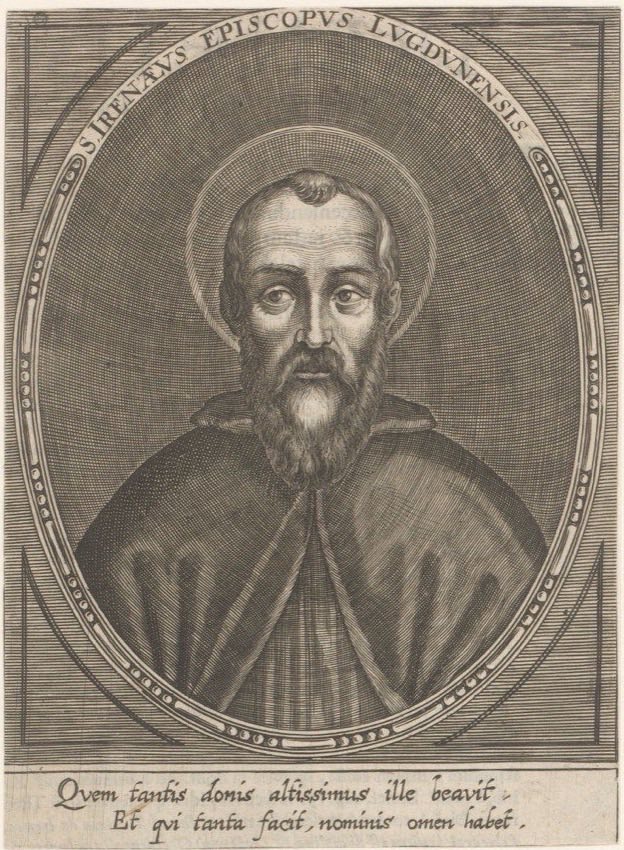
An engraved portrait of Saint Irenaeus, bearded and haloed, in an oval frame

“The most important witness to John's written works is Irenaeus.” He reports “that John wrote his gospel while in Ephesus.”

Johnin Ephesus, in the reign of Trajandisciple of PolycarpPapias 60-100Polycarp 69-155Irenaeus 120-203Polycarp and Papias: disciples of John

“Bearing witness” means “that John was still alive when these words were written.”

Ehrman's reading

“John the son of Zebedee wrote the Gospel of John and today's Scholars don't think that's right.”

Saint Irenaeus, anonymous engraving, 1600s, Rijksmuseum; CC0, via Wikimedia Commons. Sources: Douay-Rheims Commentary, Volume 1; CASB 6: The Gospel of St. John.

Robert's key witness is Irenaeus, a disciple of Polycarp who was a disciple of John, who reports that John wrote his Gospel in Ephesus.

“The most important witness to John’s written works is Irenaeus (120-203), who was a disciple of Polycarp (69-155) the bishop of Smyrna, who was a disciple of John along with Papias (60-100). It is Irenaeus who reveals in his famous book, Heresies (3, 1, 1) that John wrote his gospel while in Ephesus and that John lived there in the reign of Trajan (Heresies, 3, 4, 4; 2, 22, 25).”
Douay-Rheims Commentary, Volume 1

Robert calls the "two Johns" inference false and says none of the early commentators denied John's authorship of the fourth Gospel.

“Eusebius, however, quotes a statement from Papias from which Eusebius infers that there are two Johns, one called the “apostle John” and the other called the “presbyter John,” which supposition, though false, gained momentum with Dionysius of Alexandria (248-264 papacy) since he could not believe that John wrote the Apocalypse and therefore believed it was written by the “presbyter” John. Although none of the above commentators denied John’s authorship of the fourth gospel, modern critics attempt to use the “presbyter” theory to deny John’s authorship of both the gospel and the Apocalypse.”
Douay-Rheims Commentary, Volume 1

In Robert's reading, the crowd understood John 8:58 as a claim to be God and tried to stone Jesus, who was hidden by those around Him.

“The Jews realize Jesus is designating himself as God Almighty and they proceed to follow the prescription of Lv 24:13-16 against blasphemy by stoning him right then and there, an immediate act of mob justice, as it were, as opposed to bringing formal legal injunctions against him as demanded by the law. 396 hid himself”: ἐκρύβη, an aorist passive indicating Jesus was hidden by a third party, most likely the apostles and friends surrounding him so the Jews could not reach him.”
Douay-Rheims Commentary, Volume 1

The Greek of John 21:24, Robert argues, shows John was alive and still testifying to what he had written.

““bearing witness”: Gr: μαρτυρὼν, present participle, which means that John was still alive when these words were written and was still testifying to them. Μαρτυρὼν is followed by the aorist participle γράψας (“has written”), which syntactical order thus means that John is still orally testifying to what he has already written”
CASB 6: The Gospel of St. John

What Robert’s work does not answer here

Robert's work defends John's authorship and the meaning of John 8:58, but it does not directly answer the argument that John's portrait of Jesus differs from the Synoptics because it is theological rather than historical. In one broadcast Robert also says Jesus' "I am" sayings are ordinary Greek, with Gethsemane as possibly the only exception, which differs from his commentary's reading of John 8:58 as a claim to be God.

Ehrman says the Gospels contain flat-out contradictions, some of which cannot plausibly be reconciled (such as the day Jesus died in Mark and John), and that this affects their historical reliability.

Partly answered
Ehrman: Are the Gospels Historically Reliable? The Problem of Contradictions

Plays here. Any time on this card jumps the video to that moment; the pop-out keeps it playing while you read.

Ehrman, in his words

“I ended up deciding that the bible does have mistakes that the gospels do have contradictions in them uh some of these contradictions cannot plausibly be reconciled and that it affects the historical reliability of the accounts”
6:41Bart D. Ehrman, Are the Gospels Historically Reliable? The Problem of Contradictions
“I shouldn't pretend it's not because then I'm arguing against the truth, and that's not good. And so, look, there are flat-out contradictions. There just are.”
15:53Bart D. Ehrman, 8 Bible Myths Many Christians Believe
“In the Gospel of John, Jesus dies a day earlier than he dies in the Gospel of Mark. They both explicitly date it. Um and so you just go on and on. I mean, there there are hundreds of these things.”
16:48Bart D. Ehrman, 8 Bible Myths Many Christians Believe
“In theory you can record and you can reconcile anything in the bible you want there is nothing you cannot reconcile uh I mean when I when I was an evangelical I reconciled everything”
10:15Bart D. Ehrman, Are the Gospels Historically Reliable? The Problem of Contradictions

Robert’s answer

Robert offers explanations for the day of the crucifixion in John and the Synoptics and for Mark 2:26, and holds that Scripture contains only apparent contradictions. He also grants that some difficulties may not be answerable with the information now available.

"Eat the Passover" in John 18:28 need not mean the paschal lamb, Robert argues, so John does not contradict the Synoptics on the day.

“678 “eat the Passover”: Gr: φάγωσιν τὸ πάσχα, but the Synoptics place the eating of the lamb on Thursday evening, which is Nisan 14 (see note at Jn 12:1). The solution is that “eat the Passover” does not necessarily refer to eating the paschal lamb (at least here in John’s context); and “defilement” would not have prohibited them from eating the lamb on Friday evening.”
CASB 6: The Gospel of St. John

Mark's Greek wording means "at the time of Abiathar the high priest," according to Robert, which fits the Old Testament timing and leaves no error to prove.

“For example, in the case of Jesus saying that Abiathar was the high priest instead of Ahimelech, the particular way in which Mark worded the statement eliminates any possible way of proving that either he or Jesus erred. The Greek genitive ἐπὶ Αβιαθὰρ ἀρχιερέως means “at the time of Abiathar the high priest.” This fits the Old Testament timing very well, since after Saul had Ahimelech murdered, Abiathar, his son, fled to David and served as his priest, and was appointed high priest when David actually became king. Under these circumstances, it would be perfectly legitimate for Jesus to refer to Abiathar as the high priest.”
The Demise of Catholic Scripture Scholarship

Robert grants that some difficulties may not be answerable with current information, while rejecting the claim that apparent contradictions prove error.

“There are others that are more difficult, and some might not even be answerable since we do not have all the necessary information to make a firm decision. But noticing apparent contradictions in Scripture is nothing new. Cornelius Lapide, a late middle age Catholic theologian catalogued hundreds of supposed “errors” in Scripture, along with hundreds of explanations he gathered from various patristic and medieval exegetes. What is “new” are those in the Catholic church today who claim these apparent contradictions are irrefutable evidence of an error-filled Scripture.”
The Demise of Catholic Scripture Scholarship

Speaking of Ehrman's claim about the day of the crucifixion in John and Mark, Robert says the points can be answered from his New Testament commentary.

“Happened one day, and Mark says it happened another day. You know, be the pastor, it's very easy to deal with these things. But this guy, and he's shouting these assertions like, you know, he'd be damned if he doesn't tell you, you know, these things, because you need to know them, and the Bible's not trustworthy, and blah. And with all the bravado that he uses to get his point across, you might think that he had something of substance to say, but he didn't. Not at all. And every one of his points can be shot down real easy.”
10:19Robert Sungenis Live #124 Ask Your Question - Wed, Apr. 27, 2022, YouTube captions

What Robert’s work does not answer here

Robert grants that some difficulties may not be answerable with present information, a concession that overlaps with Ehrman's claim that some cannot plausibly be reconciled. On the hour of the crucifixion (John 19:14 against Mark 15:25) he offers only "one possible solution" from a manuscript variant, and his note on John 19:14 addresses the hour, not the phrase "Preparation of the Passover." His books and broadcasts do not treat the differing Jairus accounts or Ehrman's "hundreds" of cases as a whole.

The text of the New Testament

Ehrman says we have no original manuscripts, only copies made centuries later that differ from one another, so in some places we cannot know what the authors wrote, which undermines the claim that God inspired the words.

Partly answered
Ehrman: Misquoting Jesus in the Bible - Professor Bart D. Ehrman

Plays here. Any time on this card jumps the video to that moment; the pop-out keeps it playing while you read.

Ehrman, in his words

“What we have are copies made centuries later many of them many many centuries later these thousands of copies that we have are all different from one another in lots of little ways and sometimes in big ways there are places where we don't know what the authors of the New Testament originally wrote”
2:25Bart D. Ehrman, Misquoting Jesus in the Bible - Professor Bart D. Ehrman
“Sometimes I'll have a debate with a Evangelical scholar who's convinced that we know what the words of the New Testament are and I'll explain why some places we just don't know we can't know because the confusion of the evidence”
47:36Bart D. Ehrman, Where Did the Trinity Come From?
“What does it mean to say that God inspired the words of the of the text if we don't have the words moreover why should one think that God performed the miracle of inspiring the words of the Bible if he didn't perform the miracle of preserving the words of the Bible”
2:25Bart D. Ehrman, Misquoting Jesus in the Bible - Professor Bart D. Ehrman
“For year after year after year we don't have a copy of Mark until around the year 200 about 150 years after Mark was originally written”
6:49Bart D. Ehrman, Misquoting Jesus in the Bible - Professor Bart D. Ehrman

Robert’s answer

Robert agrees the original autographs are lost and that the copies differ. He holds that the Church always possessed the inspired word in those copies, that the discrepancies are under one percent, and that the whole New Testament is preserved across the roughly 5,000 manuscripts.

Robert's figure

about5,000

“different manuscripts so it is preserved 100%”

“all we have is copies”“less than one percent discrepancy”

“Even though the copied manuscripts had errors, the Church still claimed to possess the inspired word of God.”

Ehrman's reading

No copy of Mark “until around the year 200 about 150 years after Mark was originally written.”

Sources: Robert Sungenis Live #187 and #125 (YouTube); Bible Studies for Catholics.

Only differing copies of Paul's writings survive, Robert says, yet the Church still claimed to possess the inspired word of God because the origin of Scripture is what matters.

“extant, all we retain of his inspired writings are copies - copies which contain many differences among themselves. Would we dare to conclude that those people in the centuries following Paul did not really possess his inspired written teachings? Of course not. Even though the copied manuscripts had errors, the Church still claimed to possess the inspired word of God. The Church did not reject the copies based on their fallibility, since she understood that it is the origin of Scripture that is the real issue.”
Bible Studies for Catholics

The original autographs are gone, Robert says on a broadcast, but the copies differ by less than one percent, so it is safe to say the original is in those copies.

“We don't have any of the original New Testament, you know, the original, what they call the original autographs that Matthew, Mark, Luke and John and Saint Paul and Saint Peter wrote on, or Jude, James. We don't have any of the originals. All we have is copies. But as long as we have the copies, we're fine with that, because we know there's less than one percent discrepancy between those copies, so it's a safe bet that we have the original in those copies. So we don't really need the original autographs, and, you know, God has His reasons.”
1:51:22Robert Sungenis Live #125 Ask Your Question - Wed, May 4th, 2022, YouTube captions

In Robert's view the New Testament is fully preserved across about 5,000 manuscripts, and the task is finding that full text within them.

“The Bible is preserved, and it's preserved in about, let's say, just take the New Testament, it's preserved in about 5,000 different manuscripts. So it is preserved 100%, okay? The key, or the task, is how do you find that 100% in all those manuscripts. You know, you know all of God's word is there, okay? That is a theoretical fact, because you know that whatever is there is all that we have, and all that we have is called the Bible, okay? That's why I call it a theoretical fact. It's just a logical deduction.”
13:33Robert Sungenis Live #187- Wed, Oct. 4th 2023, YouTube captions

What Robert’s work does not answer here

Robert concedes the originals are lost and the copies differ, and answers the inspiration question by locating preservation in the whole body of manuscripts. His books and broadcasts do not take up the specific dating point that the earliest copy of Mark comes about 150 years after it was written. He himself says textual criticism is open-ended, and he does not answer one by one the places where Ehrman says the wording cannot be known.

Ehrman says most manuscript differences are insignificant, but some were intentional changes by scribes for religious reasons and some matter a lot, while agreeing that no major Christian doctrine hangs on a variant.

Partly answered
Ehrman: Misquoting Jesus in the Bible - Professor Bart D. Ehrman

Plays here. Any time on this card jumps the video to that moment; the pop-out keeps it playing while you read.

Ehrman, in his words

“I I want us to emphasize a particular point which is most of these differences that we have in our manuscripts are completely insignificant unimportant and don't matter for a thing many of these differences in the manuscripts are so unimportant that you can't replicate them in translation”
18:36Bart D. Ehrman, Misquoting Jesus in the Bible - Professor Bart D. Ehrman
“The textual variants don't change any of our cardinal Christian doctrines. You know, none of the major Christian doctrines hang on any variant. And I absolutely agree with that.”
21:44Bart D. Ehrman, 8 Bible Myths Many Christians Believe
“There are lots of differences. Most of them don't matter. Some of them matter. Some matter a lot. And so does it matter whether the Gospel of Luke got rid of the idea of atonement?”
19:51Bart D. Ehrman, 8 Bible Myths Many Christians Believe
“The difference is that with the New Testament the copyists were people who believed in these books for religious reasons and sometimes altered the books because of their beliefs”
48:34Bart D. Ehrman, Where Did the Trinity Come From?

Robert’s answer

Robert reports that about 78% of New Testament verses carry variants, from single letters to whole sentences, and agrees that no variant, not even the Johannine Comma or the ending of Mark, undermines Christianity or its major doctrines. He says the monks who copied the text were not inspired and made mistakes.

Robert's count

78%

6,176 of the 7,948 verses from Matthew to the Apocalypse

simple letterswhole sentences

The range of the variations, in Nestle-Aland, Novum Testamentum Graece (1979).

Robert

“there's just not one textual variant” that would make us “throw out the whole thing”

Ehrman

“none of the major Christian doctrines hang on any variant”

Sources: Bible Studies for Catholics; Dr. Robert Sungenis Live #033 (YouTube).

Of the 7,948 New Testament verses in Nestle-Aland, Robert reports, 6,176 carry textual variants, ranging from single letters to whole sentences.

“(An exhaustive investigation into a standard Protestant Greek text of the New Testament (Nestle-Aland Novum Testamentum Graece 580 (Stuttgart: Deutsche Bibelstiftung, 1979) reveals that of the 7,948 total verses from Matthew to the Apocalypse, 6,176 verses contain textual variants. In other words, 78% of the New Testament verses are to some extent corrupted. The variations range from simple letters that change a word or its tense, to whole sentences which are either missing or significantly different).”
Bible Studies for Catholics

Even the places with significant variants, such as the Johannine Comma and the ending of Mark, do nothing to undermine Christianity, Robert says.

“But it doesn't really make a difference in our understanding of the New Testament, because in none of the places that even have a significant amount of textual variant, like the Johannine Comma and the ending of Mark, it really has nothing to slight the Christianity at all, nothing to say, "Oh, here's a big error in Christianity, you know, let's throw out the whole thing." There's just not one textual variant that does that.”
44:48Dr. Robert Sungenis Live #033 Ask Your Question | Tue, Oct. 20, 2020, YouTube captions

No major doctrines come from the portion of the text where manuscripts disagree, according to Robert.

“The first issue would be that the 6% that there's a discrepancy on, the fact is, no major doctrines come from that 6%, okay? So we're safe there. Well, just on a practical level we're safe.”
13:33Robert Sungenis Live #187- Wed, Oct. 4th 2023, YouTube captions

The copyists of the Greek New Testament, Robert says, were not inspired and made mistakes.

“The translations, or the copies, let's say, of the Greek New Testament were not inspired by God. The monks who did this for us were not inspired by God, and they made mistakes, okay? They did make mistakes.”
46:04Dr. Robert Sungenis Live #033 Ask Your Question | Tue, Oct. 20, 2020, YouTube captions

What Robert’s work does not answer here

Robert agrees with Ehrman that most variants are minor and that no major doctrine depends on one. His books and broadcasts do not address Ehrman's claim that copyists sometimes changed the text deliberately for religious reasons; Robert speaks only of copyists making mistakes.

Ehrman says the Trinitarian passage of 1 John 5:7-8 is in Latin but not early Greek manuscripts, was added by a scribe, and was not originally in the New Testament.

Partly answered
Ehrman: Where Did the Trinity Come From?

Plays here. Any time on this card jumps the video to that moment; the pop-out keeps it playing while you read.

Ehrman, in his words

“That verse was not originally in the New Testament um this is not a debated Point among uh among Scholars this is one of those textual changes that everyone just about everybody except for except for very very hardcore fundamentalists agree it wasn't originally there”
6:25Bart D. Ehrman, Where Did the Trinity Come From?
“It doesn't start showing up in Greek manuscript for many centuries over a thousand years after the book was in circulation some scribe added that bit”
6:25Bart D. Ehrman, Where Did the Trinity Come From?
“Now there's an interesting story about this passage because it doesn't show up in the Greek manuscripts of first John it's in the Latin manuscripts of first John”
1:05:51Bart D. Ehrman, Misquoting Jesus in the Bible - Professor Bart D. Ehrman

Robert’s answer

Robert's commentary states that the Greek support for 1 John 5:7 is sparse and late and that the major Greek texts and all patristic usage omit it. He keeps it in the text because the Douay-Rheims and the Catholic Bible include it and he has no authority to remove it.

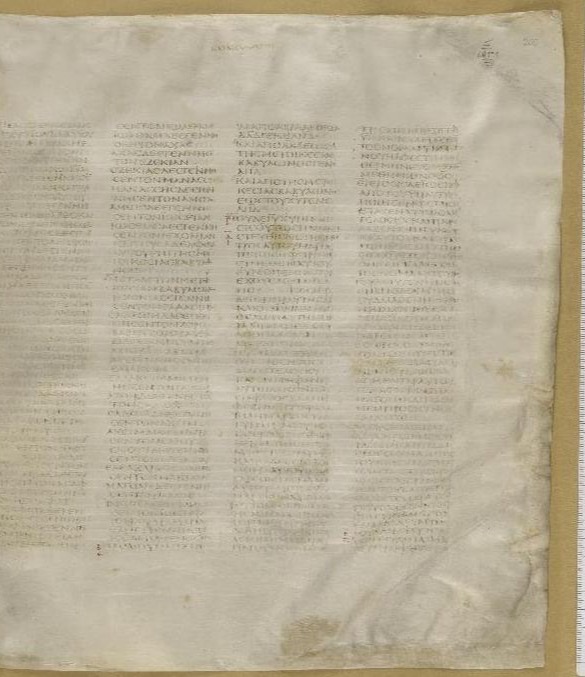
A page of an ancient Greek manuscript written in three columns of capital letters

Has the reading

“Textual evidence is sparse for this reading, appearing only in”

  • 221 (10th cen.)
  • 2318 (18th cen.)
  • Vgcl

Omit most of vr. 7

“Most Greek texts omit most of vr. 7”

  • ℵ
  • A
  • B
  • K
  • P
  • Y
  • 048
  • 049
  • 056
  • 0142
  • 33
  • 81
  • 88
  • 104
  • 181
  • 326
  • 330
  • 436
  • 451
  • 614
  • 945
  • et al
  • BYZT
  • Vgww

Robert still prints it: “the douay Reems has it in there so I will put it in there.”

Ehrman's reading

“It doesn't show up in the Greek manuscripts of first John it's in the Latin manuscripts.”

A page of Codex Vaticanus, Vatican Library, unknown scribe; public domain, via Wikimedia Commons. Sources: Douay-Rheims Commentary, Volume 4; Robert Sungenis Live #165 (YouTube).

Robert's commentary lists the verse only in two late minuscules and the Clementine Vulgate, and says most Greek texts and all listed Fathers omit it.

“Textual evidence is sparse for this reading, appearing only in minuscules 221 (10th cen.), 2318 (18th cen.), Vgcl; some omit, “and these three are one” (61, 629, 88, 429, 636, 918). Most Greek texts omit most of vr. 7 and go to vr. 8’s “the spirit the water and the blood”: ℵ A B K P Y 048 049 056 0142 33 81 88 104 181 326 330 436 451 614 945 et al, BYZT, Vgww. All patristic usage also omits it: Irenaeus, Clement, Tertullian, Hippolytus, Origen, Cyprian, Dionysius, Hilary, Lucifer, Athanasius, Basil, Faustinus, Nanzianzus, Ambrose, Didymus, Epiphanius, Chrysostom, Jerome, Augustine, Cyril.”
Douay-Rheims Commentary, Volume 4

He printed 1 John 5:7-8 in his commentary, Robert says, because the Douay-Rheims has it and he has no authority to remove it.

“When I wrote my commentary, I included First John 5:7 and 8 in the text, because I have no authority to take it out of the text, okay? The Douay-Rheims has it in there, so I will put it in there.”
1:46:45Robert Sungenis Live #165 - Wed, April 12th, 2023, YouTube captions

Someone before us already decided the Comma and the long ending of Mark belong in the canon despite the controversies, Robert says, and he sides with that decision.

“The Johannine Comma is in our Catholic Bible, so is the long ending of St. Mark. So somebody before us has already decided that these two things belong in the Canon of Scripture, okay, despite any controversies there are about them. So I side with that.”
41:40Dr. Robert Sungenis Live #033 Ask Your Question | Tue, Oct. 20, 2020, YouTube captions

What Robert’s work does not answer here

Robert accepts the manuscript facts Ehrman cites and does not argue that the verse stood in John's original letter. His response is that the Church's Bible includes it and that its content is theologically true; he does not take up Ehrman's historical claim that a scribe added it.

Ehrman says the woman taken in adultery (John 7:53 to 8:11) and the last twelve verses of Mark were added by later scribes, and that whether they belong in the Bible is a theological rather than historical question.

Partly answered
Ehrman: Misquoting Jesus in the Bible - Professor Bart D. Ehrman

Plays here. Any time on this card jumps the video to that moment; the pop-out keeps it playing while you read.

Ehrman, in his words

“This story uh th this beautiful story this powerful story uh which uh has two terrific lines uh from Jesus in it this story was not originally in the gospel of John this is a story that was added to the Gospel of John by later scribes”
34:12Bart D. Ehrman, Misquoting Jesus in the Bible - Professor Bart D. Ehrman
“We know they're added later because they're not in the earliest and best manuscripts the writing style is different from the rest of the Gospel of Mark and in fact there are uh there are inconsistencies between this ending and the the verses that precede it so this is clearly an addition to the gospel of Mark”
38:31Bart D. Ehrman, Misquoting Jesus in the Bible - Professor Bart D. Ehrman
“That non-uh original story of Jesus and the woman taking an adultery where he writes on the ground but that that was added by a scribe it wasn't originally in the gospel”
39:04Bart D. Ehrman, Did Jesus Even Exist?
“That that really is a good question and it's not a question that a historian can answer it's a question that a theologian needs to answer because it has to do not with historical fact but with theological interpretation about the nature of scripture”
1:18:23Bart D. Ehrman, Misquoting Jesus in the Bible - Professor Bart D. Ehrman

Robert’s answer

Robert acknowledges that weighty Greek manuscripts omit John 7:53 to 8:11 and Mark 16:9-20, but says the Catholic Church holds them to be authentic Scripture and that the omitting codices were found only in the 1800s. Someone must judge authenticity, he argues, and the best judge is the Church.

Mark 16:9-20John 8:1-12
  1. fourth and fifth century

    The codices that omit Mark 16:9-20 come, Robert believes, from the fourth and fifth century.

  2. Jerome's day

    “There's no competition.” Everybody believes Mark 16:9-20 belongs in scripture.

  3. the 1800s

    Those codices “were now found in the 1800s.”

Who judges

“Someone has to judge whether John 8:1-12 is indeed authentic Scripture.” The Catholic Church has officially held it to be an authentic part of Scripture.

Ehrman's reading

“Not in the earliest and best manuscripts,” and whether they belong is “a question that a theologian needs to answer.”

Sources: Geocentrism, Evolution, and Knowing God (YouTube); CASB 6: The Gospel of St. John; Not By Scripture Alone.

Robert's John commentary notes that some who doubt the passage's placement do not doubt the incident, and says the Catholic Church has officially held it to be authentic Scripture.

“Some expositors who doubt this pericope do not doubt the incident occurred but only that it does not fit within this part of John’s gospel. The Catholic Church has officialy held it to be an authentic part of Scripture.”
CASB 6: The Gospel of St. John

No one contested Mark 16:9-20 in Jerome's day, Robert says, because the codices that omit it were found only in the 1800s.

“So back in Jerome's day there's no competition. Everybody believes that Mark 16:9 to 20 belongs in Scripture, because there's no competition from these codices that were now found in the 1800s. And we believe that they come from the fourth and fifth century.”
1:49:17Geocentrism, Evolution, and Knowing God, YouTube captions

Mark 16:9-20 stays and is treated as the word of God, in Robert's view, unless someone gives positive proof it should not be there.

“So we accept their decision, and, you know, unless somebody has positive proof that Mark 16:9-20 shouldn't be there, then it stays, okay? And it's treated as the word of God until somebody can prove differently. And I can tell you this: nobody's going to be able to prove it. That's a fact.”
20:55Geocentrism, Evolution, and Knowing God, YouTube captions

Someone must judge whether John 8:1-12 is authentic Scripture, Robert argues, and the Church is the best judge.

“In the end, just as someone has to judge whether John 8:1-12 is indeed authentic Scripture, so someone has to judge whether the Assumption of Mary is indeed authentic oral tradition. What better judge of these things do we have than the Church that Jesus said he would guide and protect till the end of time?”
Not By Scripture Alone

What Robert’s work does not answer here

Robert concedes the manuscript evidence against both passages and bases their place in the Bible on the Church's judgment, a position close to Ehrman's own point that this is a theological rather than historical question. His books and broadcasts do not answer Ehrman's historical arguments that the Gospel authors did not write these passages, such as the different writing style and the inconsistencies he cites for Mark's ending.

Ehrman says only seven New Testament books (letters of Paul) are relatively certain to be authentic, that others are forgeries or misattributed, and that ancient authors condemned forgery as lying.

Partly answered
Ehrman: Faking It: Is the Bible Full of Forgeries?

Plays here. Any time on this card jumps the video to that moment; the pop-out keeps it playing while you read.

Ehrman, in his words

“There are 27 books uh in the New Testament and of those 20 uh seven books uh we are certain uh relatively certain about seven of them being authentic uh that there's seven letters of Paul”
9:21Bart D. Ehrman, Faking It: Is the Bible Full of Forgeries?
“The other books are appear to be either uh books where people were claiming to be someone they weren't which is the the hardcore pseudopigraphy that we today would call forgery or their misattributed uh they're they're assigned to people who probably did not write them”
10:31Bart D. Ehrman, Faking It: Is the Bible Full of Forgeries?
“Finally when I just read all the evidence and looked at both sides I just caved in yeah these are forgeries”
37:15Bart D. Ehrman, Faking It: Is the Bible Full of Forgeries?
“But it is clear as day when you actually read what ancient authors say about this phenomenon uh they condemn it uh it's a form of literary deceit they call it lying uh and they uh they do not like it at all”
7:16Bart D. Ehrman, Faking It: Is the Bible Full of Forgeries?

Robert’s answer

Robert holds that Paul wrote the thirteen letters that open in his name, treats vocabulary differences as an unproven basis for denying authorship, and says late dating of New Testament books is a liberal move to remove eyewitness testimony.

All thirteen Pauline letters, including Ephesians, 2 Thessalonians and the Pastorals, open with Paul's own claim to be the author, Robert says, and that is how we know he wrote them.

“In Paul's letters, his epistles, 13 of them, which are verified by himself as being written by him. Now, we know this because in each of the epistles, Romans, 1 Corinthians, 2 Corinthians, Galatians, Ephesians, Philippians, Colossians, 1 Thessalonians, 2 Thessalonians, 1 Timothy, 2 Timothy, Titus, Philemon, all of them begin with "I, Paul, write to you." Okay. So, he's claiming to be the author. That's how we know that he is the author. He's claiming to be the author.”
37:28Galileo’s Conversion, Justification, and Catholic Truths | Robert Sungenis Live, YouTube captions

The critics' assumption that new vocabulary rules out Paul as author is, in Robert's words, a presumption they cannot prove.

“The critics' assumption is that if we find new words that Paul hasn't used in the other 13 Epistles, that this ipso facto means Paul couldn't have written Hebrews. Well, that's an assumption, that's a presumption that they can't prove, okay? So you're going to have to have a lot more evidence of the Hebrew authorship that weighs against Paul than just saying he used, you know, a different vocabulary.”
1:37:51Robert Sungenis Live #165 - Wed, April 5th, 2023, YouTube captions

Robert's commentary says Jude borrows from Second Peter, showing it was recognized as canonical, while noting Jerome saw linguistic differences between the two letters.

“Jude recognizes Peter’s Second epistle and borrows material from it, thus showing Second Peter was recognized as canonical even though Eusebius classed it as “antilegomena.” Jerome noticed linguistic differences between First and Second Peter”
Douay-Rheims Commentary, Volume 4

Liberals date New Testament books late, Robert says, so that their authors could not have been eyewitnesses.

“That's why you hear liberals talking about the most of the New Testament books being written after the fall of Jerusalem in 70 A.D., well into the late 1st century or early 2nd century. They want these books written, why? Because that means if they're written in the late 1st century, that means they couldn't have been eyewitnesses.”
1:34:48Is Satan Real? Does Hell Exist? | Dr. Robert Sungenis Live #083 | June 2nd, 2021, YouTube captions

What Robert’s work does not answer here

Robert affirms traditional authorship and rejects vocabulary-based arguments in general terms, and his vocabulary remarks concern Hebrews. His books and broadcasts do not engage Ehrman's specific case against individual letters such as 1 Timothy, Ephesians or 2 Thessalonians, and do not address Ehrman's point that ancient writers condemned forgery as lying.

Jesus and His divinity

Ehrman says the historical Jesus did not call Himself God or consider Himself God, that His disciples had no inkling of it, and that He taught He was the Messiah, a human future king.

Answered
Ehrman: If Jesus Never Called Himself God, How Did He Become One?

Plays here. Any time on this card jumps the video to that moment; the pop-out keeps it playing while you read.

Ehrman, in his words

“What I argue in the book is that during his lifetime Jesus himself didn't call himself God and didn't consider himself God and that none of his disciples had any inkling at all that he was God”
2:05Bart D. Ehrman, If Jesus Never Called Himself God, How Did He Become One?
“I I am firmly convinced that Jesus never talked about himself as God and one way to demonstrate that is to line up our sources of information about Jesus chronologically”
12:57Alex O'Connor, Did Jesus Even Claim to be God? Bart Ehrman Says No...
“All of that together Jesus never calls himself God all of our earliest sources where Jesus starts calling himself God is the Gospel of John our last source”
14:56Alex O'Connor, Did Jesus Even Claim to be God? Bart Ehrman Says No...
“It's not that the Messiah was supposed to be God uh the Messiah was not supposed to be God the Messiah was a human being who would be the Future King and that's probably what Jesus taught his disciples that he was”
6:04Bart D. Ehrman, If Jesus Never Called Himself God, How Did He Become One?

Robert’s answer

Robert reads Mark 14:62, where Jesus answers the high priest's question with "I am," as the Gospel of Mark's clearest affirmation from Jesus' own mouth that He is God in the flesh, and holds that the claim to be the Son of God was the charge that brought His conviction for blasphemy. He also reads the healing of the paralytic in the Synoptics and John 5:18 as Jesus claiming divine prerogatives and equality with God.

The high priest's question in Mark 14:61, Robert says, exposes the main objection against Jesus: His claim to be the Son of God and the Messiah, both of which Robert calls equivalent to being God.

“Caiaphas cuts right to the chase and reveals the main objection against Jesus, namely, his claim to be the Son of God and the prophesied Messiah, both equivalent to being God. Anything less the Jewish leaders would have accepted and thus considered Jesus either deluded or infatuated with himself. But these two issues were the highest claims Jesus could make; that any man could make.”
Douay-Rheims Commentary, Volume 1

Jesus' answer "I am" under oath in Mark 14:62 is, for Robert, Mark's clearest and most succinct affirmation from Jesus Himself that He is God in the flesh.

“then Jesus is still under oath, and he takes full advantage of that position and thus declares he is the Son of God and thus the prophesied Messiah. As such, Mark’s gospel gives us the clearest and most succinct affirmation from the mouth of Jesus he is, indeed, God in the flesh.”
Douay-Rheims Commentary, Volume 1

In the healing of the paralytic, Robert argues, Jesus couples a miracle with His claimed power to forgive sins, pointing to Him as the Son of God who can forgive sins.

“Here Jesus is coupling the healing of the paralytic with his power to forgive sins. In the people’s minds, no one could perform such miraculous feats unless God was with the healer.236 If God is with the healer to heal, then it is not too much a stretch of the imagination to reason that he is indeed the Son of God who can forgive sins.”
Not By Faith Alone

In John 5:18, Robert says, the Jews understood Jesus to be making Himself equal with God, and Jesus cannot be God's Son without also being God.

“Jesus is so intimately connecting himself with the Father that the Jews cannot have one without the other. (This usage is in contrast to “Our Father” (Mt 6:9) or “My Father and your Father” (Jn 20:17)). The Jews understand the depths of Jesus’ meaning and thus accuse him of making himself equal with God. Jesus cannot be God’s Son without also being God, for being “equal” with God means”
Douay-Rheims Commentary, Volume 1

Ehrman says the earliest Christians believed God exalted Jesus to divine status at His resurrection, that followers called Him God almost right after His death, and that in texts such as Philippians 2 God gives Him the name Lord rather than Jesus being Yahweh.

Partly answered
Ehrman: If Jesus Never Called Himself God, How Did He Become One?

Plays here. Any time on this card jumps the video to that moment; the pop-out keeps it playing while you read.

Ehrman, in his words

“The earliest Christians during those first 20 years the very earliest Christians appear to have thought that that's what happened God raised Jesus from the dead and made him a Divine being”
17:09Bart D. Ehrman, If Jesus Never Called Himself God, How Did He Become One?
“What's interesting is when you isolate the prel literary traditions in Paul in the book of Acts that refer to to Jesus and his status as the Son of God what these consistent L point to is that Jesus became the Son of God when God raised him from the dead”
16:05Bart D. Ehrman, If Jesus Never Called Himself God, How Did He Become One?
“I think I think the followers of jesus were calling him god just almost right after his death”
17:57ReligionForBreakfast, Interviewing Bart Ehrman about Hell, Souls, and Jesus
“Paul's not saying that Jesus became Yahweh. He He gave him Yahweh's name. And the way In other words, he gave him the name Lord.”
3:56Bart D. Ehrman, 8 Bible Myths Many Christians Believe

Robert’s answer

Robert reads Romans 1:4 and Acts 13:33 as Christ being manifested as Son of God in power at the resurrection, not as the moment He became divine, and reads Philippians 2 as Christ never ceasing to be divine while taking a servant's form. He also reads Psalm 110:1 as the Lord speaking to the Lord, showing the Messiah as David's divine Lord.

Robert reads Romans 1:4 as Christ, who had emptied Himself of the majesty of His divinity, being formally manifested as Son of God in power at the resurrection.

“Rather, Paul is referring to what he states in Ph 2:6-11, namely, Christ emptied himself of the majesty of his divinity to become man. Christ did so in the “spirit of holiness” or “spirit of sanctification,” i.e., in all humility and selflessness. After this, Christ was formally manifested as the “Son of God in power” when he overcame death in the “resurrection from the dead.””
Douay-Rheims Commentary, Volume 3

Robert says the first application of "begotten" in Acts 13:33 is the Son's eternal generation from the Father, which Paul also applies to the resurrection.

“413 “this day have I begotten thee”: σήμερον γεγέννηκά σε, although the first application of “begotten” for the Son is his eternal generation from the Father, here Paul also applies it to the resurrection, but this would also include his birth, suffering, and death (cf. Lk 3:22; Hb 5:5).”
Douay-Rheims Commentary, Volume 2

Philippians 2:7, in Robert's reading, shows Christ fully human while not ceasing in any way to be divine, against the view that He emptied Himself of divinity.

“38 “likeness of men”: ἐν ὁμοιώματι ἀνθρώπων, that is, although Christ is human in every sense of the word, he did not cease in any way to be divine, as opposed to, on the one hand, the Docetists who held that Christ did not possess a real human nature but only one that appeared as human; and, on the other hand, to the Kenoticists who believed Christ emptied himself of”
Douay-Rheims Commentary, Volume 3

Robert reads Psalm 110:1 as the Lord addressing the Lord, so that the Messiah is both David's son and David's Lord who planned His own coming through David's line.

“Since that is so, then the Messiah is both Lord of David and the son of David, which necessarily means the Lord planned his own coming to earth through David’s loins and thus became the 43rd in the father-son line from David about one thousand years ago. To prove his divinity, this Messiah is told by the Lord: “Sit on my right hand, until I make your enemies your footstool,” which shows the Lord is sitting at the right hand of the Lord; and the Lord works for the Lord by vanquishing all the enemies of both.”
Douay-Rheims Commentary, Volume 1

What Robert’s work does not answer here

Robert's work does not engage Ehrman's historical reconstruction that the earliest Christians, in the first two decades, held an exaltation view before a pre-existence view developed. It also does not address Ehrman's specific reading that the "name" given in Philippians 2:9 is the title Lord rather than an identification of Jesus with Yahweh.

Ehrman says the Trinity is not stated in the Bible but emerged from biblical statements, that Arius held what most people probably thought, and that everyone at Nicaea already agreed Christ was God and debated in what sense.

Partly answered
Ehrman: Where Did the Trinity Come From?

Plays here. Any time on this card jumps the video to that moment; the pop-out keeps it playing while you read.

Ehrman, in his words

“The idea behind the Trinity is based in the Bible even though the Trinity is not found in the Bible the doctrine isn't found in the Bible but the doctrine emerges out of certain biblical statements”
7:27Bart D. Ehrman, Where Did the Trinity Come From?
“You don't have anywhere in the Bible that says it comes on says that the three are equal in substance and you don't have anywhere in the Bible that says that that there are three of these being but there's only one God”
5:20Bart D. Ehrman, Where Did the Trinity Come From?
“Everyone at the council agreed that Christ was God the question was in what sense is he God”
26:39Bart D. Ehrman, If Jesus Never Called Himself God, How Did He Become One?
“What he argued was what most people probably thought at the time which was that God the father was he's he goes back all the way into eternity at some point God begot a son”
20:22Bart D. Ehrman, Where Did the Trinity Come From?

Robert’s answer

Robert holds that the doctrine of the Trinity is implicit in Scripture and was extracted from it by the councils, which also drew on the Tradition handed down to them against the Arians. He describes Arius as teaching that the Son was a creature who had a beginning, which Nicaea's homoousios condemned.

However implicit the doctrine of the Trinity is in Scripture, Robert says, the Ecumenical Councils extracted it from Scripture.

“(1) However “implicit” the doctrine of the Trinity is in Scripture the fact remains that the Ecumenical Councils saw fit to extract the doctrine of the Trinity from Scripture, but did not see fit to extract a doctrine of sola scriptura. No council in Christian history ever declared Scripture as the ‘sole and sufficient authority’ or ‘the final court of appeal.’ Hence it is misleading to propose that “it is possible that sola Scriptura could be a necessary logical deduction” without pointing out to the reader that the very councils to which the apologist appeals did not see it as “possible.””
Not By Scripture Alone

The councils based the doctrine of the Trinity on more than Scripture alone, Robert says, citing the Fathers' appeals to Tradition against the Arians.

“(2) The Councils based their doctrine of the Trinity on more than Scripture alone. If one reads the accounts of the early Fathers on the matter of the Trinity and the Incarnation, one finds frequent references to the Tradition of the Church that was handed down to them, especially in opposition to groups like the Arians who denied the Trinity and the Incarnation claiming Scripture did not teach such doctrines.”
Not By Scripture Alone

Robert summarizes Arius as teaching that the Son was a creature with a beginning, which reduced the Word to a demigod.

“Arius stated the following four things about this relation: (1) The Son or the Word of God must be a creature, ktisma or poiema; (2) As a creature the Son or the Word must have had a beginning; (3) The Son can have no communion with, and indeed no direct knowledge of, His Father; (4) The Son must be liable to change and even sin (τρεπτος; αλλοιοτες). The net result of this teaching was to reduce the Word to demigod; even if infinitely transcended all other creatures, he himself was no more than a creature in relation to God, the Father.”
Douay-Rheims Commentary, Volume 1

What Robert’s work does not answer here

On the first point Robert largely agrees with Ehrman that the doctrine is implicit rather than formally stated, adding that the councils relied on Tradition as well as Scripture. Robert's work does not address Ehrman's claims that Arius held what most Christians probably thought, that the vote at Nicaea was not close, or that everyone at the council agreed Christ was God in some sense. It also does not answer the claim that some early bishops of Rome held modalism.

Ehrman says Jesus was an apocalyptic prophet who expected God's kingdom to arrive within His own generation, and that this expectation was wrong.

Answered
Ehrman: Did Jesus Even Exist?

Plays here. Any time on this card jumps the video to that moment; the pop-out keeps it playing while you read.

Ehrman, in his words

“I think that Jesus himself did predict that the uh the end was coming within his own generation”
34:05Bart D. Ehrman, Did Jesus Even Exist?
“I do think that Jesus had apocalyptic hopes and expectations I think they were wrong”
38:07Bart D. Ehrman, Did Jesus Even Exist?
“I think Jesus absolutely saw himself as a prophet of the coming Kingdom he thought the kingdom of God was soon to arrive and people needed to prepare for it”
1:26:48Alex O'Connor, Did Jesus Even Claim to be God? Bart Ehrman Says No...
“Jesus anticipated that the end of the age was coming within his own generation, that his disciples would live to see it, that the kingdom of God would arrive in power.”
33:52University of California Television (UCTV), How the Bible Explains Suffering with Bart Ehrman

Robert’s answer

Robert reads "this generation" as fulfilled first in the destruction of Jerusalem in 70 AD, with a further fulfilment reaching to the end of the world. He distinguishes "comings" of Christ within a generation of His resurrection, including the judgment on Israel in 70 AD, from His final coming at the end of time.

“this generation”70 ADend of time

“The generation of people then living, most of whom will have their generation cut short in the days leading up to 70 AD.” The destruction of Jerusalem is “coming in their own generation.”

“generation” can refer to

a specific generation of people say of 40 years or so

“generation” can refer to

a generation of a larger category of the human race

Ehrman's reading

“I do think that Jesus had apocalyptic hopes and expectations I think they were wrong.”

Sources: Douay-Rheims Commentary, Volume 2; CASB 1: The Gospel of St. Matthew; 3 Days of Darkness, Robert Sungenis Live #061 (YouTube).

"This generation" in Luke 21:32 means the people then living, Robert says, whose generation ended in the events leading up to 70 AD.

“In the colloquial sense ἡ γενεὰ αὕτη means, “this very generation” or “this same generation.” The phrase appears 5× in the NT (e.g., Mk 8:12; Lk 11:29 - “Why does this generation seek for a sign”; while the other two repeat Mark’s wording - Mt 24:34; Lk 21:32), and refers to the generation of people then living, most of whom will have their generation cut short in the days leading up to 70 AD.”
Douay-Rheims Commentary, Volume 2

Jesus' words, in Robert's reading, point first to the destruction of Jerusalem in that generation and also to future generations up to the end of the world.

“Jesus is making it clear to the apostles when the “abomination” would come and how it will be followed by the destruction of Jerusalem. It is coming in their own generation, not the next generation. But Jesus’ words were chosen carefully so that although they point in the first place to the then generation of Jews of the first century AD, they are also pointing to the future generations of Jews, up until the “heavens and the earth pass away” (vr. 31)”
Douay-Rheims Commentary, Volume 2

The New Testament speaks of several "comings" of Christ, Robert says: some within a generation of His resurrection, including the judgment on Israel in 70 AD, and one at the end of time.

“Historically, the judgment took place in 70 AD, but the Gospels were written before its occurrence, and therefore do not refer to it in retrospect. The NT refers to “comings” of Christ in various ways, many of which refer to Christ returning shortly, in a generation of His resurrection (cf. Jn 14:18-21; Ac 1:3-11; 10:13-15; Mt 24: 3, 34; 26:64; Mk 14:62; Lk 21:36; Ap 2:5, 16, 25; 3:3, 11); while others point to His final coming at the end of time (cf. 1Th 4:14; 2Th 2:1, 8; 2Pt 3:12).”
CASB 1: The Gospel of St. Matthew

On a broadcast Robert explains that "generation" in Greek can mean a specific generation of about 40 years or a larger category of people, giving Matthew 24 a dual meaning.

“And sometimes they'll use words that can have a dual meaning. Like when you say "this generation," it's one of those words in the Greek where generation can refer to a specific generation of people, say, of 40 years or so, or it can refer to a generation of a larger category of the human race, let's say, okay?”
1:24:003 Days of Darkness | Robert Sungenis Live #061, YouTube captions

Ehrman says Jesus certainly existed, a point not seriously debated by experts, as a Jewish preacher from Galilee crucified in Jerusalem at Passover, attested by many independent sources including Paul, who knew His brother.

Robert agrees
Ehrman: Did Jesus Even Exist?

Plays here. Any time on this card jumps the video to that moment; the pop-out keeps it playing while you read.

Ehrman, in his words

“It's the idea that Jesus himself is a myth and that that's not an issue that's seriously debated among uh experts in the field”
4:06Bart D. Ehrman, Did Jesus Even Exist?
“We can certainly say that Jesus existed and that he was a Jew From Galilee who was a preacher who had disciples and ended up making a trip to Jerusalem during a Passover feast where he was arrested and crucified”
45:31Bart D. Ehrman, Did Jesus Even Exist?
“Because we have so many records from so many independent sources uh that um that is pretty clearly existed”
6:10Bart D. Ehrman, Did Jesus Even Exist?
“One of our sources is in the New Testament the Apostle Paul who actually knew Jesus brother I mean so you know if Jesus didn't exist you think his brother would know it”
7:14Bart D. Ehrman, Did Jesus Even Exist?

Robert’s answer

Robert agrees that Jesus existed: he calls the claim that Josephus's writings are not historical ridiculous and cites a secular historian recording the darkness at the crucifixion under Tiberius. He reads Paul's "the Lord's brother" in Galatians 1:19 as a near relative rather than a blood brother.

Answering a question on Jesus mythicism, Robert calls the claim that Josephus's writings are not historical ridiculous, since writers of that time quoted one another.

“Don't be bothered by these things. To even attempt to say that Josephus's writings are not historical is ridiculous, absolutely ridiculous, okay? Because all these guys at this time who are writing, Josephus among them, were all quoting each other. I mean, Josephus quotes from, you know, some Roman emperors and Judas Maccabeus and, you know, all kinds of people that they're quoting from, as others do.”
1:37:21Robert Sungenis Live #163 - Wed, March 22nd, 2023, YouTube captions

Origen, as Robert cites him, reports that the secular historian Phlegon recorded the darkness under Tiberius, "during whose reign Christ was crucified."

“NB: This phenomenon would not have been an eclipse caused by the moon since darkness only occurs over specific areas of the earth in a total eclipse and does not last long in any case. The gospels record that the sun stopped shining for three hours. Origen (d. 254) corroborates Phlegon’s testimony: “The eclipse which took place at the time of Tiberius, during whose reign Christ was crucified, and the great earthquakes of the same time, were noted by Phlegon in his Books 13 & 24” (Contra Celsus, Bk. 2, n. 33).”
Douay-Rheims Commentary, Volume 2

Paul calls James "the Lord's brother," Robert notes, a phrase he reads as a near relative rather than a blood brother.

“In Gl 1:19 Paul calls James “the Lord’s brother,” and that some of Jesus “brothers” have wives (see commentary on Mt 12-13 that Jesus’ brothers were near relatives, not blood brothers).”
Douay-Rheims Commentary, Volume 4

Mary and the virgin birth

Ehrman says only Matthew and Luke tell of a virgin birth, that Mark and John assume Joseph is the father, that he does not believe it and sees New Testament evidence against it, and he notes that many scholars think Luke 1 and 2 were added later.

Partly answered
Ehrman: Who Says Mary Was a Virgin?

Plays here. Any time on this card jumps the video to that moment; the pop-out keeps it playing while you read.

Ehrman, in his words

“Mark says nothing about it Mark doesn't have a Virgin uh birth story and John which is later than Matthew Luke doesn't have a virgin birth story uh and no other book of the New Testament mentions the Virgin birth”
5:27Bart D. Ehrman, Who Says Mary Was a Virgin?
“Mark Mark and John uh both assume that Mary is the mother and that Joseph is the father and and in fact there are passages in both Mark and John that make make best sense if they not only say that but they also their passages make best sense if they don't know anything about of Virgin birth”
17:15Bart D. Ehrman, Who Says Mary Was a Virgin?
“It's not just saying that you know I don't believe in the Virgin birth it's saying that actually there's evidence from the New Testament that goes against the idea of the Virgin birth”
37:10Bart D. Ehrman, Who Says Mary Was a Virgin?
“There are a lot of Scholars who think that Luke's virgin birth story Luke chapters 1 and two were not originally part of the Gospel of Luke that what we think of Luke's gospel originally started what with what is now chapter 3 verse one uh and that the chap the two chapters about the Virgin birth story may have been added later and it's a very interesting idea and there's there's some good evidence to support it”
21:22Bart D. Ehrman, Who Says Mary Was a Virgin?

Robert’s answer

Robert says the Gospels call Jesus "son of Joseph" because Joseph was His legal or foster father, noting that Luke 3:23 qualifies this with "as was supposed" and that Mark 6:3 calls Jesus "son of Mary." He holds from the New Testament use of parthenos that Mary was a virgin when she conceived and gave birth.

Robert says the Gospel references to Jesus as son of Joseph are qualified in Luke 3:23 by "as was supposed," since Joseph was the foster father, and that Mark 6:3 calls Jesus the son of Mary.

“all of which were modified in Lk 3:23 as ὢν υἱός ὡς ἐνομίζετο Ἰωσὴφ (“being son, as was supposed, of Joseph”) since Joseph was not the blood father but the foster father. Jesus is also once called the “son of Mary” (ὁ υἱὸς τῆς Μαρίας) in Mk 6:3, but he is not called “the son of Joseph and Mary.””
Douay-Rheims Commentary, Volume 2

John calls Jesus son of Joseph while also calling Him the only begotten of the Father, Robert explains, because Joseph was His legal father.

“70 “son of Joseph”: Gr: υἱὸν τοῦ Ιωσῆφ, John has no qualms about calling Jesus the “son” of Joseph, even though he has identified Jesus in vr. 18 as the “only begotten of the Father.” Joseph was Jesus’ legal father, perhaps having adopted Jesus. Thus his name appears as Jesus’ legal father in the genealogy of Lk 3:23 (Gr: ὢν υἱός ὡς ἐνομίζετο Ιωσήφ: (“being the son, as was supposed, of Joseph”)) and Mt 1:16.”
CASB 6: The Gospel of St. John

From the New Testament meaning of parthenos, Robert concludes that Mary was a virgin when she conceived and gave birth to Jesus.

“Answer: Yes, both Scripture and Tradition indicate that, despite any alleged ambiguities in the wording of Isaiah 7:14, Jesus was indeed born miraculously of a virgin, namely, the Blessed Virgin Mary. The word “virgin” in Mt 1:23 is the Greek παρθένος (parthenos). It is used 14 times in the NT (e.g., Lk 1:27; Ac 21:9; 2Co 11:2; Ap 14:4). When explained in Scripture, as it is in 1Co 7:28-37, it refers to an unmarried woman who has had no sexual relations with men. Thus from the New Testament understanding of “virgin,” it is clear that Mary was a virgin when she conceived and gave birth to Jesus.”
CASB 1: The Gospel of St. Matthew

What Robert’s work does not answer here

Robert's work does not answer Ehrman's point that only Matthew and Luke narrate the virgin birth and that no other New Testament book mentions it. It also does not address the view of many scholars that Luke 1 and 2 were added later, or Ehrman's claim that passages in Mark and John make best sense if their authors knew nothing of a virgin birth.

Ehrman says Isaiah 7:14 in Hebrew speaks of a young woman (not the word for virgin) already pregnant in Isaiah's day, is not a messianic prophecy, and that Matthew relied on the Greek parthenos because he did not know Hebrew.

Partly answered
Ehrman: Bart Ehrman Exposes New Testament Errors

Plays here. Any time on this card jumps the video to that moment; the pop-out keeps it playing while you read.

Ehrman, in his words

“So there are two translational issues one is he doesn't use the Hebrew word that means a woman who's never had sex bethulha he uses just a word for young woman”
8:00Alex O'Connor, Bart Ehrman Exposes New Testament Errors
“So it's a young woman has conceived it's not a virgin will conceive and it's not talking about a future Messiah it's talking about some woman here who's pregnant who and about what's going to happen to the city so it's not even a Messianic prophecy”
9:11Alex O'Connor, Bart Ehrman Exposes New Testament Errors
“When the Greek translators were translating this for whatever reason they they used the word that becomes the Greek word for Virgin parthenos and they say a virgin has conceived and it's it's a bit of a mistranslation but that's what Matthew knew he didn't know the Hebrew”
13:00Bart D. Ehrman, Who Says Mary Was a Virgin?
“When you actually read the Hebrew it does not say a virgin shall conceive and bear a son um and in fact when you read it in the context of Isaiah it's clear as day that it's not talking about that and it's not talking about a messiah at all”
47:32Alex O'Connor, Did Jesus Even Claim to be God? Bart Ehrman Says No...

Robert’s answer

Robert argues that almah in its Old Testament uses refers to an unmarried woman without sexual relations and is interchanged with bethulah, and that the Jewish translators of the Septuagint rendered almah in Isaiah 7:14 as parthenos. He holds that Isaiah 7:14 has a dual fulfillment, in a historical birth in Isaiah's day and in Christ's birth from the virgin Mary.

None of the seven Old Testament uses of almah refers to a married or sexually active woman, Robert says, and some explicitly indicate an unmarried woman with no sexual relations.

“However, the word almah appears only seven times in the Hebrew Old Testament (cf., Gn 24:43; Ex 2:8; Ps 68:25; Pr 30:19; Sg 1:3; 6:8; Is 7:14), thus the evidence upon which to base such conclusions is rather limited. None of the above passages suggest that almah refers to a woman who is married or has had sexual relations. Conversely, there are explicit indications that almah refers to an unmarried woman who has had no sexual relations.”
CASB 1: The Gospel of St. Matthew

The Septuagint translates almah as parthenos in both Genesis 24:43 and Isaiah 7:14, Robert notes, showing the Alexandrian Jews understood the terms as identical.

“The above analysis is confirmed by the fact that the LXX translates the Hebrew almah with the Greek parthenos (“virgin”) in both Gn 24:43 and Is 7:14, showing that the Alexandrian Jews understood the latter term to be identical with the former.”
CASB 1: The Gospel of St. Matthew

Robert says Isaiah 7:14 is fulfilled both in a historical birth in Isaiah's time and in the birth of Christ from the virgin Mary.

“For example, the prophecy of Isaiah 7:14 concerning the woman who will bear a son and call his name Immanuel is fulfilled both in the historical birth of Mahershalal-hashbaz (Is 8:2, 8) and in the birth of Christ from the virgin Mary (Mt 1:23).”
CASB 1: The Gospel of St. Matthew

What Robert’s work does not answer here

Robert's work does not address Ehrman's claim that Matthew relied on the Greek because he did not know Hebrew. It also does not discuss the grammar behind Ehrman's reading that the young woman was already pregnant, beyond granting a historical fulfillment in Isaiah's day.

Ehrman says Matthew's and Luke's birth narratives tell different stories that contradict each other, including the flight to Egypt versus a return to Nazareth, conflicting genealogies, and a census of Augustus that did not happen.

Partly answered
Ehrman: Who Says Mary Was a Virgin?

Plays here. Any time on this card jumps the video to that moment; the pop-out keeps it playing while you read.

Ehrman, in his words

“If you actually read Matthew carefully and then Luke carefully they tell completely different stories and in in places their their stories are at odds with each other they contradict each other in some key key ways”
4:23Bart D. Ehrman, Who Says Mary Was a Virgin?
“So if matthew's right that they fled to egypt how can luke be right they went back to nazareth 41 days later uh okay well you can work hard you can reconcile it you reconcile anything you want but the reality is these two seem to be odds with each other”
30:26Bart D. Ehrman, Are the Gospels Historically Reliable? The Problem of Contradictions
“Of david well what if you don't know who his great-great-great-great-grandfather is well you got to make something up and so they came up with something whether you agree with that explanation or not it's a contradiction”
25:09Bart D. Ehrman, Are the Gospels Historically Reliable? The Problem of Contradictions
“So okay just say he means the entire roman empire there was no worldwide census under caesar augustus cedar augustus's reign is really well documented”
39:50Bart D. Ehrman, Are the Gospels Historically Reliable? The Problem of Contradictions

Robert’s answer

Robert holds that the differences between Matthew and Luke are apparent discrepancies arising from each writer's selection of details, with Matthew giving Joseph's genealogy and Luke giving Mary's. He argues that Quirinius was acting in a governing capacity in Syria before becoming titular governor, with a first census in 1 BC, and that the Magi's visit came after the purification in the temple.

Robert says the Gospels' conflicting details are only apparent discrepancies arising from each writer's selection of details, with Matthew giving Joseph's genealogy and Luke giving Mary's.

“Although some of the historical details of the gospels seem to be incomplete or conflicting, these are only apparent discrepancies. Deeper study shows that the gospel writers, faced with virtually an infinite number of details in each scene, selected the specific details that coincided with their particular purposes, under the direct guidance of the Holy Spirit. Regarding the genealogies, Matthew gives the genealogy of Joseph in forty-two names, from Abraham to Jesus, leaving out three names and repeating two names for his own historical and spiritual reasons; whereas Luke (Lk 3:23-38) gives the genealogy of Mary”
CASB 1: The Gospel of St. Matthew

Luke's genealogy is Mary's, Robert argues, since Joseph was only the foster father, and Luke separates Joseph from it by omitting the Greek article before his name.

“145 “as it was supposed”: ὡς ἐνομίζετο, that is, Joseph was the foster father of Jesus, not his physical father. Since Joseph was not the physical father, most scholars have understood Luke’s genealogy to be of Mary, Jesus’ real mother, since a genealogy of a foster father would be superfluous. Thus Luke separates Joseph from the genealogy by eliminating the Greek article, tou:, before his name.”
Douay-Rheims Commentary, Volume 2

Quirinius governed the military in Syria before becoming its titular governor, according to Robert, so a census in 6 AD would be a second one, the first being in 1 BC at Jesus' birth.

“Cyrinus was also an advisor to Tiberius when the latter was exiled at Rhodes between 6 BC and 2 AD (Tacitus Annals, Bk III), showing that Cyrinus was governing the military in Syria long before becoming the titular governor of Syria. Even if a census occurred in 6 AD, it was a second census under Cyrinus, the first in 1 BC during the birth of Jesus.”
Douay-Rheims Commentary, Volume 2

In Robert's reckoning the Magi likely came months after the birth, leaving time for Mary's purification in the temple before the flight to Egypt.

“We don’t know how long it was between the birth of Jesus and the visit of the Magi, but since Herod calculated that he would cover a two-year period in his slaughter of the innocents, it is likely that Jesus was a few months old to two years old when the Magi visited him. This period of almost two years would give Mary plenty of time to fulfill her purification requirements in the temple.”
15 Alleged Bible Contradictions from an Atheist, Refuted

What Robert’s work does not answer here

Robert's work explains the timing of the purification and the Magi, but does not explain how Luke 2:39's statement that the family returned to Nazareth after the purification fits with Matthew placing them in Bethlehem when the Magi came and then in Egypt. It also does not answer Ehrman's claim that Jews did not keep genealogical records.

Ehrman says the Gospels use the ordinary word for brothers, not the Greek word for cousin, of Jesus' siblings, and that Mary's perpetual virginity became an important doctrine only in the third and fourth centuries.

Partly answered
Ehrman: Who Says Mary Was a Virgin?

Plays here. Any time on this card jumps the video to that moment; the pop-out keeps it playing while you read.

Ehrman, in his words

“There is a word for cousin in Greek ansos as opposed to and that's not the word used and so it's G Mary shows up with his brothers and sisters say in John 6 or you have the brothers of Jesus I mean in Mark 6 and the brothers of Jesus in John 7 and you know it says brothers and so the normal assumption is that they were brothers”
29:46Bart D. Ehrman, Who Says Mary Was a Virgin?
“Perpetual virginity of Mary is the the doctrine that um she never does have sex and she remains a virgin her entire life this became an important Doctrine in the third into the fourth centuries”
25:30Bart D. Ehrman, Who Says Mary Was a Virgin?

Robert’s answer

Robert argues that the Hebrew word for brother and its Greek rendering adelphos cover cousins and other relatives, and that the Gospels' Greek reflects the Jewish idiom of the speakers rather than requiring anepsios. He cites Papias identifying James, Judas and Joseph as sons of an aunt of the Lord.

The argument that the Evangelists would have used anepsios for cousins holds little weight, Robert says, because the Gospel Greek portrays the idioms of the Jewish speakers.

“Although one might argue that, since the Gospels were written in Greek, the Evangelists were compelled to use Greek terminology (i.e., if the “brothers” of Mt 13:55 were truly Jesus’ cousins then they should be called the Greek term for cousin ἀνεψιός (“cousin”), such argumentation holds little weight, since the Greek of the New Testament was written to portray the thought-structure and idioms of the Jews who were speaking in the narrative of Mt 13:55, not vice-versa.”
CASB 6: The Gospel of St. John

Robert says the Hebrew word for brother and the Greek adelphos were not limited to siblings, so the Evangelists could call Jesus' cousins His brothers.

“All the above passages prove that the Hebrew word for “brother” (and its LXX Greek translation, adelphos), were not limited to siblings from the same immediate family. Thus, the Evangelists could refer to Jesus’ cousins or near relatives with the words “brothers” or “sister” and be perfectly consistent with the traditional usage of those terms.”
CASB 1: The Gospel of St. Matthew

Papias, as Robert cites him, says James, Judas and Joseph were sons of an aunt of the Lord.

“Patristics and Medievals: Papias: “(1) Mary the mother of the Lord; (2) Mary the wife of Cleophas or Alphaeus, who was the mother of James the bishop and apostle, and of Simon and Thaddeus, and of one Joseph; (3) Mary Salome, wife of Zebedee, mother of John the evangelist and James; (4) Mary Magdelene. 233 These four are found in the Gospel. James and Judas and Joseph were sons of an aunt of the Lord’s.”
CASB 1: The Gospel of St. Matthew

What Robert’s work does not answer here

Robert answers the word argument directly, but his work does not address Ehrman's claim about when perpetual virginity became an important doctrine. It cites early sources on the identity of the brothers without dating the doctrine's rise to prominence.

The resurrection

Ehrman says historians as historians cannot conclude that God raised Jesus or that any miracle happened; he says his book leaves open whether Jesus was raised, yet he also says he understands Easter not to be a historical event.

Partly answered
Ehrman: If Jesus Never Called Himself God, How Did He Become One?

Plays here. Any time on this card jumps the video to that moment; the pop-out keeps it playing while you read.

Ehrman, in his words

“Historians acting as historians whether they're Believers or non-believers as historians they simply cannot say Jesus was probably raised by God from the dead”
8:05Bart D. Ehrman, If Jesus Never Called Himself God, How Did He Become One?
“One of the things that historians cannot show as having happened in the past is anything that's miraculous because to believe that a miracle has happened to believe that God has done something in our world requires a person to believe in God”
7:04Bart D. Ehrman, If Jesus Never Called Himself God, How Did He Become One?
“I think it's important to understand that in this book I actually do not take a stand on either the question of whether Jesus was God or whether he was actually raised from the dead um I leave open both questions because those are theological questions based on religious belief”
31:51Bart D. Ehrman, If Jesus Never Called Himself God, How Did He Become One?
“I understand the Easter story not to be a historical event but I still think that it says something very important about how we ought to live in the world”
35:58Bart D. Ehrman, If Jesus Never Called Himself God, How Did He Become One?

Robert’s answer

Robert holds that Jesus' resurrection can be shown from history through eyewitness testimony and early writers, and he traces the academic rejection of miracles to a starting assumption that miracles do not occur.

Jesus' rising from the dead can be shown from history, Robert says, pointing to evidence of His crucifixion and death, many witnesses, and evidence of His resurrection.

“Now, the fact is that Jesus rose from the dead. That can be shown from history. Really no question about that, okay? We have historical evidence that He was crucified, that He died on the cross. We have tremendous witnesses all throughout that time of history that tell us that, and we have evidence of His resurrection.”
1:17:42Faith, Geopolitics, and the Gospel: Debunking Modern Myths and Biblical Misconceptions, YouTube captions

The resurrection is known through eyewitnesses, including the 500 who saw Jesus during His 40 days, and through early writers, Robert says, and this would hold up in a court of law.

“We have eyewitnesses that were there that told the story. Jesus appeared to 500 people after He rose from the dead and stayed on earth for 40 days, okay? So that's why God made Him do that, so that we would have witnesses to His resurrection. And then some people wrote it down, and some people got their stuff published, like Josephus and some other people around that time. We got some early Fathers like Papias, Justin Martyr, Irenaeus, Polycarp, who knew John the Apostle. I mean, we have enough. This would hold up in the court of law.”
1:46:38Robert Sungenis Live #135: Ask Your Question, YouTube captions

Liberal Protestant scholarship, beginning in the Enlightenment, treats the Gospels like any other book, in Robert's account, and starts from the assumption that miracles do not occur.

“There was a whole slew of Protestants who came afterward in the Enlightenment period. That's when the liberal Protestants started, okay? And there were many of them. And this is what happens when the Gospel gets into the universities. What are they going to do? They're going to treat it like any other book. And so, "Come on, man, you don't really believe Jesus walked on water. You don't believe really fed 5,000 people. It's all miracles. We know they don't occur, so let's look at this rationally."”
1:31:54Why Cain's Offering Was Rejected, Fatima's Russia Error & the Axis of Evil, YouTube captions

What Robert’s work does not answer here

Robert's books and broadcasts do not engage Ehrman's specific methodological argument that historians, working as historians, cannot conclude that God caused an event. They also do not address the tension between Ehrman leaving the question open in his book and calling Easter non-historical.

Ehrman says Jesus probably did not receive a decent burial in a known tomb, since Romans normally left the crucified on their crosses, and that no one in the New Testament comes to believe because of the empty tomb.

Partly answered
Ehrman: If Jesus Never Called Himself God, How Did He Become One?

Plays here. Any time on this card jumps the video to that moment; the pop-out keeps it playing while you read.

Ehrman, in his words

“Apart from the fact that I don't think Jesus was given a decent burial that he was probably thrown into a common grave of some kind”
12:06Bart D. Ehrman, If Jesus Never Called Himself God, How Did He Become One?
“I don't I don't know of any instance uh where we have a verified account of anybody being buried on afternoon of their crucifixion in a known tomb so How likely is it that they made an exception in the case of Jesus”
1:07:30Alex O'Connor, Did Jesus Even Claim to be God? Bart Ehrman Says No...
“We do have a number of references to what Romans did once the person died on their crosses and the accounts are consistent that what they did is they left them on their crosses as part of the humiliation”
6:03Alex O'Connor, Bart Ehrman Responds to William Lane Craig on the Resurrection
“I was struck in doing my research by the fact that the New Testament never indicates that people came to believe in the resurrection because of the empty tomb”
12:06Bart D. Ehrman, If Jesus Never Called Himself God, How Did He Become One?

Robert’s answer

Robert reads John 20 as saying that John believed in the resurrection because he saw the tomb was empty, and he treats Joseph's nearby tomb, the undisturbed grave cloths and Paul's statement that Christ was buried as details of a real burial.

Robert says John believed in the resurrection because he saw that Jesus was not in the tomb, while noting that the apostles as a group came to full belief only later.

“735 “believed”: Gr: ἐπίστευσεν, that is, John believed in the resurrection because he saw that Jesus was not in the tomb. In contrast, Lk 24:12 indicates that Peter left the scene still wondering what had occurred. But at this point none of the apostles really believe the Lord has risen. Even John is silent in vr. 18. As the story unfolds, they finally believe only when there is no other logical choice. Yet their previous unbelief has a silver lining, since it shows that the proofs of Jesus’ resurrection must have been so overwhelming that they could not help but change their minds and believe.”
CASB 6: The Gospel of St. John

The undisturbed linen cloths, Robert argues, indicate that no one handled Jesus' body as Lazarus' grave cloths were handled, and that enemies did not mangle it or carry it off.

“733 “linen cloths lying”: Gr: τὰ ὀθόνια κείμενα, implying by the word choice that the linens were not manually handled in any way as were the grave cloths of Lazarus when he rose from the dead (Jn 11:44). It further suggests that Jesus’ body was not mangled in any way by enemies, since tattered linens and blood would be the result of such an attack. Moreover, enemies would have carried off the body with the linens intact.”
CASB 6: The Gospel of St. John

Jesus had to be buried quickly before the Sabbath, Robert notes, and Joseph's tomb, which Matthew says Joseph owned, was near Golgotha.

“726 “close at hand”: Gr: εγγὺς ἦν, the body of Jesus needed to be buried quickly in order to escape running into the Sabbath at 6:00 pm. Joseph’s tomb was near to Golgatha so it was the wisest choice for burial. Matthew tells us that Joseph owned the tomb whereas John is not interested in that detail.”
CASB 6: The Gospel of St. John

Paul affirms that Christ really died and was buried like all other men, Robert says, and the Creeds mention His burial to stress the reality of His death.

“291 “died”: ἀπέθανεν. Paul reiterates this truth to affirm that Christ really died. He was not a phantom; it did not only appear as if he died; his death was not faked. He died and was buried like all other men, and his body would have begun decomposing if not for the special intervention of God (Ac 2:27-28). Similarly, the Apostle’s Creed and the Nicene Creed both contain a reference to Christ’s burial to emphasize the reality of his death.”
Douay-Rheims Commentary, Volume 3

What Robert’s work does not answer here

Robert's work does not address the claim that Romans normally left crucified bodies on the cross or put them in common graves, nor Ehrman's point that there is no verified case of a crucified man buried in a known tomb. Robert draws his account of the burial from the Gospel and Pauline texts themselves.

Ehrman says belief in the resurrection arose from visions some followers had, that Paul, Peter and Mary Magdalene probably each saw something they took to be Jesus, that the 500 witnesses are a claim rather than evidence, and that the resurrection narratives contradict one another.

Partly answered
Ehrman: If Jesus Never Called Himself God, How Did He Become One?

Plays here. Any time on this card jumps the video to that moment; the pop-out keeps it playing while you read.

Ehrman, in his words

“In the gospels the empty tomb leads to confusion but it doesn't lead to belief what leads to belief is that some of the followers of Jesus have visions of him afterwards”
13:04Bart D. Ehrman, If Jesus Never Called Himself God, How Did He Become One?
“My sense is that these three people independently saw something they interpreted to be Jesus they maybe um they maybe had a vision of some sort they mistook an identity what they had they had they had a dream I don't know”
1:19:36Alex O'Connor, Did Jesus Even Claim to be God? Bart Ehrman Says No...
“Paul Paul knows there's a story that 500 people saw him but I don't think that's evidence that 500 people saw him that that's a claim and so a claim isn't evidence”
1:13:21Alex O'Connor, Did Jesus Even Claim to be God? Bart Ehrman Says No...
“When you compare their narratives of the Resurrection they're more contradictory than the stories of the birth narratives we don't have a consistent independent narrative what we have are independent narratives that contradict each other that are all written 40 50 60 years later by people living in a different part of the world who didn't know any eyewitnesses”
1:21:34Alex O'Connor, Did Jesus Even Claim to be God? Bart Ehrman Says No...

Robert’s answer

Robert says Paul's word for Christ "being seen" means ordinary sight, not hallucination, that the 500 saw Him at one event in Galilee, and that the risen Jesus was the same Jesus who died. He holds that alleged contradictions among the resurrection accounts come from each evangelist recording only certain details.

The verb Paul uses for Christ "was seen" refers to seeing with the natural eye, Robert says, which he takes to confirm the appearances were not hallucinations.

“290 “was seen”: Gr: ὤφθη, aorist passive of ὁράω, a verb that refers to seeing with the natural eye as any person or object is seen, thus confirming that the sight of Christ’s resurrected body was not a hallucination (cf. Lk 24:39-43; Jn 20:27). Paul does not give a complete list of people who saw Christ, but only those who would be important to the Corinthians.”
CASB 5: The First Epistle to the Corinthians

Paul specifies that the 500 saw Christ at one time at one event, Robert says, most likely the Galilee meeting where Jesus gave the Great Commission.

“291 “five hundred”: such that Paul specifies that these 500 saw Christ at one time and at one event. The most likely event that Paul has in view is the meeting Jesus had in Galilee to announce the Great Commission (cf. Mt 26:32; 28:7-16; 19:1; Mk 14:28; Jn 21:1). Perhaps the entire town of Galilee had only 500 people.”
CASB 5: The First Epistle to the Corinthians

In Luke 24:39, Robert says, Jesus is not merely appearing as a human, as angels did, but is the same Jesus who died days earlier, His body preserved from decay.

“755 “I myself”: ἐγώ εἰμι αὐτός, lit., “I am myself.” Jesus is not just appearing as a human, nor as the angels appeared as humans at the resurrection for the sake of the apostles’ senses (Lk 24:4). This was the same Jesus who died days earlier, his body having been miraculously preserved from decay in the grave (Ac 2:20-21).”
Douay-Rheims Commentary, Volume 2

Robert says most alleged contradictions between John and the Synoptics are explained by careful attention to detail, and the rest by each evangelist recording only certain details.

“He assumes the reader is familiar with the Synoptic accounts, and thus adds what is mostly new material to the resurrection and surrounding events. As regards alleged contradictions between John and the Synoptics, most can be explained by paying careful attention to the detail. The others are logically because each evangelist records only certain details and no one records everything that occurred, thus we can only piece together the sequence of events.”
Douay-Rheims Commentary, Volume 1

What Robert’s work does not answer here

Robert does not answer Ehrman's point that Paul's report of 500 witnesses is a claim rather than independent evidence, nor the argument that the Gospels were written decades later by authors who did not know eyewitnesses. His treatment of contradictions states a general principle rather than working through the specific Galilee and Jerusalem accounts.

Paul and the early Church

Ehrman says Paul's teaching on salvation cannot be reconciled with Jesus', since Jesus taught that salvation comes by doing God's will and helping those in need while Paul argues one is not made right with God by keeping the law.

Answered
Ehrman: 8 Bible Myths Many Christians Believe

Plays here. Any time on this card jumps the video to that moment; the pop-out keeps it playing while you read.

Ehrman, in his words

“You can there are lots of differences between them, but I don't I don't think you can reconcile the two.”
26:33Bart D. Ehrman, 8 Bible Myths Many Christians Believe
“The teachings of Paul are different from the teachings of Jesus Paul's understanding of the importance of Jesus does not reflect what Jesus himself said about himself in our earliest gospel sources and Paul's view of Salvation is completely different from the view of Jesus”
7:45Bart D. Ehrman, Is Paul the Founder of Christianity?
“When you read When you read the Gospels, it's pretty clear that Jesus thinks that salvation comes to those who follow the will of God by helping those who are in need.”
24:50Bart D. Ehrman, 8 Bible Myths Many Christians Believe
“Paul does not think that. Paul think Paul claims Paul explicitly argues against that view in Galatians and Romans. You are not made right with God by keeping the law.”
25:42Bart D. Ehrman, 8 Bible Myths Many Christians Believe

Robert’s answer

Robert argues that Jesus and Paul agree: neither teaches salvation by faith alone, Jesus ties salvation to obedience to the commandments, and Paul says God will justify the doers of the law. He reads Paul's statements against works as aimed at works done without faith.

Robert says neither Paul nor Jesus teaches anywhere that one can be saved by faith alone, so Jesus' stress on works does not set Him against Paul.

“there must also be a problem in reconciling Jesus’ teaching with Paul because of Jesus’ stress on works. Neither Paul nor Jesus, however, say anywhere in Scripture that one can be saved by faith alone.”
Not By Faith Alone

In the story of the Rich Man, Robert says, Jesus teaches that faith and obedience to the commandments are the means of salvation.

“3) In the story of the Rich Man in Mt 19:16‐26 (Mk 10:17‐21), Jesus commends the man for his faith and obedience to the commandments and teaches that such is the very means of salvation. Communicating to him in love, Jesus calls him to a higher level of obedience, e.g., giving his riches to the poor, in order to finally attain the kingdom of God.”
Not By Faith Alone

Romans 2:13, in Robert's reading, has Paul assign justification to the doers of the law, using the same Greek verb he uses elsewhere in Romans.

“The pivotal verse is Romans 2:13 in which Paul says, “For it is not the hearers of the law who are righteous before God, but the doers of the law who will be justified.” If we did a word-study on “justified,” we would see that it is the same Greek word, dikaioo, that Paul uses throughout the book of Romans, including Romans 3:28; 4:2, 5. But the curious fact is that Paul is assigning justification to those who are “doers of the law,” which matches his statements in Romans 2:6-7”
Bible Studies for Catholics

Robert says that in Romans 4 Paul faults Jewish reliance on works without faith, such as circumcision, so that Paul's point is that work without faith is dead.

“In Romans 4, Paul is not faulting Abraham’s concept of faith and works. He is faulting the Jews. He has to expose a glaring contradiction in their theology so they can see how spiritually bankrupt they are. To do this, he attacks the very practice in which they most take pride - circumcision. Works without faith will simply not pass muster with God. All in all, as James points out that faith without works is dead, Paul’s point is that work without faith is dead.”
Not By Faith Alone

Ehrman says Paul founded the variant of Christianity that succeeded by opening salvation to Gentiles without becoming Jews, but did not invent salvation through Jesus' death and resurrection, which followers taught before him.

Partly answered
Ehrman: Is Paul the Founder of Christianity?

Plays here. Any time on this card jumps the video to that moment; the pop-out keeps it playing while you read.

Ehrman, in his words

“Paul founded the variant of Christianity that ended up succeeding so early Christianity was very diverse”
14:18Bart D. Ehrman, Is Paul the Founder of Christianity?
“In my view this is Paul's contribution to Christianity Paul did not contribute the theology that Jesus death and Resurrection brings salvation Paul contributed the theology that it's open to Gentiles without becoming Jews”
13:14Bart D. Ehrman, Is Paul the Founder of Christianity?
“Paul agreed with that but he didn't invent it the followers of Jesus were saying that for years before he even converted”
43:55Bart D. Ehrman, Is Paul the Founder of Christianity?
“The Apostle Paul I think without a doubt is the second most important person in the history of Christianity apart from Jesus”
42:45Bart D. Ehrman, Is Paul the Founder of Christianity?

Robert’s answer

Robert credits Peter with opening the gospel to Gentiles through Cornelius and with the definitive ruling at the Council of Jerusalem that Gentile converts need not be circumcised. He also denies that Paul originated the gospel, saying Paul received it directly from Christ.

God gave Cornelius' household the gift of tongues as a sign to Peter that the Gentiles were now part of God's plan, Robert says, with no distinction by race regarding the gospel.

“God gave them the gift of tongues as a visible sign to Peter and the Jews that the Gentiles were now a major part of God’s plan, a plan which Scripture prophesied long before it occurred (cf. Gn 12:3/Gl 3:6-9; Rm 9:30; 11:13; 15:9-27). Since the Gentiles are given the same charismatic gift that Peter and the Jewish apostles received at Pentecost, Peter sees again that there is no longer any distinction based on race in regard to the gospel”
Douay-Rheims Commentary, Volume 2

At the Council of Jerusalem, Robert notes, Peter referred to his own preaching to Cornelius about ten years earlier.

“461 “the Gentiles”: τὰ ἔθνη, Peter referring specifically to his preaching to Cornelius (Ac 10-11), which was ten years prior. 462 “who knoweth the hearts”: ὁ καρδιογνώστης, lit., “the heart-knower.” The same term is used in Ac 1:24 when Peter prays to God to help determine who the apostle would be to replace Judas. Here it is used to express the idea that God made no mistake when he chose Cornelius to hear the gospel.”
Douay-Rheims Commentary, Volume 2

Peter gave the definitive decision at the Council of Jerusalem on whether Gentile converts had to be circumcised, according to Robert.

“Some claim that since James was the bishop of Jerusalem, he had control over the meeting. Although James certainly held authority there, the fact that Peter rose to give the definitive decision on the single matter at hand (i.e., whether Gentile converts had to be circumcised), shows all the more that Peter was the recognized leader of Christendom since he, not James, makes the crucial decision that has been held as the dogma for the church ever since. There is no vote on whether to accept Peter’s doctrine. Everyone accepts his unilateral judgment.”
Douay-Rheims Commentary, Volume 2

Robert says that in 1 Corinthians 15:3 Paul refers to receiving the gospel directly from Christ, as Galatians 1:11-12 states, so it would not be dismissed as Paul's own opinion.

“290 “received”: παρέλαβον, Paul is here referring to his direct receiving of the gospel from Christ himself, as he makes clear in Gl 1:11-12 cf. Acts 9, 22, 26. Paul wants to make his direct reception from Christ clear to the Corinthians so that they are not tempted to dismiss Paul’s messages as his own opinion.”
Douay-Rheims Commentary, Volume 3

What Robert’s work does not answer here

Robert's work does not address Ehrman's picture of a diverse early Christianity in which Paul's form of the faith is the one that prevailed. On the origin of the saving message, Robert agrees that Paul did not invent it but attributes it to direct revelation from Christ rather than to earlier followers.

Ehrman says no council or official vote fixed the New Testament canon until the Council of Trent, Nicaea did not discuss it, and the Fathers' test of apostolic authorship was circular because it turned on orthodoxy.

Partly answered
Ehrman: Who Chose the Books of the New Testament?

Plays here. Any time on this card jumps the video to that moment; the pop-out keeps it playing while you read.

Ehrman, in his words

“The other thing that we'll we might be getting into more but uh if not now later is there never was a church Council that decided this uh there never was an official vote uh which until way way later”
9:09Bart D. Ehrman, Who Chose the Books of the New Testament?
“There were later councils that stated their opinions about it but they were never like worldwide ecumenical big councils that were kind of official the official word until the 16th century the Council of Trent in the middle of the 16th centuries the first big Council that actually made a decision”
10:12Bart D. Ehrman, Who Chose the Books of the New Testament?
“We know what happened in the Council of nice here we have records from what happened in the council nicaea they didn't even talk about which book should be in the news it wasn't an issue this is not the issue at the Council of nicaea”
10:12Bart D. Ehrman, Who Chose the Books of the New Testament?
“And so it ends up being kind of a circular process uh in one way it's circulars because the way they decided if a book was Apostolic was if it was orthodox the way they decided it was Orthodox was that if it agreed with the dominant theological view”
17:22Bart D. Ehrman, Who Chose the Books of the New Testament?

Robert’s answer

Robert lists a series of councils and popes that approved the same canon from the Council of Rome in 382 onward, while agreeing that the final infallible decree came at the Council of Trent and that the earlier decisions were authoritative but not infallible. He argues apostolic authorship cannot serve as the test of canonicity and that the Church is the final judge.

382 to 4197871440Trent
  1. 382Council of Rome Pope Damasus officially approved the canon we have today
  2. 393Council of Hippo did likewise
  3. 405Pope Innocent approved the same canon in a letter to a Gallican bishop
  4. 419Council of Carthage did likewise
  5. 787Council of Nicea approved the same canon
  6. 1440Council of Florence approved the same canon
  7. TrentThe infallible decree, “bound by all the previous statements concerning the canon”

27

books of the New Testament, declared by the Council of Rome

73

books in the Old Testament, declared by the Council of Rome

Ehrman's reading

No official decision “until the 16th century the Council of Trent,” “the first big Council that actually made a decision.”

Sources: CASB 4: The Book of Genesis, 1-11; Robert Sungenis Live! #006 (YouTube).

Pope Damasus approved the present canon at Rome in 382, Robert says, followed by Hippo, Carthage, Pope Innocent, Nicaea in 787 and Florence.

“In 382, at the Council of Rome, Pope Damasus officially approved the canon we have today. In 393, the Council of Hippo did likewise, as did the Council of Carthage in 419. In 405 Pope Innocent approved the same canon in a letter to a Gallican bishop. In 787, the Council of Nicea approved the same canon, as did the Council of Florence in 1440.”
CASB 4: The Book of Genesis, 1-11

Trent issued the final infallible decree on the canon, according to Robert, but was bound by the earlier Fathers, popes and councils.

“Even though it made the infallible decree, the Council of Trent showed that it was bound by all the previous statements concerning the canon which appeared in the consensus of the Fathers and the decrees of the popes and councils.”
CASB 4: The Book of Genesis, 1-11

On a broadcast Robert says the Council of Rome declared the 27-book New Testament canon, which was authoritative but not an infallible dogmatic proclamation.

“First council under Damasus in 380 A.D., Council of Rome, declared a canon, okay? 27 books of the New Testament they declared, okay? 73 books in the Old Testament they declared. But can we consider that an infallible dogmatic proclamation of the Church at 388 A.D.? The answer is no, okay? We would consider authoritative. We would consider it the only gospel in town to be followed. You know, our church, which somebody in 381 could say, "Our church has said that the Canon is composed of these books."”
41:45Robert Sungenis Live! #006 April 29, 2020, YouTube captions

The Church, after weighing the evidence, is the final judge of a book's canonicity, Robert says.

“Catholicism has no problem with these issues since her tradition and councils provide the answer to the authorship of Matthew and Hebrews and the authenticity of Luke’s writings. We end up in the same place every time. The Church, after it gathers all the evidence for canonicity, is the final judge of a book’s canonicity, just as a judge in a courtroom, after all the evidence is presented before him, must make the final decision.”
Not By Scripture Alone

What Robert’s work does not answer here

Robert agrees that Trent issued the first infallible decree, and answers Ehrman's claim that there was no official decision before then by pointing to earlier councils and popes. He does not address Ehrman's point that the Council of Nicaea in 325 did not discuss the canon. He also does not take up the charge that the Fathers' test was circular because they judged apostolic authorship by orthodoxy; his reply is that apostolic authorship is an insufficient test and the Church decides.

Ehrman says apostolic succession appears not to be historically true, and that the creeds, the Mass and transubstantiation are later theological developments rather than what the New Testament states.

Partly answered
Ehrman: 8 Bible Myths Many Christians Believe

Plays here. Any time on this card jumps the video to that moment; the pop-out keeps it playing while you read.

Ehrman, in his words

“The question is is that is it actually historically true or not? It's a very interesting question because it looks like the answer's no.”
38:16Bart D. Ehrman, 8 Bible Myths Many Christians Believe
“We don't actually have solid evidence for these lineages, these apostolic lineages, is one point. Second point is that the heretical groups made the same claims.”
38:16Bart D. Ehrman, 8 Bible Myths Many Christians Believe
“The statements in the nyine Creed or the Apostles Creed are not statements that you find in the New Testament but they are theological views that emerge among Church fathers who were studying the New Testament”
51:58Bart D. Ehrman, Who Says Mary Was a Virgin?
“My view of it is that the mass itself and the theology connected with the mass with transubstantiation uh and and everything connected with it is a much later development that you don't get into the Early Middle Ages but that that um the earliest understanding was that this was a commemorative meal to remember Jesus death”
42:15Bart D. Ehrman, Where Did the Trinity Come From?

Robert’s answer

Robert holds that Scripture and the Fathers support apostolic succession and that the Didache already speaks of the Eucharist as a sacrifice offered on the Lord's day. He adds that the Greek Fathers spoke of a change of substance in the Eucharist long before anyone coined the word transubstantiation.

Many passages of Scripture together support apostolic succession, Robert says, and the Fathers believed in it.

“The doctrine of apostolic succession, however, has support from so many passages of Scripture that, in the aggregate, bring us to conclude that it is a divine teaching. 50 Moreover, the Fathers of the Church believed in apostolic succession (we will document momentarily). Hence, both Scripture and Tradition confirm this teaching.”
Not By Scripture Alone

Robert's John commentary argues the Didache's Sunday "sacrifice" is the Eucharistic sacrifice, already practised when it was written.

“Since the Didache specifies that the time of the sacrifice takes place “On the Lord’s own day” when the people “assemble...to break Bread,” it is clear that the sacrifice refers to the Eucharistic sacrifice, which, according to writings from Fathers concurrent with the writing of the Didache, was in full practice.”
CASB 6: The Gospel of St. John

Robert's commentary traces the term transubstantiation to the 11th to 13th centuries and says earlier Latin and Greek Fathers used words for conversion and change of substance.

“The term Transubstantiation was first used by Hildebert of Tours (c. 1079); followed by Stephen of Autun (d. 1139); and Peter of Blois (d. 1200). In 1202, Pope Innocent III used transsubstantiari (Denz. 416, 784), which led to the use of transsubstantiatio at the ecumenical councils of Fourth Lateran in 1215 and Lyons in 1274. Previous to this, the early Latin Fathers used “convertere” (Eng. “to convert”); “transmutare” (Eng. “to change”); “transformare,” “transfigurare,” and “transfundere.” The strongest designation used by the Greek Fathers was μεταουσιος (“change of substance”).”
CASB 5: The First Epistle to the Corinthians

Although the doctrine was dogmatized in 1215, Robert says, the Benedictine editors were referring to the concept of transubstantiation, or something similar, in the earlier writer Theodoret.

“The “anachronism” to which Schaff refers is that the doctrine of Transubstantiation was not dogmatized until the Fourth Lateran Council in 1215, thus Theodoret could not be speaking of it in the previous quote. However, the Benedictine editors surely understood this. They are referring, instead, to the concept of Transubstantiation, or something similar to it.”
Why I Left the Catholic Church, Refuted

What Robert’s work does not answer here

Robert answers the claims about the Mass and transubstantiation with patristic evidence, and affirms apostolic succession from Scripture and the Fathers. His books and broadcasts do not meet Ehrman's specific points that the episcopal lineages lack solid historical evidence and that heretical groups made the same claims. They also do not address Ehrman's statement that the Nicene and Apostles' Creeds are later theological formulations rather than New Testament statements.

God, suffering and the afterlife

Ehrman says Jesus never spoke of eternal conscious torment but taught that God's opponents would be destroyed, and that souls going to heaven or hell is a later blend of Jesus' teaching with Plato.

Partly answered
Ehrman: Am I Going to Hell?  What the New Testament Says About Death and the Afterlife

Plays here. Any time on this card jumps the video to that moment; the pop-out keeps it playing while you read.

Ehrman, in his words

“When English Bible translators translate words like gehenna as hell they do us all a disservice Jesus does not ever talk about a place of Eternal conscious torment at all”
25:14Bart D. Ehrman, Am I Going to Hell? What the New Testament Says About Death and the Afterlife
“Those who who have opposed God and who have not lived good lives are going to be condemned shown the errors or the ways and then eternally destroyed it'll be they'll be annihilated they'll be wiped out”
18:58Bart D. Ehrman, Am I Going to Hell? What the New Testament Says About Death and the Afterlife
“The interesting irony is that the christian view of a soul going to heaven and hell is a kind of a combination of what jesus was saying about rewards and punishment after death for those who who follow god and the platonic view of that the soul is going to live on forever”
5:43ReligionForBreakfast, Interviewing Bart Ehrman about Hell, Souls, and Jesus
“This view about your soul going to heaven or hell is found nowhere in the Old Testament and it's not what Jesus taught and so why is it the Christian view”
4:25Bart D. Ehrman, Am I Going to Hell? What the New Testament Says About Death and the Afterlife

Robert’s answer

Robert holds that Jesus' use of Gehenna means hell, not annihilation, and that the damned will never see God. His commentary also grants that the Greek does not settle how long punishment lasts beyond separation from God, and that the concept of an eternal soul was the essence of Platonic philosophy, later adopted by some Christians.

Robert says that if Jesus believed in Gehenna He believed in hell, and that those who claim otherwise would have to prove Gehenna meant annihilation.

“Well, if Jesus believed in Gehenna, He believed in hell, okay? And the next thing they would have to do is they'd have to prove that Gehenna was a destruction to bring non-existence. Annihilation is another word for, okay.”
1:55:53Robert Sungenis Live! #119 Ask Your Question | Tue, Sep. 1, 2020, YouTube captions

It is certain from Scripture and Church teaching that the damned will never see God, Robert says, while whether the body suffers physical pain for eternity remains somewhat ambiguous.

“Eternally speaking, the damned are never going to see God. That we know for sure. That's as clear as day in both Scripture and Church teaching, okay? The only thing that is left a little ambiguous is the physical punishment of the body in hell. The question is, is that eternal in the sense that there will be physical pain for eternity on that body?”
1:05:17Noah's Curse on Ham, the Pope's Gay Blessings & Augustine's Retreat from Genesis, YouTube captions

Matthew 25:46 speaks of eternal punishment, Robert says, but the Greek word does not answer how long the punishment lasts beyond eternal separation from God.

“(“and these will go away into eternal punishment but the righteous into eternal life”), which is certainly true, but how long the punishment lasts, outside of already being eternally separated from God, is not answered by the Greek αἰώνιον, and perhaps deliberately so.”
Douay-Rheims Commentary, Volume 1

Before the Christian era, Robert writes, the eternal soul was the essence of Platonic philosophy; some Christians such as Augustine adopted it, and since the soul is created it can be destroyed.

“Before the Christian era, the concept of an eternal soul was the essence of Platonic philosophy. It believed that each person had an eternal soul that previously existed in another world and came to earth when it was united with a human body (hence, our knowledge was “a-priori”). When the body eventually died, the soul would live on forever. Although some Christians adopted Plato’s concept and integrated it with Scripture (e.g., Augustine), nevertheless, since Christianity believes (in opposition to Plato), that the soul is created, not eternal (e.g., Gn 2:7; Ps 103:30), logic dictates the soul can be destroyed.”
Douay-Rheims Commentary, Volume 1

What Robert’s work does not answer here

Robert's own commentary agrees with Ehrman that the concept of an eternal soul was Platonic and that some Christians adopted it. It also leaves open whether punishment beyond separation from God is endless. Robert's books and broadcasts do not directly address Ehrman's claim that the Hebrew Bible has no heaven or hell for souls.

Ehrman says he left the faith not because of biblical contradictions but because he could not reconcile so much suffering with a God who is active in the world, and that the free-will defense fails since believers expect free will without suffering in heaven.

Partly answered
Ehrman: Why Doesn't Bart Believe in God?

Plays here. Any time on this card jumps the video to that moment; the pop-out keeps it playing while you read.

Ehrman, in his words

“What ended up getting me to think not um was the age-old problem of suffering that there's so much suffering in the world that it's I I came to a point where I thought it was impossible to uh explain it”
9:11Bart D. Ehrman, Why Doesn't Bart Believe in God?
“What ended up getting me wasn't the contradictions it wasn't the biblical problems the historical mistakes anything like that or even the doctrine of the atonement or what got me was whether I really believed that there was a God who was active in this world”
8:13Bart D. Ehrman, Why Doesn't Bart Believe in God?
“I was a practicing christian for many years very active in my church uh for many years after realizing these problems in the bible I left the faith for unrelated reasons the reason has to do with the problem of suffering in the world”
49:27Bart D. Ehrman, Are the Gospels Historically Reliable? The Problem of Contradictions
“Do you think that when you die and go to heaven will you have free will and they say well yes of course so but there won't any suffering in heaven right he said well no I said so it is possible to have free will and no suffering”
17:17Bart D. Ehrman, Why Doesn't Bart Believe in God?

Robert’s answer

Robert holds that the suffering of the human race is brought on by sin, that God permits things He does not prefer, and that God uses suffering to conform believers to the image of Christ.

Suffering is part of God's plan according to Romans 8:28, Robert says, and God uses the suffering caused by sin to conform people to the image of Christ.

“In verse 28, Paul explains to the Romans that the suffering they are going through is part of God’s plan, since everything (good and bad) works for good. This is the marvel of Christianity when compared to the rest of the world’s religions - that God can bring something good out of suffering. In fact, not only does He make something good out of it, this was His “predestined” plan of long ago. God “foresaw” the sin of man, but instead of destroying all of mankind, God used the suffering caused by sin to conform us to the image of Christ, the image we need to get into heaven.”
Bible Studies for Catholics

The pain and suffering of the human race come from sin, Robert writes.

“similarly, we experience suffering and pain in this world (due to sin), and we too cry out for relief, hoping that the enemy will not consume us before our final redemption is accomplished. Accordingly, the pain of the Woman of Apocalypse 12 symbolizes all the pain and suffering brought upon the human race due to sin, but especially the pain experienced by the Church as it suffers the onslaught from the unrepentant sinners of mankind.”
CASB 2: The Apocalypse of St. John

Robert distinguishes between what God allows to happen, which is His will in a general sense, and what God prefers but does not get.

“Everything, you can consider in God's will, because He allowed it to happen, if you want to look at God's will in that sense, in the general sense, okay? But then there's another part of God's will that we talk about, and that is what He would prefer, okay? We can talk about God's Providence on the one hand; we can talk about what God wants and doesn't get on the other hand, okay?”
57:42Head Coverings, Prayer That Feels Dry & Why the Tychos Model Fails, YouTube captions

What Robert’s work does not answer here

Robert's books and broadcasts do not engage Ehrman's account of why he left the faith, or his argument that the free-will defence fails because believers expect free will without suffering in heaven. Robert's passages on suffering state a Christian view of it without answering the objection that so much suffering is incompatible with a God active in the world.

Sources

Videos