Live debate
The Eucharist
Robert Sungenis vs. Dan Chapa

What was argued
Chapa argued that faith alone is sufficient to receive Christ's propitiation, that Hebrews teaches a single offering never to be repeated, that the words of institution follow the biblical pattern in which a sign is named as the thing it signifies, and that John 6 presents eating Christ as believing in Him. Sungenis argued that the Mass is not another sacrifice but the one sacrifice of Calvary presented continually to the Father, that 1 Corinthians 11 and the chewing language of John 6 require the real body of the Lord, and that the early liturgies and the major Fathers described the Eucharist as a propitiatory sacrifice and a change of substance. Both men agreed that faith alone is the dividing line between their positions, that Christ died once and now intercedes for His people, and Chapa said he agrees with the Ante-Nicene Fathers and holds to a spiritual real presence.
How it ran
- 11:11Sungenis opening statement
- 34:00Chapa's opening statement
- 55:00Sungenis first rebuttal
- 1:06:47Chapa's first rebuttal
- 1:17:56Sungenis second rebuttal
- 1:23:54Chapa's second rebuttal
- 1:28:25Cross-examination, Sungenis questions Chapa
- 1:57:21Cross-examination, Chapa questions Sungenis
- 2:25:08Sungenis closing statement
- 2:32:05Chapa's closing statement
- 2:38:53Audience questions
The key exchanges
Dan Chapa's point first, then Robert's answer. The time jumps to that moment in the video.
- 56:13
1. Faith alone as the dividing line
Chapa argues that the key question is whether faith alone is sufficient to receive Christ's propitiation, since Trent says contrition and faith are not enough to receive the propitiation of the Mass.
Robert answered that he agrees this is the dividing line, and that the Catholic view is an ongoing propitiatory relationship with the Father, in which believers come to the Eucharist to receive grace and mercy for the sins they commit and are kept from falling away.
“If you believe in faith alone you're not going to believe in the Eucharist.”
- 1:01:46
2. What this is my body means
Chapa argues that this is a demonstrative pronoun that locates a thing in a place, so if Christ's body is not extended in space as Aquinas and the 1566 catechism say, no one is reading this is my body literally.
Robert answered that Jesus did not say this bread is my body, so this cannot refer to bread and has to refer to the body, and he added that he does not hold Aquinas's non-local view and so does not need to defend it.
“Jesus doesn't say this bread is my body, he said this is my body.”
- 1:04:15
3. Chewing language in John 6
Chapa argues that John 6 sets believing in parallel with eating, that the life promised is spiritual life, and that no bread was available to eat a year before the Last Supper.
Robert answered that verses 1 to 47 are symbolic, but from verse 48 Jesus switches to trogo, a word meaning to chew or munch, used four times; had the crowd accepted, He would have set a time to give them the bread, as He later did with the disciples.
“The context has switched from being symbolic to being very literal.”
- 1:19:08
4. Better sacrifices in Hebrews 9:23
Chapa argues that sacrifices is plural in Hebrews 9:23 only because it is contrasted with the many Old Testament sacrifices, a plural of category, and that the verse says nothing about the Mass.
Robert answered that if only one sacrifice were meant the writer could have said one better sacrifice than these, and that the verse places the better sacrifices in heaven, where Christ presents His Calvary sacrifice to the Father continually.
“That's why the word sacrifices is there because it's continually going on.”
- 1:20:19
5. Repeated offering, repeated suffering
Chapa argues from Hebrews 9:25 to 28 that a repeated offering would require a repeated suffering, so Christ's single offering is finished and only His intercession continues.
Robert answered that the argument holds against another sacrifice, but the Church teaches no other sacrifice, only the same one presented to the Father, which is why Christ, unlike the Old Testament high priest, remains in the holy of holies.
“It's just a representation of the same sacrifice to the Father in heaven for our sins.”
- 1:22:38
6. Penal substitution
Chapa argues that the wages of sin is death and Christ died in our place, and that Romans 8, 2 Corinthians 5:21 and Galatians 3 show a legal, forensic side to justification.
Robert answered that the wages of sin include spiritual death, so a strict legal payment would require Christ to remain in hell, and in cross-examination he pressed that appealing to mercy concedes the exchange is not purely forensic.
“Hell is forever, so if Christ paid our price then he would still be in hell.”
- 1:34:32
7. Discerning the body
Chapa argues, citing Thomas Schreiner, that failing to discern the body in 1 Corinthians 11 means mistreating fellow believers and failing to grasp the unity of the church that Christ's death created.
Robert answered that the text is about what the Corinthians were eating, not about the cross, and that people were sick and dying because they did not distinguish the love feast from the body of the Lord.
“Are they eating lunch or are they eating the body of the Lord?”
- 2:02:26
8. Is it cannibalism
Chapa argues that without Aquinas's teaching that Christ's body is not extended in space, a physical eating of Christ cannot be distinguished from cannibalism, which the Old Testament ban on drinking blood also rules out.
Robert answered that cannibalism is defined by the immoral killing of a human being to eat him, and that Catholics receive Christ's body and blood as sacramentally offered under the species of bread and wine; he added later that Aquinas on extension is not Catholic dogma.
“It is a deliberate immoral act.”
- 2:09:00
9. Confession before Communion
Chapa asks how the Mass can be a propitiation that pardons grave sins when the communicant has already had his mortal sins forgiven in confession minutes earlier.
Robert answered that neither the cross nor the Mass forgives sins automatically; the Eucharist gives grace and power to repent of future sins, venial or mortal, and to live the way God wants.
“The Eucharist gives us God's power to repent of sin and to lead a good life.”
Robert's case in 5 points
- 1
Christ on the cross did not pay a legal debt but appeased the Father's wrath and repaired the insult of Adam's sin, reopening a pathway to heaven that had been closed.
12:26 - 2
Acts 2:42 records the first Christians commemorating Christ's death in the breaking of the bread and a set form of prayers, and six New Testament passages treat the same subject.
17:54 - 3
The early liturgies and the Fathers, including Chrysostom, Jerome, Ambrose and Augustine, describe the Eucharist as a bloodless sacrifice offered as a propitiation.
19:14 - 4
Greek and Latin Fathers used many words for a change of substance, such as metousiosis, long before the term transubstantiation was adopted.
22:52 - 5
Unlike the Old Testament high priest, Christ entered the holy of holies once and stays there, offering His one sacrifice to the Father continually, which is how the Mass is once for all.
31:41
Closing
Robert closed by admitting that the Eucharist is beyond human comprehension, something the world laughs at, but that God gives His wisdom to those who receive it by faith, as with baptism. He said the early Church faced the choice between a comfortable symbolic reading and the hard literal one, chose the literal reading under the guidance of the Spirit, and that this is the choice he left with the audience.
2:25:08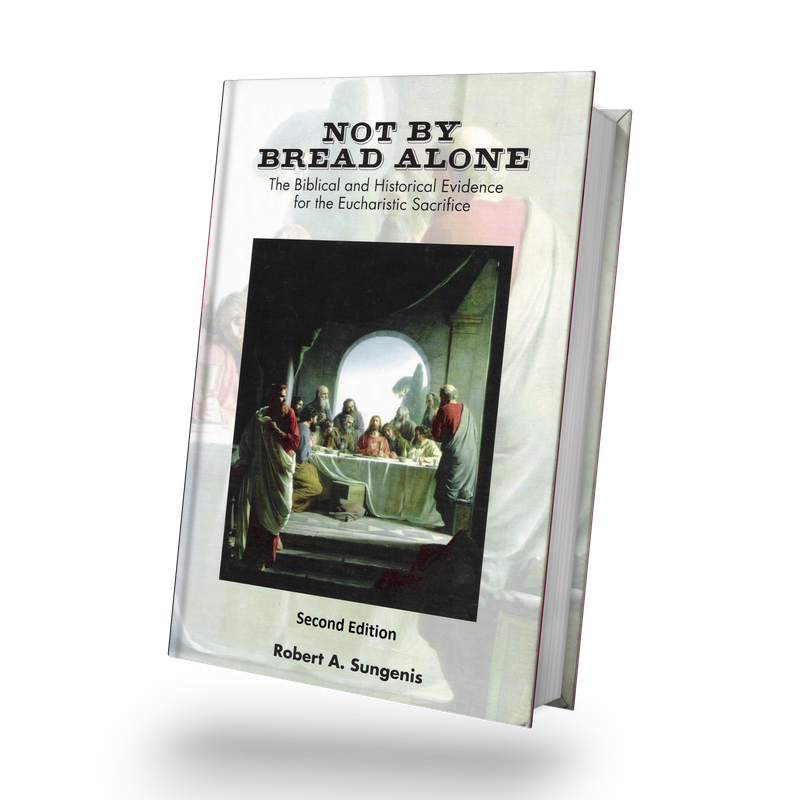
Go deeper: Not By Bread Alone
The biblical and historical evidence for the Eucharistic sacrifice, 2nd edition (2019).
Get the book