Live debate
Authority in Religion
Robert Sungenis vs. David Hester

What was argued
Hester argued that Christ's words, delivered through the apostles once for all and written in the 66 books, are the only standard by which Christians will be judged, that no one may go beyond what is written, and that Catholic tradition contradicts Scripture on points such as immersion, infant baptism, clerical celibacy and apostolic succession. Sungenis argued that the Bible does not say which books belong in it or settle many questions of faith and morals, that the early Church which fixed the canon had to be divinely guided, and that God gave the Church, Scripture and tradition together as three authorities, with the keys of Matthew 16 providing one binding answer. Both men agreed that public revelation ended with the apostles, that the apostles' oral and written teaching did not contradict each other, and that abortion is wrong even in cases of rape and incest.
How it ran
- 0:00Host introduces the speakers
- 1:22Night one: Hester's opening statement (affirmative)
- 22:08Sungenis opening statement
- 41:14Hester's rebuttal
- 51:36Sungenis rebuttal
- 1:03:24Cross-examination
- 1:32:21Hester's closing statement
- 1:43:24Sungenis closing statement
- 1:55:02Night two: host states the Catholic proposition
- 1:57:46Sungenis opening statement (affirmative)
- 2:08:37Hester's opening statement
- 2:31:37Sungenis rebuttal
- 2:42:14Hester's rebuttal
- 2:53:20Question and answer between the speakers
- 3:24:21Sungenis closing statement
- 3:34:28Hester's closing statement
The key exchanges
David Hester's point first, then Robert's answer. The time jumps to that moment in the video.
- 33:03
1. Not beyond what is written
Hester argues that 1 Corinthians 4:6, where Paul tells the Corinthians not to go beyond what is written, forbids adding doctrines and practices that have no scriptural basis.
Robert answered that Paul kept giving the Corinthians oral revelation while writing to them, so if the verse means Scripture is the only authority today it had to mean the same thing then, which it plainly did not.
“If it's true today it had to be true yesterday in the apostolic times.”
- 54:13
2. Seventeen books and ten more
Hester argues that at least 17 New Testament books were already recognized as Scripture within the New Testament itself, and that the books existed long before any council met.
Robert answered that the books obviously had to exist before the Church could rule on them, and that the New Testament says nothing about the other ten, so someone other than Scripture had to decide on those.
“Obviously they're going to have to exist before the church can make a decision on them.”
- 57:57
3. What counts as contradiction
Hester argues that Catholic tradition contradicts the Bible, since Scripture requires hearing, believing and repenting before baptism while the Catechism requires the baptism of infants.
Robert answered that a real contradiction needs Scripture to say one thing explicitly and the Church the opposite, such as a command not to baptize infants; differences that come from rival interpretations of hard passages are not contradictions.
“If that contradiction stood up I wouldn't be a Roman Catholic today.”
- 1:00:31
4. Did the keys end with Peter
Hester argues that the Greek of Matthew 16:19 means what is bound on earth will already have been bound in heaven, and that nothing in the text says Peter's authority passes on through succession.
Robert answered that Jesus would not set up an office of authority only for it to vanish at Peter's death, any more than the presidency ended with George Washington, and that already bound only strengthens his point because heaven cannot bind a falsehood.
“The fact is heaven's not going to bind a lie.”
- 1:22:03
5. Implicit teaching and Mary
Hester argues that the Bible authorizes by implicit as well as explicit statements, and that Catholic doctrines about Mary, such as her perpetual virginity, are contradicted by passages like Matthew 1:24 to 25.
Robert answered that the Bible never mentions the Immaculate Conception, so it cannot contradict it, and that the Church draws the doctrine from Scripture implicitly, the very method Hester says he uses.
“So I'm just using David's hermeneutic to defend the Immaculate Conception.”
- 1:27:23
6. The meaning of baptizo
Hester argues that baptizo means to immerse, that Romans 6:4 describes burial in baptism, and that the Catechism itself admits the word means to plunge.
Robert answered that the word is wider than dipping, since Scripture speaks of baptism with fire and the Spirit, and that the Church immerses as well as pours and sprinkles because sprinkling is also found in Scripture, as in Hebrews.
“The word baptism is much wider than the idea of just dipping or immersing somebody.”
- 1:45:50
7. No central headquarters
Hester admits that churches of Christ still differ on questions such as divorce and remarriage and war, but argues that congregations are autonomous and each Christian can read and understand Scripture for himself.
Robert answered that this admission is his whole case: without a central authority such disputes run on for generations, and even Hester's answer on abortion for rape and incest came from reasoning about implicit information, which is what the Church does.
“Well I couldn't have said it better myself because that's exactly the problem, there is no central authority.”
- 1:53:27
8. Profitable, not sufficient
Hester argues from 2 Timothy 3:16 to 17 that Scripture alone makes the man of God complete, thoroughly equipped for every good work, which no catechism or creed can do.
Robert answered that the Greek word means profitable, not sufficient or the only authority, and that in the same context Paul points Timothy to tradition as well as Scripture.
“It doesn't mean sufficient, it doesn't mean the only authority, it doesn't mean perfect, it means profitable.”
- 2:41:12
9. A prophet of warning
Hester quotes Robert's own website calling recent pontificates almost a total disaster and asks how he can defend an unbroken, authoritative Magisterium at the same time.
Robert answered that he distinguishes official, binding teaching from the private opinions of churchmen, and that like Israel, which had infallible access to God and still disobeyed, the Church can be rebuked by a prophet without its binding doctrines changing.
“So I can condemn my church just like Jeremiah condemned Israel.”
- 3:02:37
10. What succession means
Hester argues that Acts 1:21 to 22 requires an apostle to have been a witness of Jesus' ministry and resurrection, so no pope or bishop today can succeed the apostles.
Robert answered that apostolic succession does not produce new apostles: it means the Church's authority is built on the apostles, passed to bishops such as Timothy, whose qualifications in 1 Timothy 3 many men can meet.
“Apostolic succession does not mean there has to be another apostle after the apostle Peter.”
Robert's case in 5 points
- 1
The Bible does not directly settle many questions, such as abortion, war, surrogacy and slavery, and even on topics it covers, like predestination and free will, readers of good will have disagreed for centuries.
23:22 - 2
The Bible does not say which books belong in it; the only church in existence when the canon was settled was the Catholic Church, and everyone who uses the 27 books accepts its decision.
27:17 - 3
One answer for the people requires one authority, which is why Christ gave Peter the keys and the power to bind and loose, and God will not bind in heaven what is false.
35:41 - 4
If the early Church was not divinely guided, its choice of the last ten books is suspect and Hester becomes the authority himself; if it was guided, its other binding teaching must be accepted too.
2:07:05 - 5
The Church, Scripture and tradition are three authorities that work together, with God working through each, rather than the Church standing above Scripture.
2:33:16
Closing
Robert closed by answering the remaining points: Philip and the eunuch both went into the water, Peter settled the circumcision question in Acts 15, and succession means bishops built on the apostles, not new apostles. He then put the burden back on Hester to name another first-century church with a traceable line of leaders, pointing to Justin Martyr, Irenaeus, Polycarp and other Fathers who wrote to and about Rome and handed down the Trinity, the Incarnation and the Bible itself.
3:24:21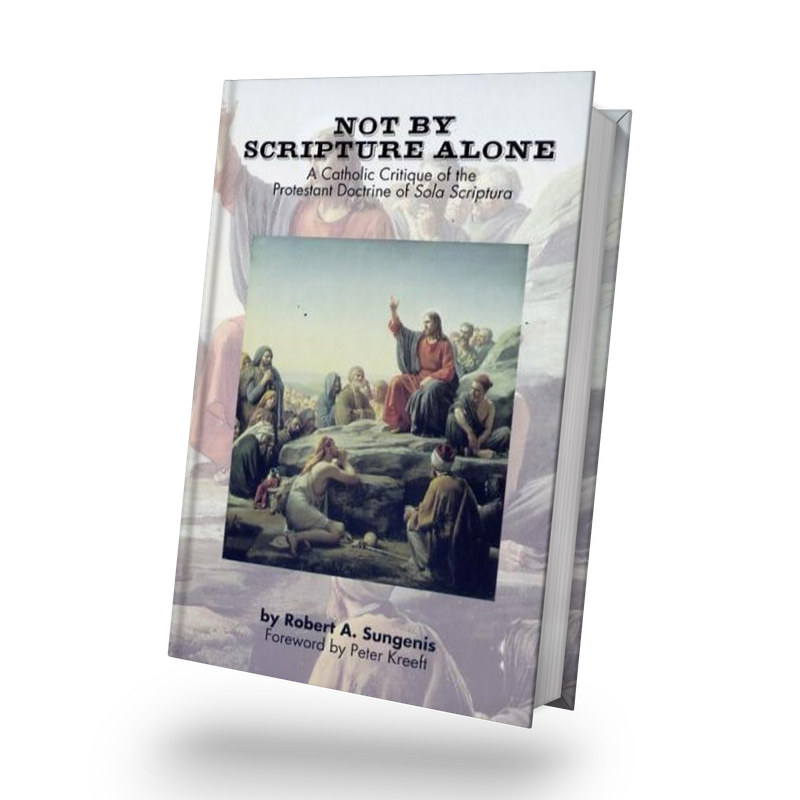
Go deeper: Not By Scripture Alone
A Catholic critique of the Protestant doctrine of sola scriptura, 2nd edition (2019).
Get the book