Live debate
What Still Divides Us? Scripture Alone
Robert Sungenis vs. Robert Godfrey, Michael Horton and Rod Rosenbladt
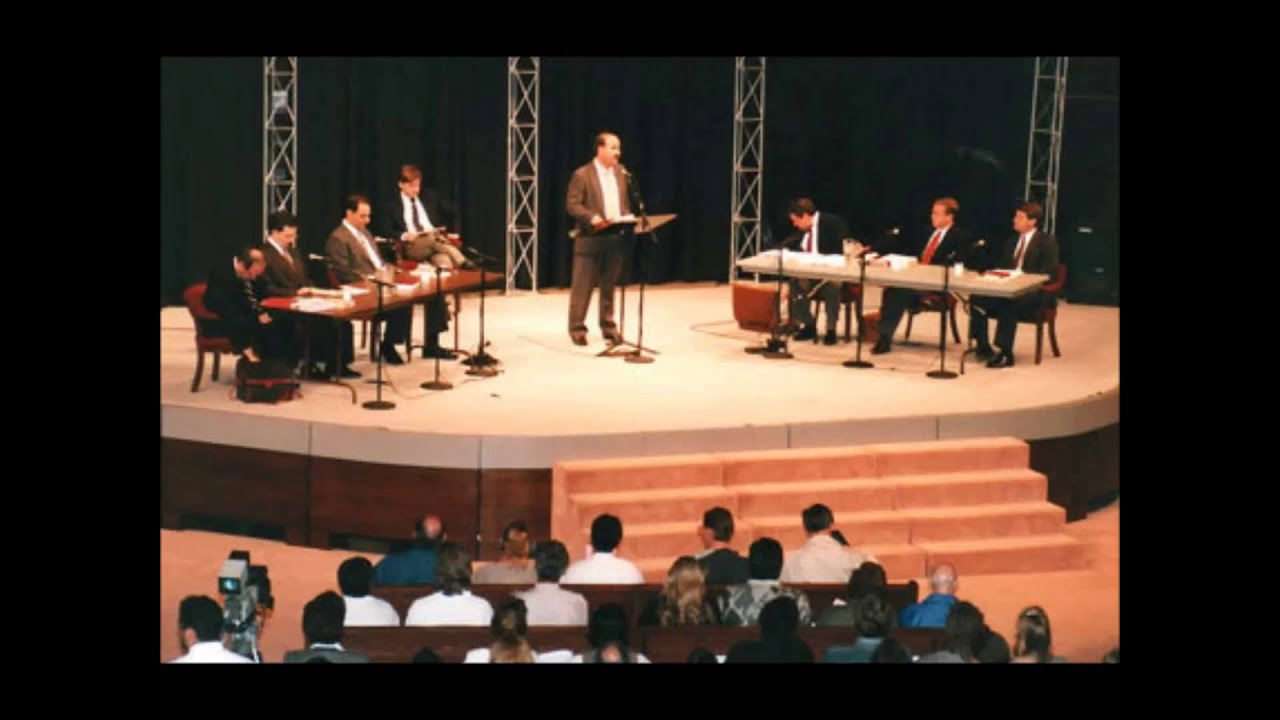
What was argued
The Protestant panel argued that Scripture teaches its own sufficiency and clarity for salvation (Godfrey citing Deuteronomy 31 and 32, 2 Timothy 3, Christ's "it is written" and the Bereans), that Rome's real authority is the Church rather than Scripture, and (Horton) that popes and councils have contradicted one another while Scripture has not. Sungenis argued that 2 Timothy 3:16 to 17 describes the equipping of the man of God, calls Scripture profitable rather than sufficient, and sits beside Paul's commands to guard his oral teaching and hand it on to reliable men, so the Bible never teaches a quantitative sufficiency of Scripture. Both sides agreed that Scripture is inspired and without error, and the Protestants granted that the Church has a real ministerial teaching role and that the apostles' preaching was itself the word of God.
How it ran
- 0:00Host introduces the debate and panelists
- 4:43Moderator explains the format
- 7:02Godfrey's opening statement
- 44:40Madrid opening statement
- 1:02:30Sungenis opening statement
- 1:13:43Marshner opening statement
- 1:27:53Catholic side cross-examines
- 1:41:16Protestant side cross-examines
- 1:55:13Protestant rebuttal
- 2:04:56Catholic rebuttal
- 2:16:50Open forum and audience questions
- 2:38:25Protestant wrap-up
- 2:47:52Sungenis closing statement
The key exchanges
Robert Godfrey, Michael Horton and Rod Rosenbladt's point first, then Robert's answer. The time jumps to that moment in the video.
- 1:03:40
1. The context of 2 Timothy 3
Godfrey argues that 2 Timothy 3:15 to 17 teaches the sufficiency of Scripture over and over, since the Scriptures make Timothy wise for salvation and equip him for every good work.
Robert answered that Paul is not staging a contest between Scripture and other sources in that passage. If Paul had a doctrine of Scripture alone in mind, this was the place to state it plainly, as he states the resurrection or salvation by grace plainly elsewhere.
“In the context of 2 Timothy 3.16, Paul is not setting up a contest between Scripture and other sources of revelation.”
- 1:04:44
2. Thoroughly equipped for what
Godfrey argues that the Greek words behind thoroughly equipped cannot be weakened by appealing to supposed parallel texts that use different words.
Robert answered that the two words are rare in the New Testament and range in meaning from fit or suitable to perfect, so an absolute sufficiency should not be loaded onto them. In any case they describe the condition of the man of God, not the Scripture.
“they are describing the man of God, not the Scripture.”
- 1:05:48
3. Quality versus quantity
Godfrey argues that because the Scriptures make one wise for salvation, they are sufficient and nothing else is needed today to know God's truth for salvation.
Robert answered that Scripture is qualitatively sufficient: it has no errors, its canon is complete, and it teaches salvation. But the word sola is numerical, and the Scripture Timothy had known since childhood was only the Old Testament, which no one claims was quantitatively complete.
“The word Sola in Sola Scriptura is numerical, and thus they push for a quantitative sufficiency of Scripture.”
- 1:06:51
4. Profitable, not sufficient
Godfrey argues that in spite of all the oral teaching Timothy received, Paul points him to the Scriptures because they give him clearly all that he needs.
Robert answered that Paul calls Scripture profitable (ophelimos), not sufficient, though Greek had words for sufficiency. Something useful implies other useful sources, and saying Scripture is the only infallible one assumes what has to be proved.
“But why didn't Paul say, Scripture is inspired and sufficient?”
- 1:10:03
5. Another infallible source
Godfrey argues that the Catholic side must show that Paul taught his oral teaching would be needed to supplement the Scriptures, and says Paul never taught this.
Robert answered that the same letter tells Timothy to keep what he heard from Paul as a pattern, to guard the deposit, and to entrust it to reliable men, and that 1 Thessalonians 2:13 calls Paul's spoken word the word of God and not of men.
“Hence, it is clear that Timothy has another infallible source to depend upon.”
- 1:13:43
6. No expiry date on tradition
Godfrey argues that the question is whether anything other than the Scriptures is necessary today, after the apostolic age, to know God's truth for salvation.
Robert answered that Paul wrote 2 Timothy while ordering the oral teaching to be kept and passed on, and nowhere says it would lapse at his death, at the close of the canon, or once the Bible was recognized.
“No, there is no such qualifying statement in Scripture.”
- 1:40:09
7. Deuteronomy and the word only
Asked for a text other than 2 Timothy 3, Godfrey points to Deuteronomy 31 and 32, where Moses says the written law is Israel's life, and says Scripture alone means Scripture teaches all that is necessary for salvation.
Robert answered by asking where Moses says the written law was the only way to know God's infallible truth. When Godfrey replied that Protestants never claimed it was the only way, Robert pressed that sola means only.
“I thought the word Sola meant only.”
- 2:47:52
8. Not left as orphans
The Protestant side argues that a layperson can open the Bible and find Christ, that the question of how a sinner is made right with God is clear enough for a child, and that Christ does not leave His children orphans.
Robert answered that he would consider himself an orphan if he could not say whether to baptize infants, a question the Protestant panel itself splits on. He pointed to 1 Timothy 3:15, the Church as the pillar and ground of the truth, and to the first three centuries, which had no doubt about it.
“Yes, He will not leave us orphans, but I would consider myself an orphan if I could not answer the question whether I baptize infants or not.”
- 2:50:00
9. The whole counsel of God
The Protestant side argues that the tradition Scripture speaks of is the apostles' teaching before it was written down, a deposit delivered once for all, not an evolving post-apostolic process.
Robert answered that Paul told the Ephesians he had given them the whole counsel of God, told the Corinthians he would say more when he came, and wrote in Ephesians 3:3 that he had written only briefly. Timothy was told to guard that fuller teaching because it carried the interpretation of the Scriptures Paul was giving.
“Did not Paul tell them much more about their faith than the mere six chapters in Ephesians?”
Robert's case in 5 points
- 1
Scripture is qualitatively sufficient, being without error and complete as a canon, but the sola of Sola Scriptura is a claim about quantity that the Bible never makes.
1:05:48 - 2
Paul calls Scripture profitable, and something profitable implies that other sources are profitable as well, so claiming Scripture is the only infallible source begs the question.
1:07:57 - 3
Paul's oral teaching was received as the word of God (1 Thessalonians 2:13), and Timothy was told to keep it as a pattern, guard it and entrust it to reliable men.
1:08:54 - 4
The same context gives Timothy three ways to be ready for every good work: his own cleansing and character (2 Timothy 2:21), Paul's inspired oral teaching, and the Scriptures.
1:11:08 - 5
Reading 2 Timothy 3:16 as Scripture alone is an anachronism, since the New Testament was not yet complete or recognized and Paul gave no hint that his oral teaching would ever be set aside.
1:13:00
Closing
Robert closed by asking whether a Church that still cannot say after twenty centuries whether to baptize infants is the Church Jesus left, the pillar and ground of the truth, and noted that the only other text Godfrey offered for Scripture alone was Deuteronomy 31. He restated that Paul calls Scripture profitable rather than sufficient and that the Bible, while perfect and complete in quality, nowhere teaches a quantitative sufficiency of Scripture.
2:47:52
Go deeper: Not By Scripture Alone
A Catholic critique of the Protestant doctrine of sola scriptura, 2nd edition (2019).
Get the book