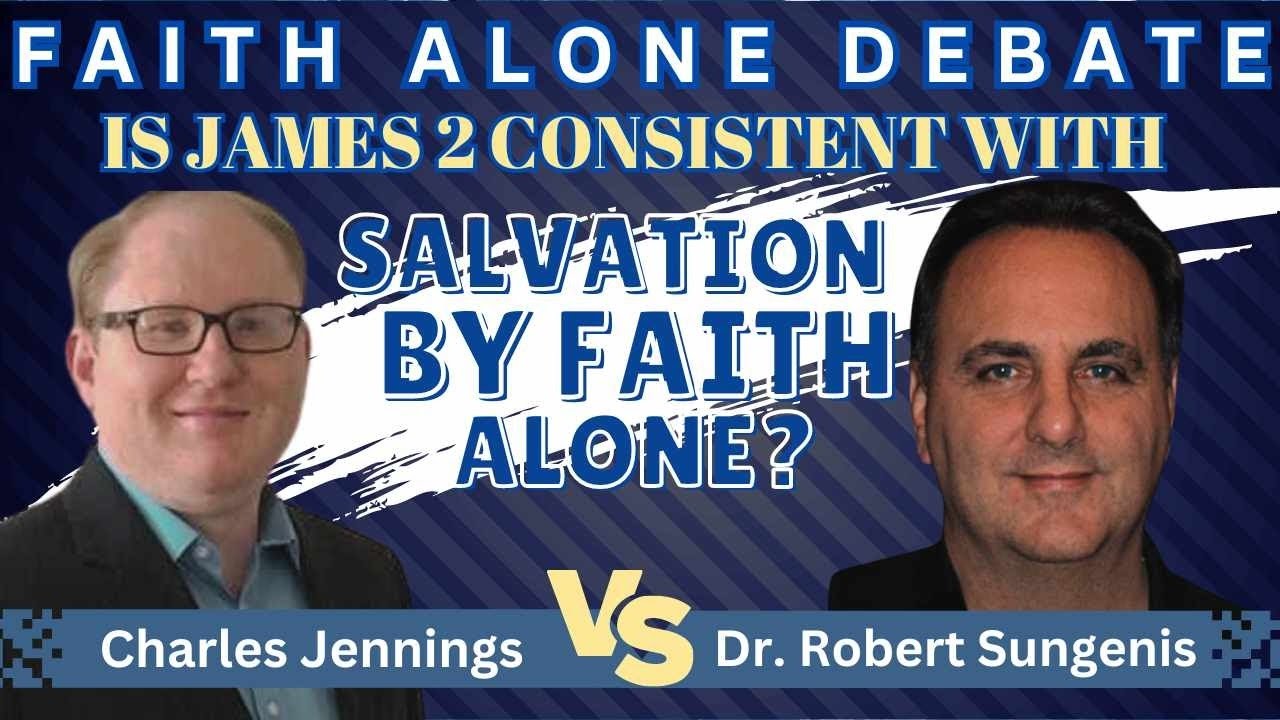
Live debate
Is James 2 Consistent with Faith Alone?
Robert Sungenis vs. Charles Jennings
What was argued
Jennings, arguing from Free Grace theology, held that justification in James 2 and Romans 4 alike is not about escaping hell but about participating in the blessings and inheritance of the covenant, so that one moment of belief makes a person eternally secure while the warnings concern temporal discipline and rewards. Sungenis argued that however justification is defined, the question is how one is justified: faith comes first, works must then be deliberately added and continued to the end, and Scripture warns throughout that believers can fall away, a point he said Jennings asserted away with distinctions he never proved. Both agreed that being justified is not the same as final salvation, that God cannot be put in debt, and that works done without faith are not acceptable to God.
How it ran
- 0:23Host states the debate resolution
- 8:20Jennings's opening statement
- 24:00Sungenis opening statement
- 39:04Jennings's first rebuttal
- 49:34Sungenis first rebuttal
- 1:00:16Jennings's second rebuttal
- 1:05:10Sungenis second rebuttal
- 1:11:12Cross-examination, Jennings leads
- 1:31:33Cross-examination, Sungenis leads
- 1:53:55Jennings's closing statement
- 1:54:54Sungenis closing statement
- 1:55:55Audience questions
The key exchanges
Charles Jennings's point first, then Robert's answer. The time jumps to that moment in the video.
- 31:11
1. Works do not simply flow
Jennings argues that justification in James 2 is God recognizing and rewarding what a believer does rightly in fellowship with Him, a matter of sanctification rather than of escaping hell.
Robert answered that James's own church shows works do not flow automatically from faith: they were favoring the rich and fighting among themselves. Doing works is hard, as Abraham's offering of Isaac was hard, so works must be deliberately added and they justify alongside faith.
“Faith will justify you just like it did Abraham, but works also justify you.”
- 52:26
2. Believing once
Jennings argues that one moment of belief places a person forever in the class of believers, so that no one goes to hell because of sin.
Robert answered that this was asserted, not proved, and that reading endure to the end as a tribulation text ignores Matthew 10:22 and the warnings found in every New Testament book except Philemon. Defining faith alone as believing once assumes the very thing to be proved.
“Asserting something and proving it is two different things.”
- 1:05:10
3. Objection to his James 2
Jennings argues that Robert raised no objection to his readings of James 2 and Romans 4, which shows the real dispute is the Catholic model of sanctification.
Robert answered that he objected strongly, because James 2 requires works for the rest of one's life. Abraham offered Isaac roughly fifteen years after the faith that first justified him.
“So it's a continual thing.”
- 1:06:14
4. Hebrews 10 and judgment
Jennings argues that Hebrews 10 speaks of temporal judgment, tied to the capital crimes of the Old Testament and the approach of AD 70.
Robert answered that raging fire consuming the enemies of God is the language of hell, echoing Mark 9, and that the passage names deliberate sin as the cause, which contradicts the claim that sin sends no one to hell.
“It's sin that is the reason why you end up in this judgment.”
- 1:18:27
5. The one believing
Jennings argues that the substantival participle in John 3:18, like the one look at the bronze serpent in John 3:14, classifies a person as a believer on the basis of one moment of faith.
Robert answered that nothing in the context hints at a single act of belief, and that one must believe all the days of one's life. A beginning point does not make that point the only thing required.
“You can say that it started at one moment, but you can't conclude from that that only that moment is needed for salvation.”
- 1:24:01
6. Died with Him, live with Him
Jennings argues that in 2 Timothy 2:11 the only condition for living with Christ is having died with Him, so the call to endure concerns reigning and reward, not resurrection.
Robert answered that the saying does not address someone who stops believing, and that dying with Christ in baptism, as in Romans 6, still leaves him needing to endure. Enduring means continuing to believe.
“I hope to, unless I do what the rest of the Bible says and I fall away for my sin.”
- 1:36:22
7. Inheriting the kingdom
Jennings argues that those in Galatians 5:21 who will not inherit the kingdom lose a place ruling with Christ, and that Romans 8:17 distinguishes heirs of God from fellow heirs who suffer with Christ.
Robert answered that the distinction is not in Galatians 5, and that Romans 8:17 simply calls believers heirs through the New Covenant and joint heirs because they have died and risen with Christ. He also noted that suffering as a condition sits oddly with one-time faith.
“I thought you said it doesn't take suffering or anything else, just faith alone one time.”
- 1:43:00
8. Is the covenant salvation
Jennings argues that covenants are not about salvation but are master and servant arrangements, like ancient land grants, through which blessings flow on the basis of Christ's death.
Robert answered that Hebrews 10:16 promises sins remembered no more, and Hebrews 7:18 to 19 and 8:6 present Jesus as mediator of a better covenant because the law made nothing perfect.
“He made a New Covenant for salvation.”
- 2:25:44
9. Abraham's promised land
Jennings argues that the land promise to Abraham and his seed will be fulfilled when the dead are raised to rule, and that salvation existed before any covenant, so covenant inheritance is not salvation itself.
Robert answered that the land promised to Abraham's seed was fulfilled in Joshua 21, while Hebrews 11 says Abraham never received it because he looked for the city God builds. That heavenly inheritance is salvation, and Hebrews 11 shows Abraham's faith was a continuing faith.
“The reason Abraham didn't receive the promises on Earth was because he was looking for the heavenly land that God Himself would build.”
Robert's case in 5 points
- 1
In Catholic theology a justified person is not necessarily saved: justification starts one on the road to salvation, can be lost, and only he who endures to the end is saved.
25:17 - 2
Faith comes first, as Romans 9:31 to 32 shows of Israel, and once God has accepted a person by faith He can accept that person's works as well.
28:28 - 3
However justification is defined, the real question is how one is justified: by faith alone with works simply flowing, or by deliberately adding works to faith.
32:33 - 4
God accepts our imperfect works as He accepts our imperfect faith, so Romans 2, which says God judges and justifies by works, need not be made hypothetical.
37:49 - 5
Every New Testament book except Philemon warns of those who do not endure to the end, which rules out a faith that needs to be exercised only once.
52:26
Closing
Robert closed by saying the crux of the debate had just been stated: not one passage in the Bible says we need only believe once with no requirements thereafter, whether of faith, works or avoiding sin. A whole theology built on that idea needs proof, and without it, he said, the conclusion does not follow.
1:54:54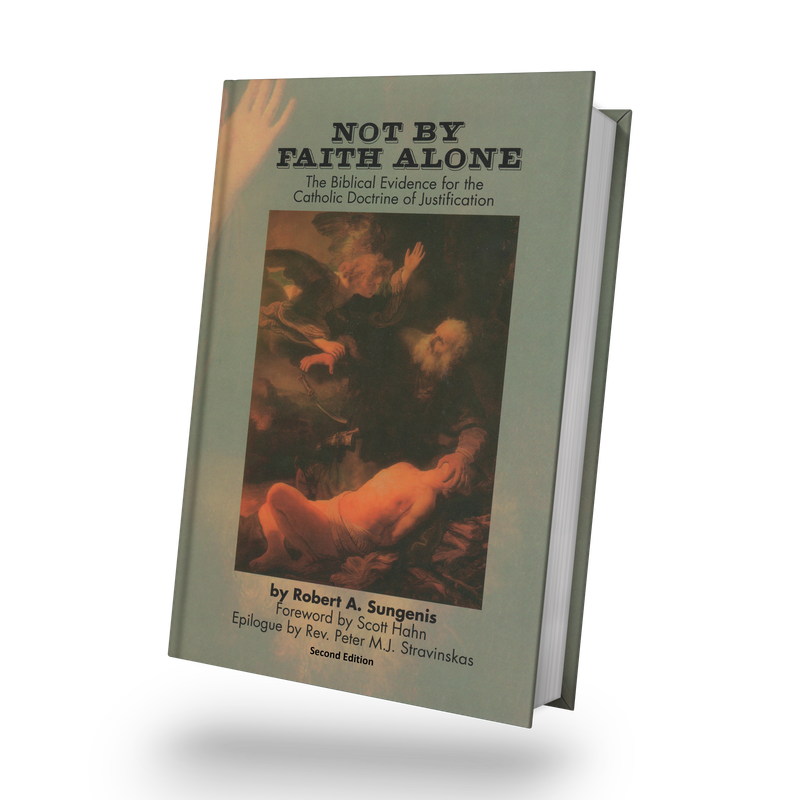
Go deeper: Not By Faith Alone
The full written case for the Catholic doctrine of justification, verse by verse, 2nd edition (2019).
Get the bookQuestions readers have asked on salvation, grace, and justification