Live debate
Justification by Faith Alone?
Robert Sungenis vs. Chris Morrison

What was argued
Morrison argued that faith is a sufficient condition for everlasting life and therefore for justification (John 6:47, Romans 3:22), that James 2 presupposes a justification by faith alongside a second justification by works that makes one a friend of God, and that since Galatians 3 shows sanctification is by faith, justification must be by faith all the more, with eternal life never lost even if belief ceases. Sungenis argued that Scripture never joins faith to alone except to deny it, that Romans 2 means what it says when it promises life to those who do good, that Paul condemns only works offered to put God in debt, and that David in Romans 4 is a justified man who lost justification through murder and adultery and regained it by repentance. Both men agreed that God cannot be obligated by anyone, that James 2 speaks of more than one justification, and that the word reckoned does not mean a legal fiction.
How it ran
- 0:00Host introduces the question and the debaters
- 10:33Morrison's opening statement
- 26:53Sungenis opening statement
- 43:06Morrison's rebuttal
- 52:52Sungenis rebuttal
- 1:05:30Cross-examination led by Morrison
- 1:30:39Cross-examination led by Sungenis
- 1:54:48Morrison's closing statement
- 1:59:52Sungenis closing statement
- 2:05:28Audience questions
The key exchanges
Chris Morrison's point first, then Robert's answer. The time jumps to that moment in the video.
- 57:32
1. Alone as an adverb
Morrison argued that alone in James 2:24 is an adverb modifying justified, so the verse teaches a justification by faith plus a second justification by works rather than negating faith alone.
Robert answered that monos can be adjective or adverb depending on context, but either way the verse says a man is not justified by faith alone, the only place Scripture uses the phrase. He added that two justifications is not the standard Protestant reading but the Catholic one.
“The point is being made that it's not by faith alone and that's the only place that Scripture uses that term.”
- 59:55
2. Romans 2 is not hypothetical
Morrison argued that Romans 1 to 3 sets a real standard of perfect law keeping that only Jesus has met, which shows why a justification by faith is necessary.
Robert answered that nothing in Romans 2 says the works cannot be done, and that Paul's condemnation of the Jew for stealing and adultery would make no sense if no one could do them. Paul never speaks hypothetically about salvation anywhere else.
“Romans chapter 2 assumes that it can be done otherwise it wouldn't say that a man who works is justified.”
- 1:02:16
3. The Rich Young Ruler
Morrison argued there is no first century evidence that Jews thought God owed them salvation, pointing to the Rich Young Ruler asking what he must do to inherit eternal life.
Robert answered that the ruler came because Jesus spoke of salvation differently from the Pharisees, who trusted their ritual while sinning in secret. Jesus did not tell him to have faith; He told him to give his riches to the poor.
“Jesus gave him a work to do, didn't he?”
- 1:11:14
4. Two justifications in James
Morrison pressed that if James 2 contains both a justification by faith and one by works, nothing in the text says failing the second sends a believer to hell.
Robert answered that the weight of the evidence says such a man is not saved. Abraham already had faith in verse 23, and the question James raises is whether he will do the works.
“If he doesn't do the works then the logical answer is then he's not going to be justified.”
- 1:24:31
5. Now I know at Moriah
Morrison argued from Genesis 22, Exodus 33 and a medieval Jewish commentary that God's now I know means God making Abraham's faith publicly known, a justification before men.
Robert answered that Abraham left his servants at the foot of the mountain, so no one was watching; the act was displayed for God, who was the witness to Abraham's obedience.
“When Abraham took Isaac up to the mountain there were no men there watching it, it was all for God.”
- 1:28:38
6. Can God be obligated
Morrison argued that God cannot in principle be obligated, so reading Paul as refuting that idea treats a contradiction as real, and Romans 4 never distinguishes meritorious from non meritorious works.
Robert answered that God owes no one, but men can still think He does, and that error is exactly why Paul uses the employer and wage picture. Romans 4 must be read with Romans 2 and 3.
“That's the whole problem is they don't know who God is.”
- 1:32:14
7. David in Romans 4
Morrison argued that David in Romans 4 is the specific example of the general case of justification by faith apart from works, and that the text never says David lost his justification.
Robert answered that David was a man of God who fell into adultery and murder and then repented in Psalms 32 and 51, the Catholic pattern of mortal sin and restoration. If David was not regaining justification, Paul would have no reason to cite him.
“If David is not the one then who is it? Why mention David?”
- 1:40:20
8. Galatians 3 and the law
Morrison argued that Galatians 3 shows the Spirit and Christian growth come by believing, not by works of the law including the Ten Commandments, so sanctification and therefore justification are by faith alone.
Robert answered that the context is the Judaizers requiring Mosaic rituals, which Paul calls works of the law, and that Galatians 5 lists sins that exclude from the kingdom and calls for good works through the fruit of the Spirit.
“There's no context here where normal good works are being shunned by Paul.”
- 1:49:19
9. Can eternal life be lost
Morrison argued that eternal life, once received, is everlasting even if a person stops believing, and that 2 Timothy 2:12 to 13 concerns losing rewards, not salvation.
Robert answered that the same passage says if we disown Him He will disown us, and names Hymenaeus and Philetus as men who wandered from the truth, which on Morrison's view would still leave them saved.
“So they can depart from the faith and still go to heaven.”
Robert's case in 5 points
- 1
Paul uses the word alone four times in Romans 4 and never joins it to faith, and the only time Scripture pairs faith with alone is to deny that justification comes that way.
28:12 - 2
Romans 4:4 condemns works presented to God as a wage He owes, as between employer and employee, not works offered within a personal relationship like the one God had with Abraham.
33:52 - 3
Romans 2 says the doer of good receives eternal life, and since Paul never speaks hypothetically about salvation, the verses cannot be set aside.
37:59 - 4
Faith in what Christ did on the cross takes a person from under the law into grace, where God accepts imperfect works just as He accepts imperfect faith.
41:50 - 5
Abraham's faith was tested for decades and many people lose their faith, so believing is not a single past act that guarantees eternal life.
56:28
Closing
Robert closed by citing 1 Corinthians 3:16 to 17 and 2 Corinthians 5:10 to show that believers who destroy God's temple face destruction and judgment for bad deeds, not a mere loss of rewards, and argued that God's testing of Abraham shows faith alone is not sufficient. He repeated that no men were present on Moriah and that Paul cites David in Romans 4 precisely because David was justified again after murder and adultery.
1:59:52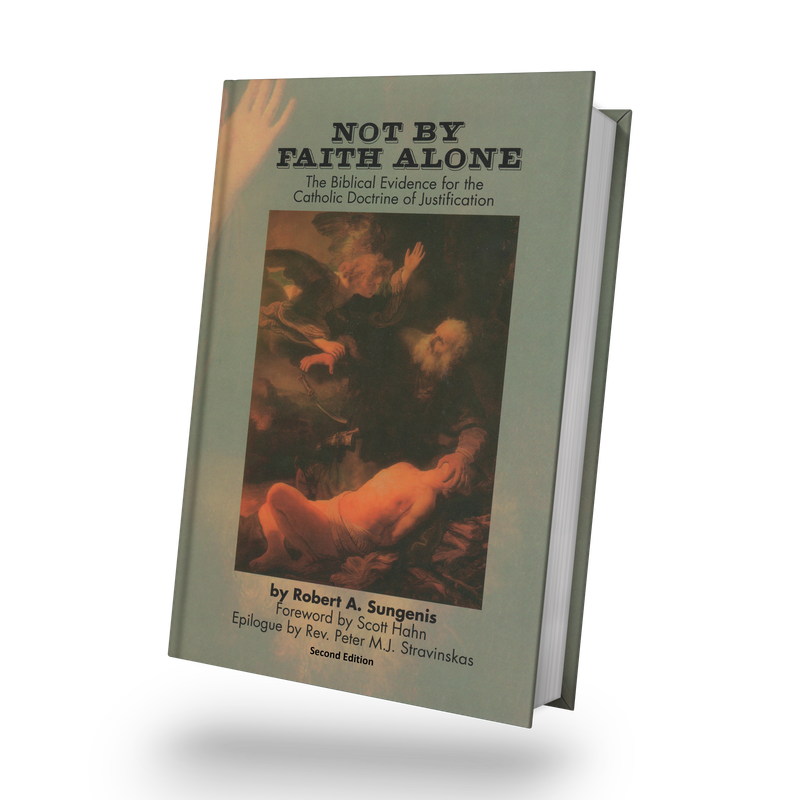
Go deeper: Not By Faith Alone
The full written case for the Catholic doctrine of justification, verse by verse, 2nd edition (2019).
Get the bookQuestions readers have asked on salvation, grace, and justification