Live debate
Justification (third debate)
Robert Sungenis vs. Matt Slick

What was argued
Slick argued that justification is a single act of God received by faith alone, that Paul, Titus 3 and the tax collector of Luke 18 exclude every kind of work, and that Christ's perfect law-keeping is the righteousness credited to the believer; he also pressed Robert on the late and thin patristic evidence for the Assumption of Mary. Robert argued that everything a Catholic does toward salvation is done by grace, that what Paul and Trent condemn is works presented to God as a debt He owes, and that works done inside grace are required and rewarded, with David's repeated justification as his example of justification as a process. Both men agreed that no one is saved by works done apart from grace, and Robert granted that the early evidence for the Assumption is scant and that Scripture gives no direct evidence for it.
How it ran
The key exchanges
Matt Slick's point first, then Robert's answer. The time jumps to that moment in the video.
- 13:13
1. The Assumption's late witnesses
Slick argues that no early Father teaches the Assumption of Mary, so a doctrine that first appears some 700 years after the apostles, with no trail behind it, looks like a rumor that hardened into dogma.
Robert answered that he had already admitted the patristic evidence is scant, but John Damascene, Germanus of Constantinople and Modestus of Jerusalem all wrote of it, and a writer who holds to tradition would not invent a doctrine; the silence of earlier writers does not prove the idea did not exist, and the Church weighs such witnesses and makes the decision.
“I realize that John Damascene is not going to make up a doctrine of the Assumption of Mary by his own mind.”
- 18:25
2. Did Peter's authority stop
Slick argues that Peter acted in Acts 15 as an inspired apostle, and that claiming the same authority for later popes simply assumes the Roman Catholic Church is the true Church.
Robert answered that Peter decided the circumcision question with no prior Scripture or precedent, and it would be absurd for that authority to end with him, since Jesus promised the Spirit would guide the apostles into all truth and be with them to the end of the age; the Church likewise decided which books out of about two hundred belonged in the New Testament.
“How could Jesus tell the apostles that this Holy Spirit would lead them into all truth and He would be with them forever if it stopped with Peter?”
- 26:11
3. David justified again
Slick argues that 2 Samuel 12:13 shows God took away David's sin the moment he confessed to Nathan, so David was justified once and permanently, and later Psalms only restate it, which fits Reformed doctrine.
Robert answered that Psalm 32 uses the same language as Psalm 51 and Romans 4, so Paul's example is David's repentance after his sin, and once Slick agreed David had been justified earlier and was then reconfirmed, that is the Catholic teaching of progressive justification.
“Well, welcome to the Catholic doctrine, Matt.”
- 29:06
4. Merit and sanctifying grace
Slick argues that if merit is needed to receive sanctifying grace, then the works become a necessary cause of salvation, and whatever is a necessary cause makes heaven the result of one's own effort.
Robert answered that the power to do the work comes from actual grace and the reward for it is sanctifying grace, so the whole process is grace, and the claim that Catholics work for salvation apart from God is a myth.
“Everything we do is by grace, even the very power I have to do the work comes by God's grace.”
- 35:56
5. James 2:24 and vindication
Slick argues that James 2 is only distinguishing true faith from false faith, the kind of faith even the demons have, and is not teaching how a person is justified before God.
Robert answered that even granting that, verse 24 still says Abraham was justified by works and not by faith alone, so reading justified as vindicated leaves the same problem; a believer who refuses to clothe and feed the needy man when the opportunity comes cannot be justified by his faith.
“Abraham was vindicated by his works and not vindicated by faith alone, that's the way you have to say it because the grammar demands it.”
- 39:16
6. Works of the law
Slick argues that Romans 3:28, Galatians 2:16 and Titus 3:5 exclude any works of law, which would include the Catholic list of commandments and corporal and spiritual works of mercy.
Robert answered that Paul and Titus rule out works brought to God as a claim that He owes salvation, which Trent also condemns; a person who enters the system of grace by faith does good works that God rewards.
“If you are under the system of law and you come to God with your good works and you say God, you owe me, that's anathema and you will not be justified.”
- 43:02
7. The tax collector in Luke 18
Slick argues that the tax collector went home justified after only asking for mercy, offering no works, baptism or anything else, which is justification by faith alone.
Robert answered that the parable contrasts the hypocrite with the repentant man and is not a full doctrine of justification; like Abraham, the tax collector would keep his justification only if he did not refuse the works that followed.
“The man of true repentance like David is going to be justified.”
- 50:28
8. Did Christ earn merit
Slick argues that Christ kept the law perfectly and so earned the reward the law promises, and that His righteousness, not our own, is what the believer receives according to Philippians 3:9.
Robert answered that Scripture never says Jesus earned anything from the Father, and that Philippians 3:9 contrasts righteousness from the law with righteousness from faith, not our own righteousness with an imputed one.
“He was blessed by the Father for His obedience.”
Robert's case in 5 points
- 1
Peter settled circumcision in Acts 15 with no precedent, and Christ's promise that the Spirit would guide the Church to the end of the age means that authority continues in Peter's successors.
18:25 - 2
David was justified, sinned, and was justified again through repentance, so justification is progressive rather than a single closed event.
26:11 - 3
Catholic teaching rejects strict merit, where God owes a reward, which is what Trent anathematized; any merit a Catholic speaks of is congruent or condign, given by God without being owed.
28:03 - 4
Actual grace gives the power to do good works and sanctifying grace is the reward for them, so every step of salvation is by grace.
29:06 - 5
Good works are required once the opportunity comes: a believer who refuses to help the naked and hungry man cannot be justified by his faith, as James teaches.
34:15
Closing
There was no formal closing; Robert's last argument, as time ran out, was that no passage of Scripture says we are justified because we received Christ's righteousness, and that Abraham was justified by his faith on account of Christ's atoning work. He then offered to come back the following Monday to take up another topic.
52:23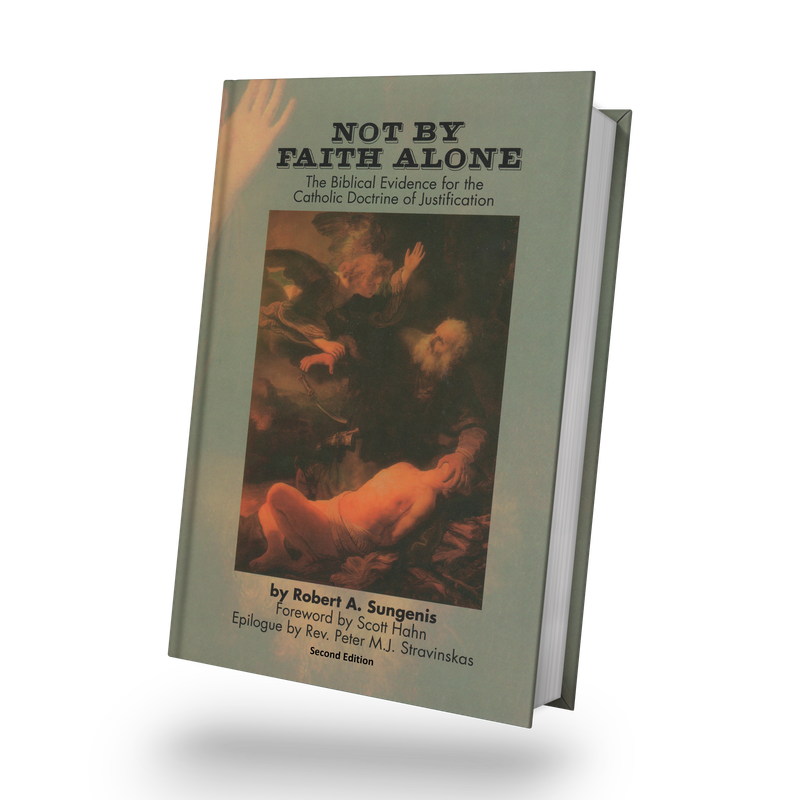
Go deeper: Not By Faith Alone
The full written case for the Catholic doctrine of justification, verse by verse, 2nd edition (2019).
Get the bookQuestions readers have asked on salvation, grace, and justification