Live debate
Is Sola Scriptura True?
Robert Sungenis vs. TurretinFan

What was argued
TurretinFan argued that Scripture itself teaches sola scriptura: it contains everything needed for salvation, teaches those things clearly, and stands above every human teacher, even the apostles' own preaching. Robert argued that Scripture is inspired and supreme in its own way, but that it is not the only infallible authority, since it does not settle questions such as the canon, infant baptism, or whether Christ had one will or two. He argued that God gave the Church apostolic tradition and a living magisterium to decide those questions.
How it ran
- 7:21TurretinFan's opening statement
- 24:18Robert's opening statement
- 39:45TurretinFan's rebuttal
- 47:21Robert's rebuttal
- 57:30TurretinFan's cross-examination of Robert
- 1:18:11Robert's cross-examination of TurretinFan
- 1:39:23TurretinFan's closing statement
- 1:54:30Robert's closing statement
- 2:10:57Questions from the audience
The key exchanges
TurretinFan's point first, then Robert's answer. The time jumps to that moment in the video.
- 47:10
1. Aquinas on the rule of faith
TurretinFan argues that Thomas Aquinas taught that only canonical Scripture is the rule of faith, and that this was a common medieval view.
Robert answered that the line needs its context: the fathers and the medievals argued from Scripture alone when debating opponents because Scripture was the ground both sides already accepted. He added that Aquinas himself held to tradition and the magisterium, and that Aquinas is in any case not the authority that settles the question.
“Look, you want to argue? Let's just argue from what we both believe is true and trustworthy, and that's the Scripture.”
- 52:05
2. What sola scriptura has to prove
TurretinFan defines sola scriptura as the claim that everything needed for salvation is taught in Scripture and is taught clearly there.
Robert answered that he already grants that Scripture can lead a person to salvation, and that this is not what is in dispute. What has to be proved, he said, is that Scripture is the only infallible authority for the Christian faith.
“The issue for sola scriptura is that Scripture is the only inerrant, infallible authority for me to know about the Christian faith. Can you prove that?”
- 59:15
3. The decision in Acts 15
TurretinFan argues that the decision at the council in Acts 15 did rest on Scripture, since Amos was quoted in the course of it.
Robert answered that Amos 9:11 says nothing about circumcision and only notes that the gentiles are being brought in. The decision itself, he argued, came from what God had already taught Peter in the vision of Acts 10, which is tradition rather than a text.
“The issue is what prompted the decision. This is a big decision, whether you circumcise or not. It's not in Amos 9:11.”
- 1:25:33
4. Infant baptism from Scripture
TurretinFan argues that infant baptism is drawn from Scripture itself, pointing to the passages where a whole household is baptized.
Robert answered that a household is not the same as an infant, and that no passage says infants were baptized, which is why Baptists read the same texts the other way. He argued that Presbyterians reached their practice by an ecclesiastical decision on an unclear text, the same move he says the Church made.
“You can say a household was baptized, but you can't say dogmatically that infants were baptized.”
- 1:26:35
5. Fallible church decisions
TurretinFan says Presbyterians do make decisions from Scripture but do not claim that those decisions are infallible.
Robert answered that this leaves a believer carrying a decision he only hopes is right. The Catholic claim, he said, is that the Holy Spirit promised to guide the Church into all truth, and so her definitions are certain rather than a best guess.
“The Holy Spirit said it was going to guide us into all truth, and He's infallible, and He made our decision infallible.”
- 1:36:13
6. The best verse for sola scriptura
TurretinFan names 2 Timothy 3:14-17, that Scripture thoroughly equips the man of God for every good work, as his strongest text.
Robert answered that the passage nowhere says Scripture alone, and pressed for a verse that uses the word alone or only, one that separates Scripture from tradition and the magisterium and sets it above them.
“You're aware that that passage does not say that Scripture alone is profitable for teaching, correction, training in righteousness, right?”
- 1:55:25
7. Scripture as the judge
TurretinFan argues that Scripture stands above every human teacher, even the apostles, and is the measure by which other teaching is judged.
Robert answered that Scripture is a written text, so it cannot hear two rival readings and hand down a verdict the way a judge does. That work, he argued, was given to Peter and to the Church, as it was used in Acts 15.
“It's going to take a thinking personality to figure these things out.”
- 2:20:38
8. Knowing the canon infallibly
TurretinFan says he holds the canon with reasonable certainty, through the testimony of Scripture and the inward witness of the Holy Spirit, but does not claim personal infallibility.
Robert answered that the Church has declared the canon infallibly, resting on Christ's words to Peter that whatever he binds on earth is bound in heaven. Since heaven cannot lie, he argued, what is endorsed there has to be true.
“The Church has declared them infallibly, and as Jesus said, whatever you bind on earth shall be bound in heaven.”
- 2:36:59
9. Written and unwritten tradition
TurretinFan argues that any oral teaching of the apostles should be held, but that no reliable example of apostolic oral tradition outside Scripture has survived.
Robert answered that Paul tells us to hold to the tradition, whether written or by word of mouth, so two sources of revelation stand whether or not an example can be produced on demand. He offered infant baptism as one such tradition.
“There are two sources of revelation: one is written, one is not, one is oral.”
Robert's case in 5 points
- 1
Dogmatic tradition is the tradition the apostles themselves taught, and the magisterium is what determines which traditions are apostolic.
26:25 - 2
Questions Christians have to answer, such as whether Christ had one will or two, are not settled by Scripture, so a living authority has to decide them.
31:04 - 3
The canon of Scripture cannot be drawn out of Scripture, so the list of books lies outside Scripture's own authority.
34:28 - 4
The debate is not whether Scripture leads people to salvation, which he grants, but whether Scripture is the only infallible authority.
52:05 - 5
The promise that the Holy Spirit would guide the Church into all truth is what makes her definitions certain rather than a hopeful guess.
1:26:35
Closing
Robert closed by arguing that Scripture, being a written text, cannot weigh two rival readings and hand down a decision. Christ gave that authority to Peter and to the Church, men guided by the Holy Spirit, which is how the canon and the great doctrinal disputes were settled.
1:54:00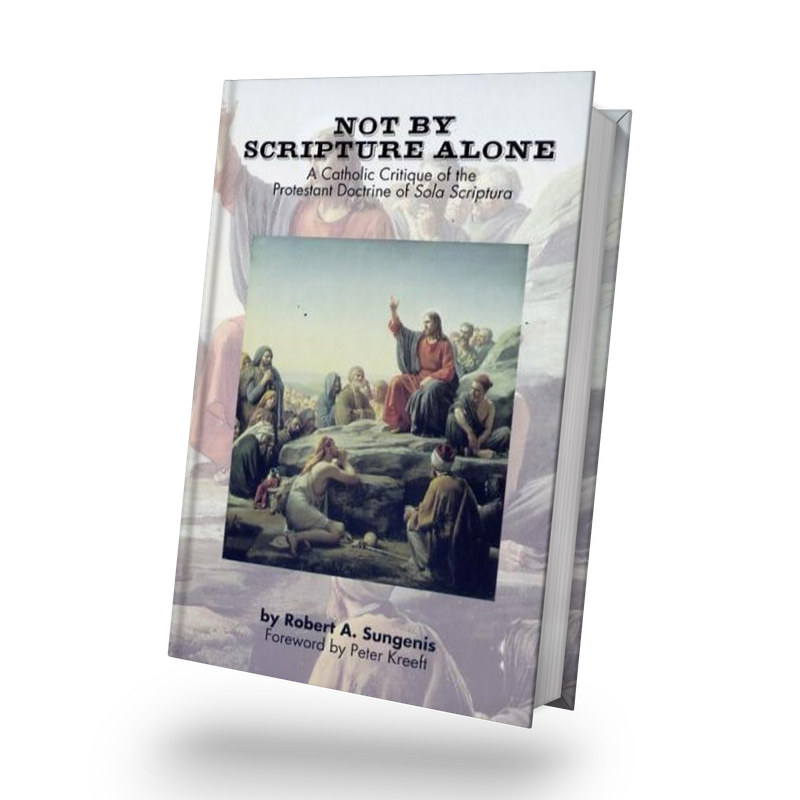
Go deeper: Not By Scripture Alone
A Catholic critique of the Protestant doctrine of sola scriptura, 2nd edition (2019).
Get the book