Live debate
Justification by Faith
Robert Sungenis vs. James White

What was argued
White argued that justification is a single past act of God: grace must be free, saving faith is itself God's gift, and the perfect righteousness of Christ is credited to the believer once for all, so no one who is justified can be lost. Sungenis argued that Scripture never joins the word faith to the word alone, that Romans 2 and the judgment texts promise eternal life to those who do good under grace, and that what Paul rules out is works done to put God in debt, not obedience offered inside a relationship of grace. Both men agreed that no one is saved by works done apart from grace.
How it ran
The key exchanges
James White's point first, then Robert's answer. The time jumps to that moment in the video.
- 44:05
1. Who is the blessed man
White argues that the blessed man of Romans 4:8, the man whose sin God will never take into account, is the believer whose sins were borne by Christ at Calvary.
Robert answered that Paul names the man: it is David, quoting Psalm 32, which David wrote after repenting of adultery and murder. If David was justified at the moment he repented, then a godly man can lose justification and receive it back, which is what the Catholic Church teaches.
“The man that is described in Romans 4 verse 8 is David himself.”
- 50:08
2. Scripture never says faith alone
White argues that sinners are justified by grace through faith alone, apart from any human work of merit.
Robert answered that the New Testament uses faith and its forms over two hundred times and never once couples it with the word alone, though Paul uses alone freely elsewhere. The one place the phrase appears, James 2:24, it is denied.
“The word faith is never used with the word alone.”
- 53:56
3. What works of law means
White argues that grace, to be grace, cannot be mixed with any human action that is in any way meritorious.
Robert answered that Paul's target is works of debt, the attempt to make God an employer who owes a wage. He added that Trent says the same thing: anyone claiming to be justified by his own powers apart from grace is condemned.
“Paul is concerned that one who works places God in debt to pay him, as if God owed him something.”
- 1:33:47
4. Romans 2 and the Gentiles
White argues that Romans 2 is aimed at the self-righteous Jew who thinks possessing the law is enough, and that Paul has not yet reached the question of how anyone is made righteous.
Robert answered that Paul addresses Jew and Gentile alike in that chapter, the same pairing he opened the letter with, and that Paul calls the judgment he has just described my gospel in verse 16.
“The Gentile must fulfill Paul's requirement to be justified by obeying the law in order to have a representative case to use against the Jew”
- 1:38:33
5. The standard is perfection
White argues that the law's standard is perfect obedience, so the law can only expose sin and drive a person to Christ.
Robert answered that he had said the same thing: under the system of law one sin condemns. His point was that repentance moves a person out from under law and into grace, where God gives the power to obey.
“I said that if we are under the system of law we will be condemned for one sin.”
- 1:42:17
6. Dikaioo in James 2
White argues that James 2 speaks of demonstrating righteousness before others, not of the declaration by which God counts a person righteous.
Robert answered that James had other Greek words available for demonstrate or vindicate and chose none of them. James uses the same verb Paul uses, and in the space of four verses he also quotes Genesis 15:6, so the meaning cannot switch back and forth.
“He used the same word that Paul used, justified.”
- 1:47:12
7. Can a son cease to be a son
White asks how, on the Catholic view, committing sin can move a person in and out of the father and son relationship with God.
Robert answered that the sinner does not stop being a son. What mortal sin costs him is the inheritance, which is why Paul warns baptized believers in Ephesians 5:5, Galatians 5:21 and 1 Corinthians 6 that they can lose it.
“The person remains a son.”
- 1:55:33
8. Peace with God
White asks how a Catholic can claim the true peace of Romans 5:1 when an infused righteousness can be destroyed by mortal sin.
Robert answered that baptism is the point of justification, so a Catholic can rest at night knowing he is in a state of grace. What he does not know is whether he will stay faithful, and he argued the Reformed view carries its own uncertainty about whether one's works ever qualified the faith.
“When we are baptized we do have peace with God because that's the point of our justification”
- 2:01:57
9. No men at Moriah
White argues that Isaac was present at the altar, so Abraham's obedience was witnessed and James can be speaking of righteousness shown to others.
Robert answered that Isaac is not the one who speaks in the account: God says now I know that you fear Me, so God is the witness to the work. He added that Rahab's faith and works came together with no gap between them.
“It was God who said now I know you fear Me, so God was the witness to that work.”
Robert's case in 5 points
- 1
Paul's second example in Romans 4 is David repenting in Psalm 32, which shows justification can be lost by grave sin and received again, so it is a process and not a single closed event.
44:05 - 2
God made a promise, not a legal contract, so no one can present a list of works and demand salvation as a wage.
57:22 - 3
Romans 2:4 to 13 says God will render to every man according to his works and that the doers of the law will be justified, and Jesus says the same in Matthew 16:27 and John 5:28 to 29.
1:00:56 - 4
Calling Romans 2 hypothetical, or passing over it entirely, sets one passage against another instead of explaining it.
1:05:30 - 5
God looks at the repentant believer through the eyes of grace rather than the uncompromising law, which is how Scripture can call Noah, Elizabeth and Zechariah blameless and righteous.
1:13:40
Closing
Robert closed by arguing that the Greek word behind credited means recognizing something really there rather than importing an alien righteousness, and that White never gave a reason why Romans 4 cannot be about David. He restated that God accepts both our faith and our works through grace, since neither would survive being measured by His perfect standard.
2:27:20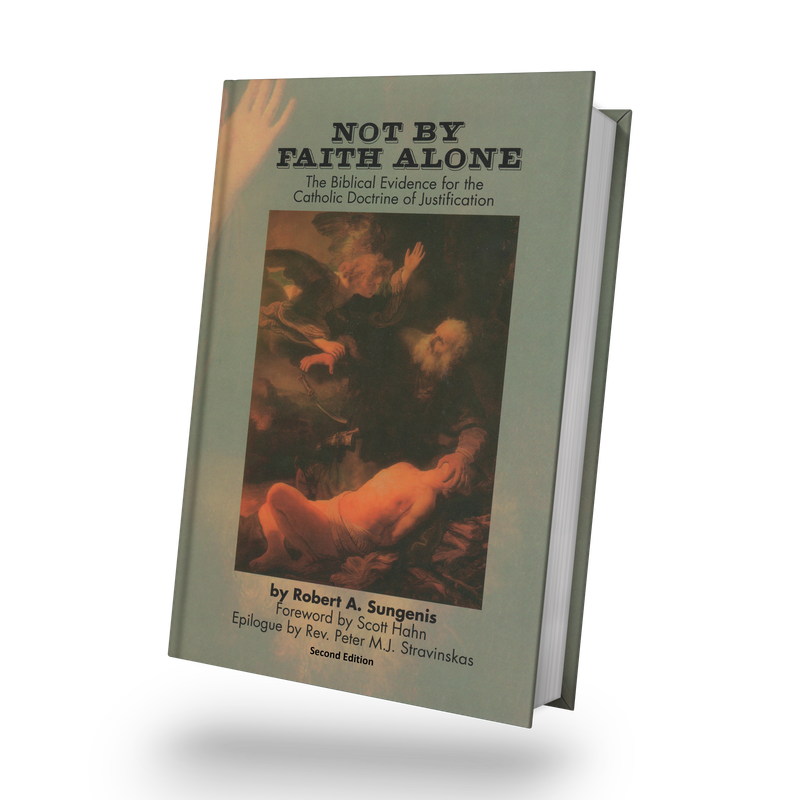
Go deeper: Not By Faith Alone
The full written case for the Catholic doctrine of justification, verse by verse, 2nd edition (2019).
Get the bookQuestions readers have asked on salvation, grace, and justification