Live debate
Predestination or Free Will?
Robert Sungenis vs. James White
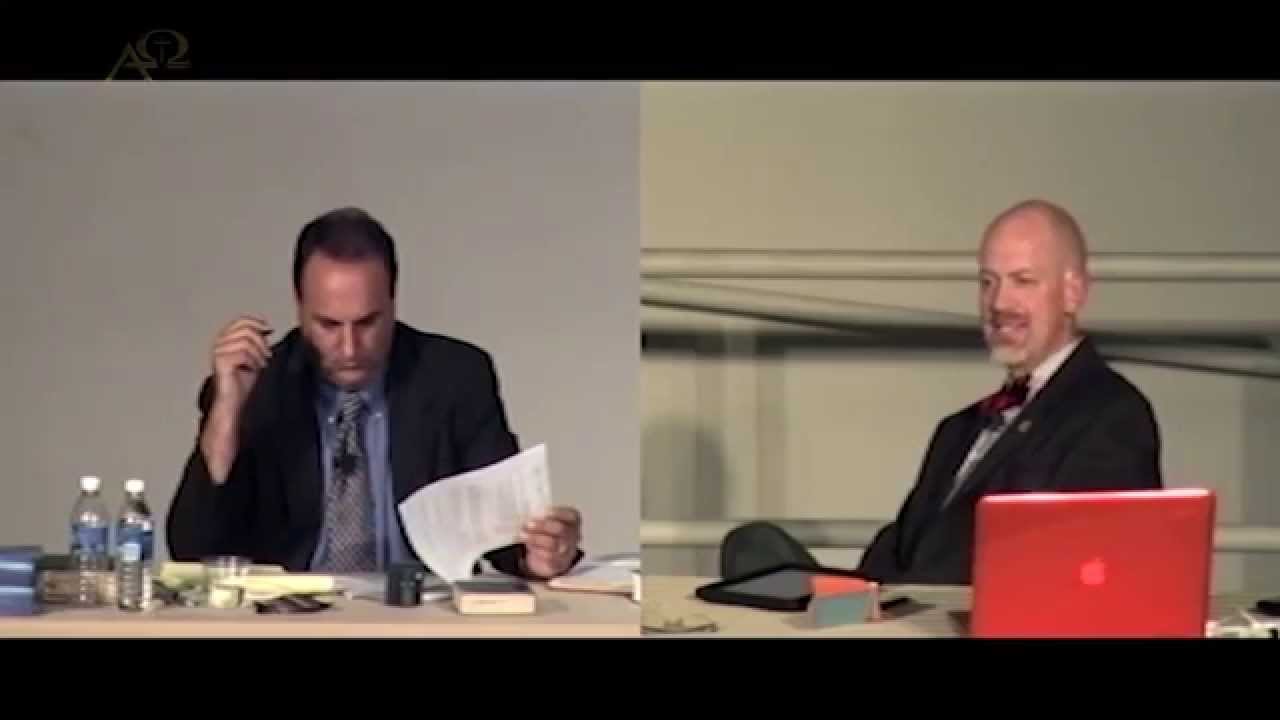
What was argued
White argued that fallen man's will is enslaved to sin and unable to submit to God, so salvation is monergistic: the Father gives a specific elect people to the Son, draws them infallibly, and grants them faith and repentance as gifts, all by the good pleasure of His will. Sungenis argued that Scripture teaches both predestination and a free will to accept or reject God, pointing to 1 Timothy 2:4, the warnings addressed to the elect, and the Council of Orange and the Catechism, which say God's plan includes each person's free response to His grace. Both men affirmed predestination, agreed that no one can come to God without His grace, rejected an autonomous free will, and agreed that God's decree includes the decisions of men.
How it ran
- 2:10Host states the resolution
- 3:26White's opening statement
- 23:56Sungenis opening statement
- 43:09White's rebuttal
- 52:42Sungenis rebuttal
- 1:02:42White's second rebuttal
- 1:08:02Sungenis second rebuttal
- 1:13:18Cross-examination: White questions Sungenis
- 1:29:09Cross-examination: Sungenis questions White
- 1:44:35White's closing statement
- 1:54:35Sungenis closing statement
The key exchanges
James White's point first, then Robert's answer. The time jumps to that moment in the video.
- 38:30
1. All men in 1 Timothy 2
White argues that the context of 1 Timothy 2 defines all men as all kinds of men, since Paul goes on to name kings and those in authority, and Christ intercedes only for those for whom He made His sacrifice.
Robert answered that the Greek means all men without limitation, that Paul asks prayer for all men and calls Christ a ransom for all, and that inserting the word kinds edits the text to fit a prior theology.
“He edits it by injecting the word kinds to make it say God desires to save all kinds of men so that it fits with his preconceived theology.”
- 54:03
2. Warnings to believers
White argues that texts like he who endures to the end shall be saved are descriptive of God's people, whose endurance flows from a faith God gives, not prescriptions by which they secure their salvation.
Robert answered that reading every warning as a description turns Scripture's admonitions into bare statements of fact, and pointed to Romans 8:13, where Paul warns the same people White cited that living by the flesh means death.
“And so what Dr. White has essentially done is empty the scripture of all its warnings, all its admonitions, all its pleadings with men, not to fall.”
- 56:06
3. No autonomous free will
White argues that Romans 8 says the mind set on the flesh is not able to subject itself to God's law, so man cannot choose God until God frees him from slavery to sin.
Robert answered that no one who takes free will from Scripture believes it is autonomous: the will and the power to use it are gifts of God, which is what the Council of Orange taught against the semi-Pelagians. God's will is always accomplished, but it includes man's free will.
“No, we can't have the power of even free will unless God gives it to us as a gift and gives us the power to use that free will.”
- 58:08
4. Dead in sin
White argues that Ephesians 2 describes sinners as dead in their trespasses until God makes them alive, and that the neuter pronoun in 2:8 makes grace, salvation and faith all the gift of God.
Robert answered that slave and dead in sin are metaphors, and Ephesians 2:1 to 6 says the sinner is dead in sin without saying how he gets out or that he cannot use his will. He agreed faith is a gift, adding that free will is a gift as well.
“But where does it deny that man has a free will to work with God's grace?”
- 1:01:42
5. All the Father gives
White argues that in John 6:37 the Father's giving comes first and determines who comes to the Son, which could not be said if the human will were autonomous.
Robert answered that the verse does not say how the Father obtained those He gives. He illustrated with an offer of a trip to Europe: those who raise their hands could then be handed over to White, so the giving can follow a free response.
“Does it say how the Father obtained these people?”
- 1:08:02
6. The sinking ship
White argues that the sinking ship analogy is unbiblical because no sinner is calling out to be saved: all are rebels who hate God, so there is nothing unjust in God leaving some in their sin.
Robert answered that this was his point: no one on the ship asks to be saved, all are equally guilty, so on White's view God's choice to save some and pass over others has nothing to do with them and is arbitrary.
“Nobody was raising their hand saying, I want to be saved.”
- 1:16:32
7. Mercy on whom I will
White asks how Robert can object to God's freedom when Romans 9:15 says I will have mercy on whom I have mercy, and Paul concludes that it does not depend on the man who wills or runs.
Robert answered that Paul quotes Exodus 33:19, where Moses pleaded and fasted after the golden calf and God relented. God's mercy on Israel came through Moses, not through anything the Israelites willed or did, so it was not arbitrary.
“It was because Moses did what was necessary to appease the wrath of God.”
- 1:23:44
8. Jacob and Esau
White argues that Romans 9:10 to 13, where God chose before the twins were born or had done good or bad, shows that God's calling and choice, not man's will, is primary.
Robert answered that Paul is refuting Jews who sought righteousness by works, so he picks a case where working was impossible. The text says only that the older will serve the younger, which concerns the inheritance, not who goes to heaven or hell.
“It doesn't say anything about who's being chosen to heaven or hell here.”
- 1:41:07
9. Called but not enabled
White argues that it is not odd for God to command all men to repent while giving the ability only to His elect, since mercy to rebels who hate Him must be free and cannot be demanded.
Robert answered that White's description of God-haters fits everyone, since Scripture says none is righteous, so the question remains why God would give only some of these equally guilty people the ability to repent.
“And yet Scripture says that there is none righteous, no, not one.”
Robert's case in 5 points
- 1
Predestination is Catholic doctrine, confirmed at the Council of Orange in 529, which condemned the semi-Pelagians for saying free will is not prompted by God's grace.
25:09 - 2
The real question is whether man after Adam has a free will to accept or reject God that works with predestination, and if he does, every point of TULIP falls.
27:31 - 3
The Bible teaches both predestination and free will, and they work together even though we cannot understand how, just as we cannot fully understand God Himself.
28:47 - 4
Paragraph 600 of the Catechism says that when God establishes His eternal plan of predestination He includes in it each person's free response to His grace.
39:37 - 5
In 2 Timothy 2:10 to 13 Paul writes to the elect and still warns that if we deny Him He will deny us, so Scripture always joins election and free will rather than opposing them.
41:49
Closing
Robert answered White's final question by saying that God is glorified even when men refuse His call with the free will He gave them, since His glory does not depend on us, and he argued that the Reformed tradition has split into competing camps by building on one set of verses and shelving the other. He closed by saying the Church holds predestination and free will together as it holds the Trinity, telling us what we cannot say without claiming to explain it, and that White's question about grace being sufficient is one the Bible never asks.
1:54:35
Go deeper: Predestination and Free Will
Robert's talk on how God's predestination and man's free will fit together, one MP3.
Get the talkQuestions readers have asked on salvation, grace, and justification