Live debate
The Mass
Robert Sungenis vs. James White

What was argued
White argued that Scripture does not require belief in transubstantiation, that the Supper is a symbolic memorial proclaiming Christ's death, that the fathers and medieval practice show the doctrine was neither universal nor ancient as Trent claims, and above all that Hebrews presents one offering that perfects for all time those for whom it is made, which a repeated propitiatory Mass contradicts. Sungenis argued that the fathers from Ignatius to Augustine taught that the bread becomes Christ's flesh, that Hebrews describes a permanent priest who continually presents His sacrifice before the Father, and that the once for all atonement must be applied to present and future sins through repentance, which is what happens at the Mass. Both men agreed that Christ is a high priest who appears before the Father for His people, though they disagreed over whether that presentation is needed to apply the benefits of the cross.
How it ran
- 22:51Moderator states the topic; Sungenis opening statement
- 52:55White's opening statement
- 1:24:07Sungenis rebuttal
- 1:36:01White's rebuttal
- 1:48:09White cross-examines Sungenis
- 2:02:35Sungenis cross-examines White
- 2:16:56White cross-examines Sungenis (second round)
- 2:30:14Sungenis cross-examines White (second round)
- 2:45:22Sungenis closing statement
- 2:52:29White's closing statement
- 2:59:45Audience questions
The key exchanges
James White's point first, then Robert's answer. The time jumps to that moment in the video.
- 1:25:50
1. Saving to the uttermost
White argues that Hebrews 7:24 to 25 presents Jesus as a perfect Savior who is able to save to the uttermost those who draw near to God through Him.
Robert answered that the same verse says He always lives to make intercession, and that intercession would be pointless if believers were saved automatically, which is why half of Hebrews warns Christians against falling away.
“if we were saved completely and automatically with no problem there would be no need for intercession”
- 1:27:04
2. Repeated sacrifices remind of sin
White argues that under the old covenant the repetition of sacrifices proved their imperfection and served as a reminder of sins, so a sacrifice offered again and again cannot be the one that perfects.
Robert answered that the old sacrifices were a reminder because they could not completely forgive past sins, while Christ's sacrifice forgives them so fully that God remembers them no more. The open question, he said, is the sins a believer has yet to commit.
“we're talking about my present and future sins and that's the argument of the book of Hebrews”
- 1:30:39
3. The shift in John 6
White argues that the hunger and thirst of John 6:35 are plainly spiritual, so the eating of Christ's flesh later in the same discourse should be read the same way.
Robert answered that the discourse begins symbolically but shifts at verses 49 to 51, where Jesus first uses the words eat, flesh and blood, and then four times uses a Greek verb for eating that Scripture only uses physically, which is why His hearers objected.
“now why if Jesus is just remaining with a symbolic context is he using a word that is only interpreted in scripture as physical”
- 1:32:53
4. Why defined so late
White argues that the medieval controversies over the Eucharist and the late appearance of the word transubstantiation show it was never the constant faith of the church, as Trent claims.
Robert answered that the church defines a doctrine when someone first challenges it, as it did with the Trinity against the Arians. The Greek fathers already spoke of a change of substance, and Berengarius, the first to cast doubt, later recanted.
“that's why doctrines always come in the Catholic church that's why they're dogmatized because someone raises an objection”
- 2:01:41
5. The verb for eating
White asks for a lexical source showing that the meaning of the verb for eating in John 6 rules out any figurative use.
Robert answered that the standard Greek lexicons he checked give no instance of the word being used figuratively, and he asked White to produce any lexical or biblical source where it carries a symbolic meaning.
“they never give an instance of that word being used figuratively”
- 2:06:11
6. Did Augustine adore the Eucharist
White argues that leading scholars place Augustine among the fathers with a symbolic or spiritual view, and that the adoration and procession of the host appear only in the second millennium.
Robert answered by reading Augustine on the Psalms, that no one eats Christ's flesh unless he first adores it and that we sin by not adoring it. He added that Augustine's spiritual applications were meant to prepare hearts, not to deny the real presence.
“but the point in fact is that Augustine adored the Eucharist just like those of the second Millennium did”
- 2:23:10
7. A limited propitiation
White argues that, since Catholic theology says the fruits of the Mass depend on the recipient's disposition, a person can attend Mass thousands of times and still die impure, so the Mass cannot be the sacrifice that perfects for all time.
Robert answered that any limit comes from the person's dispositions and not from God, who gives as much as people want, and that a Protestant who believes in free will faces the same possibility of falling away.
“it's not limited in the sense that God is limiting it God gives as much as the people want”
- 2:41:03
8. White's own words on intercession
White argues that Christ's intercession is not a separate work but the presence of His finished work before the Father, and that Hebrews 8:1 to 2 shows Him seated, with minister used as a noun rather than describing further action.
Robert answered that White's own book says Christ presents His finished work to the Father to assure the application of its benefits, and that a presentation needed for that purpose is exactly what White elsewhere says a complete sacrifice would not require.
“if the sacrifice of Christ on the cross was perfect and complete and once and for all there would be no need to continually present it to the father”
- 3:26:05
9. Who the warnings address
White argues that the warnings in Hebrews are given to a congregation whose hearts the preacher cannot see, so they do not assume every hearer possesses saving faith.
Robert answered that Hebrews 10 describes its readers as people who had received the light, endured public persecution and accepted the loss of their property, seasoned Christians who are nonetheless warned they can fall.
“and these are the kind of people that Paul is talking about that they may fall from the faith”
Robert's case in 5 points
- 1
The fathers, from Ignatius, Justin and Irenaeus to Ambrose, Chrysostom and Augustine, teach that after consecration the bread becomes the flesh of Christ and that the church offers an unbloody sacrifice.
24:26 - 2
Hebrews 2:17 uses a present infinitive for making propitiation, so if Christ's high priestly office is not over, His propitiation before the Father is not over either.
32:26 - 3
Hebrews 9:23 speaks of better sacrifices, in the plural, by which Christ now appears for us in God's presence, and that continual presentation of His sacrifice to the Father is the essence of the Mass.
35:44 - 4
The once for all sacrifice forgives confessed past sins completely, but there is no guarantee future sins will be repented of, so the atonement of the cross must be continually applied, which is what occurs at the Mass.
48:15 - 5
From Abel, Job and Noah onward, before the Levitical law, men offered sacrifice because God is a personal being offended by sin and appeased by sacrifice, and since we still sin, that offering continues in heaven.
51:47
Closing
Robert closed by arguing that, whatever ambiguity appears in Augustine, the consensus of over a hundred fathers is that the Eucharist is the body and blood of Christ, and that a God who parted the Red Sea can change bread into His body. He challenged anyone to show one Catholic dogma that has changed and insisted that the warnings of Hebrews about falling away are real.
2:45:22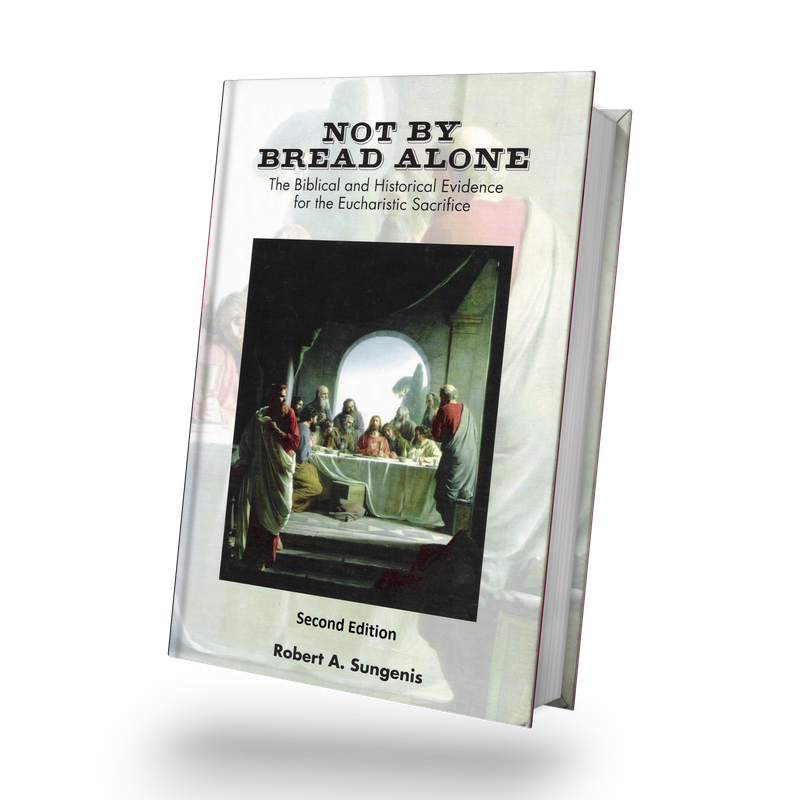
Go deeper: Not By Bread Alone
The biblical and historical evidence for the Eucharistic sacrifice, 2nd edition (2019).
Get the book