Live debate
Salvation by Faith Alone?
Robert Sungenis vs. Bob Wilkin
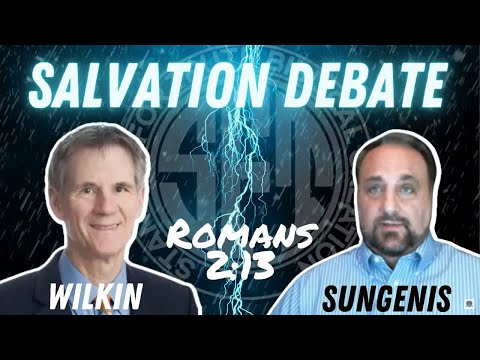
What was argued
Wilkin argued that Romans 2:13 is Paul speaking hypothetically, since no one actually keeps the law, and that more than a hundred verses give everlasting life as a free gift to whoever believes in Jesus. Sungenis argued that Romans 2:13 means what it says, that James 2:24 uses the same Greek word for justified, and that God accepts a believer's obedience because He is gracious, not because the obedience earns a wage. Much of the exchange turned on one question: was Abraham's justification in James 2 before God, or before other people?
How it ran
The key exchanges
Bob Wilkin's point first, then Robert's answer. The time jumps to that moment in the video.
- 17:12
1. Is Romans 2:13 hypothetical
Wilkin argues that Romans 2:13 is Paul speaking hypothetically, since verse 12 has already placed everyone under sin and Romans 3 and Galatians 2 say no one is justified by works of the law.
Robert answered that James 2:24 says the same thing Romans 2:13 says, and that Luther wanted James out of the Bible while others declare Romans 2 hypothetical. Both moves, he argued, avoid the text instead of reading it.
“James chapter 2 verse 24 speaks about Abraham being justified by works, just as Romans 2:13 says that the doers of the law will be justified.”
- 23:10
2. Certain of heaven tonight
Wilkin asks whether Robert is certain he would be in the presence of the Lord if he died tonight.
Robert answered that the question assumes what is being debated. He said he is in a state of grace now and as certain as a finite man can be, but no one knows whether he will keep faith until death.
“The question assumes that you know that if you die tonight you would go to heaven”
- 27:50
3. Two justifications of Abraham
Wilkin argues that Abraham was justified before God at Genesis 15:6 and vindicated before other people twenty five years later when he offered Isaac.
Robert answered that James quotes Genesis 15:6 but is describing Genesis 22, which means Abraham had at least two justifications, not one justification and one vindication. That is why James concludes that a man is justified by works and not by faith alone.
“Abraham had at least two justifications, one in Genesis 15:6 from where he quotes, and the second in Genesis 22 when he sacrificed Isaac.”
- 32:48
4. Righteousness at baptism
Wilkin asks how a newly baptized adult can be counted righteous when he does not yet have any actual righteousness of his own.
Robert answered that baptism is regeneration, not a symbol: the soul that was dead is made alive, so the righteousness is real rather than a covering God looks at instead of the person.
“We believe that in baptism, as the fathers of the church all believed in consensus, it's baptismal regeneration”
- 38:22
5. Vindicated or justified
Wilkin argues that the verb in James 2:24 means declared righteous, and that when the declaration is made by people rather than by God it is best translated vindicated.
Robert pressed Bob to read the whole verse with his own word in it, a man is vindicated by works and not by faith alone, and to explain what that sentence would mean. He argued the switch is made because the plain word justified does not fit the theology.
“He's not justified before men, and that's why you have to switch to the word vindicated.”
- 59:20
6. Acts 16:31 and baptism
Wilkin argues that when the jailer asked what he must do to be saved, Paul answered believe on the Lord Jesus Christ and said nothing about baptism.
Robert answered that Paul then baptized him that same night, at some risk to a man responsible for prisoners, so believing led straight to baptism. He added that Trent itself calls faith the beginning of salvation.
“So, Bob, it looks like Acts 16 is requiring more than you're requiring, because it's requiring baptism.”
- 1:30:26
7. Who witnessed Abraham
Wilkin argues that the audience for Abraham's vindication is everyone who has since read the account, Jews, Christians and Muslims alike.
Robert answered that by that standard Genesis 15:6 is equally public, so the distinction collapses. At the mountain and at the starry sky it was God alone who was present and God alone who accepted the act.
“None of these justifications of Abraham are before men.”
- 1:40:13
8. Judgment or rewards
Wilkin argues that Colossians 1:21 to 23 and the judgment seat of Christ concern a believer's rewards and standing, not whether he enters the kingdom.
Robert answered that the New Testament never sorts the judgment texts that way. He pointed to 1 Corinthians 3:13 to 17 and 2 Corinthians 5:10, where a man is judged for good and bad deeds and can be lost.
“We stand before the judgment seat of Christ to be judged for our good and bad deeds”
- 2:09:12
9. Falling away and staying saved
Wilkin argues that a person who is born again keeps everlasting life even if he later abandons the faith and never repents, because the one who has believed remains a believer.
Robert answered that he was genuinely startled, and that this position would be formal heresy in the Catholic Church. He asked how the promise can hold for someone who stops believing and never repents of the fall.
“This will be formal heresy in the Catholic Church, to say that someone can fall and still be saved.”
Robert's case in 4 points
- 1
Being judged by works is not a stray idea: Paul says the same in 2 Corinthians 5:10 and Romans 14:10, and Revelation 22 repeats it, so Romans 2:13 fits the rest of the New Testament.
19:48 - 2
Paul is answering Jews who thought God owed them salvation as descendants of Abraham, so what he condemns is trying to put God in debt, not obedience itself.
22:03 - 3
Justification is real rather than a legal fiction: God renews the soul, so when He calls a man righteous the man truly is righteous.
33:59 - 4
God accepts works on His terms, after faith establishes the relationship, and whatever He gives back comes as a reward of grace rather than a wage He owes.
1:16:16
Closing
Robert closed by asking where in Romans 3 or 4 Paul ever says that Romans 2:13 was hypothetical, noting that Romans 2:5 to 8 promises eternal life to those who persist in doing good and reads nothing like a hypothesis. He said gracious merit and a free gift are the same thing, since God rewards out of His benevolence and not because He owes anyone.
2:19:01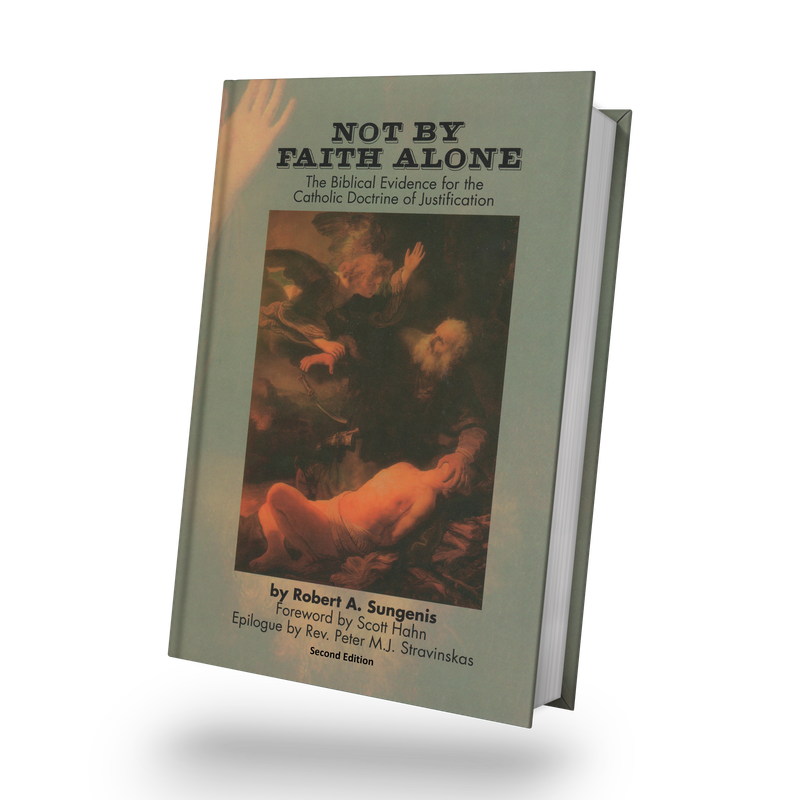
Go deeper: Not By Faith Alone
The full written case for the Catholic doctrine of justification, verse by verse, 2nd edition (2019).
Get the bookQuestions readers have asked on salvation, grace, and justification