Page 131 and paragraphs 121, 839, 674
The Catechism and the Mosaic Covenant
A sentence on page 131, a bishops' vote of 231 to 14, and three paragraphs of the Catechism itself.
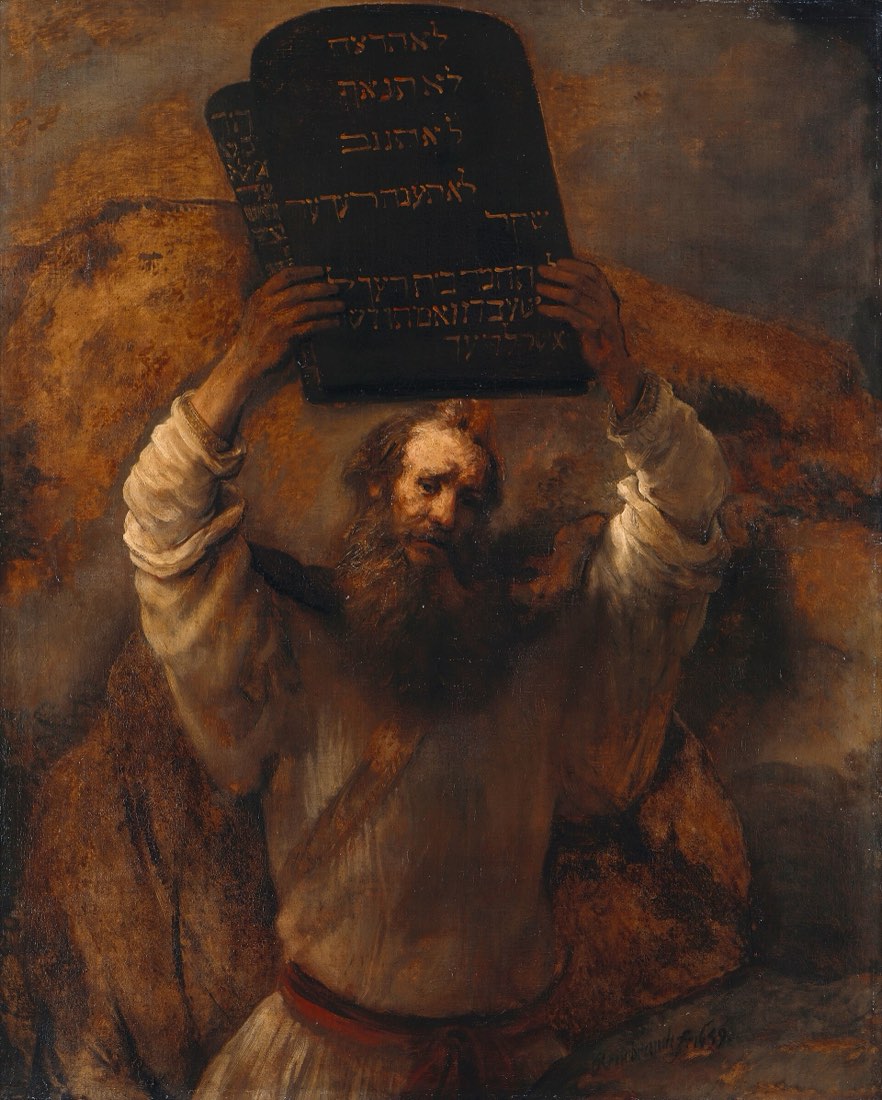
Painting: Rembrandt, Moses with the Ten Commandments, 1659, Gemäldegalerie, Berlin. Public domain.
The United States Catholic Catechism for Adults is the bishops' own introduction to the faith, approved by them in November 2004 and published by the USCCB in July 2006. On page 131, in a paragraph on the Church and the Jewish people, it said that "the covenant that God made with the Jewish people through Moses remains eternally valid for them."
Dr. Robert Sungenis read that sentence as a claim that the Mosaic covenant stands forever beside the New Covenant, and wrote to the bishops' conference and to the Congregation for the Doctrine of the Faith. Two years later the bishops voted to replace it. Below, the text, the vote and the Vatican's confirmation come from the bishops' own documents, and Dr. Sungenis describes his part in his own words.
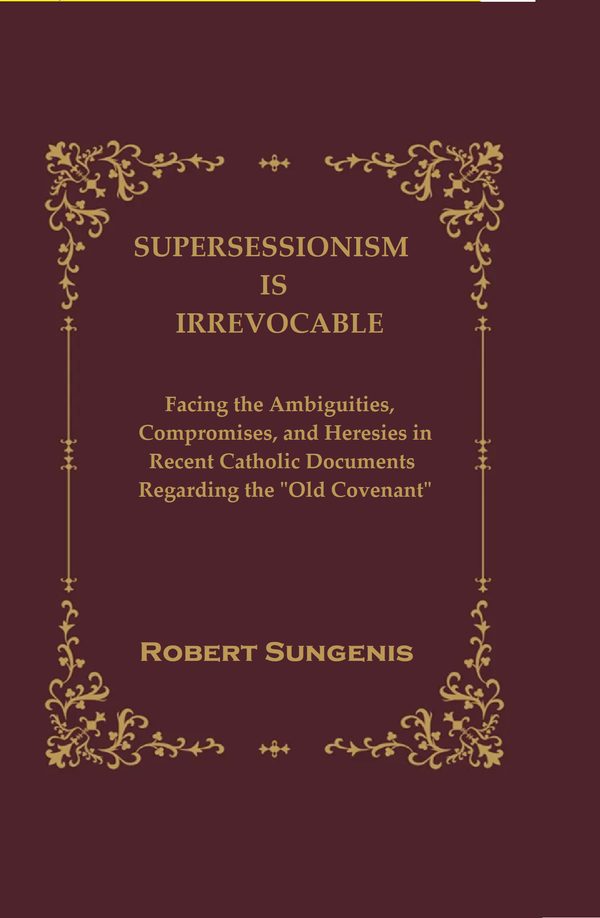 Dr. Sungenis tells the whole story, with the documents, inSupersessionism is Irrevocable (2024)
The passage, before and after
The paragraph on pages 130 and 131, with the 2006 text struck out and the text the Vatican approved in 2009 set in its place.
The Catholic Church also acknowledges her special relationship to the Jewish people. The Second Vatican Council declared that "this people remains most dear to God, for God does not repent of the gifts he makes nor of the calls he issues." (LG, no. 16). When God called Abraham out of Ur, he promised to make of him a "great nation." Removed in 2008: This began the history of God revealing his divine plan of salvation to a chosen people with whom he made enduring covenants. Thus the covenant that God made with the Jewish people through Moses remains eternally valid for them.
At the same time, "remembering, then, her common heritage with the Jews, and moved not by any political consideration, but solely by the religious motivation of Christian charity, she [the Church] deplores all hatred, persecutions, and displays of anti-Semitism leveled at any time or from any source against the Jews." (Second Vatican Council, Declaration on the Relation of the Church to Non-Christian Religions [Nostra Aetate; NA], no. 4)
246 ballots
- For the new text
- 231bishops voted to replace the sentence
- Against
- 14voted to keep it
- Abstained
- 1abstained
Mail ballot of all members, result announced August 5, 2008. The change needed two-thirds of the whole conference, which the June meeting in Orlando had not reached.
From page 131 to the recognitio
11 steps from 2004 to 2019. Each step carries a label: the documentary record, or Dr. Sungenis's own account.
November 2004The record
The bishops approve the adult catechism
The USCCB adopts the United States Catholic Catechism for Adults, and the Vatican later approves it.
It was the first official catechism produced by the American bishops since the Baltimore Catechism, first published in 1885 and revised in 1941.
July 31, 2006The record
Published, with the sentence on page 131
The 664-page catechism goes on sale and sells more than 25,000 copies in its first two weeks.
In a paragraph on the Church's relationship with the Jewish people, the text moves from God's call of Abraham to "enduring covenants," and then to the sentence at issue.
“Thus the covenant that God made with the Jewish people through Moses remains eternally valid for them.”
“Thus the covenant that God made with the Jewish people through Moses remains eternally valid for them.”
December 12, 2006Dr. Sungenis's account
Dr. Sungenis writes to Washington and to Rome
He raises the sentence with the USCCB's general secretary and, when referred to the Holy See, with the Congregation for the Doctrine of the Faith.
He has described these letters as a layman's duty under Canon 212 of the Code of Canon Law, which gives the faithful "the right and even at times the duty to manifest to the sacred pastors their opinion on matters which pertain to the good of the Church."
“In late 2006, I brought this error to the attention of both the USCCB and the Vatican. Monsignor David Malloy, the general secretary of the USCCB in 2006, excused the matter because, as he put it, the catechism was submitted to the Holy See for review and recognition.”
“In late 2006, I brought this error to the attention of both the USCCB and the Vatican. Monsignor David Malloy, the general secretary of the USCCB in 2006, excused the matter because, as he put it, the catechism was submitted to the Holy See for review and recognition.”
After his letter (undated)Dr. Sungenis's account
The CDF acknowledges his letter
By his account, Archbishop Angelo Amato, secretary of the Congregation, replied for Cardinal William Levada.
“My letter to the Vatican was received by Archbishop Angelo Amato who was the secretary to Cardinal Levada at the CDF. In a return letter, the Archbishop said, "Cardinal Levada received my letter and that the Holy See would deal with the matter as appropriate."”
“My letter to the Vatican was received by Archbishop Angelo Amato who was the secretary to Cardinal Levada at the CDF. In a return letter, the Archbishop said, "Cardinal Levada received my letter and that the Holy See would deal with the matter as appropriate."”
January 2007Dr. Sungenis's account
Msgr. Malloy replies
The USCCB's general secretary answers his December 12 letter by pointing to the Vatican's approval of the catechism as a whole.
Dr. Sungenis prints the letter in full in his 2024 book, and reads it as declining to take the matter further.
“To help insure that the United States Catholic Catechism for Adults assists the Bishops in that task, and in conformity with the prescriptions of the Code of Canon Law, after the text’s completion and approval by the bishops in their General Meeting, it was submitted to the Holy See for review and recognition. I am pleased that the Holy See has granted that recognition, as noted in each edition of the Catechism.”
“To help insure that the United States Catholic Catechism for Adults assists the Bishops in that task, and in conformity with the prescriptions of the Code of Canon Law, after the text’s completion and approval by the bishops in their General Meeting, it was submitted to the Holy See for review and recognition. I am pleased that the Holy See has granted that recognition, as noted in each edition of the Catechism.”
June 26, 2007Dr. Sungenis's account
A meeting at the Harrisburg chancery
By his account, he met his diocese's vicar general, Fr. William King, with Fr. James Massa of the USCCB present.
“I met with Fr. King at the chancery on June 26, 2007, at which time Fr. King told me, “I speak for the bishop,” and said directly to me, “We no longer believe in supersessionism.””
“I met with Fr. King at the chancery on June 26, 2007, at which time Fr. King told me, “I speak for the bishop,” and said directly to me, “We no longer believe in supersessionism.””
June 2008The record
Executive session in Orlando
The bishops discuss the change at their June meeting, but it falls short of the two-thirds of all members it needs.
The conference then puts the question to every bishop by mail ballot.
July 15, 2008Dr. Sungenis's account
The diocese writes to its clergy
Three weeks before the vote was announced, the diocese of Harrisburg's vicar general emails its priests and deacons about Dr. Sungenis.
Dr. Sungenis reproduces the email in his book, including its criticism of him.
“His personal opinions regarding the Jewish people and covenant, including conspiracy theories as well as supercession [sic] of the Old Testament Covenant, stand apart from (and in discord with) authentic Catholic teaching on these subjects.”
“His personal opinions regarding the Jewish people and covenant, including conspiracy theories as well as supercession [sic] of the Old Testament Covenant, stand apart from (and in discord with) authentic Catholic teaching on these subjects.”
August 5, 2008The record
The vote: 231 to 14
Monsignor Malloy announces the final result in a letter to the bishops: 231 in favor of the change, 14 against, one abstention.
The talking points sent with the letter said the revision "is not a change in the church's teaching," and that "the prior version of the text might be understood to imply that one of the former covenants imparts salvation without the mediation of Christ."
Father James Massa of the USCCB's ecumenical office told Catholic News Service the old wording "was not flat-out wrong" but "was ambiguous and needed to be qualified."
“It was an overwhelming consensus of our Bishops... which made me very proud of our Catholic Bishops at that time.”
“It was an overwhelming consensus of our Bishops... which made me very proud of our Catholic Bishops at that time.”
August 27, 2009The record
The Vatican grants its recognitio
The USCCB announces that the Holy See has approved the new text, and that the catechism is going into a second printing.
Catholic News Service reported that the approval came from the Congregation for Clergy. The new sentence quotes St. Paul in Romans 9:4-5, which the bishops noted "echoes what the Catholic faithful hear during the celebration of the Good Friday liturgy."
Dr. Sungenis's 2024 book also names the Congregation for Clergy. On his live shows he has credited Cardinal Levada, to whom he had written at the CDF.
“The clarification reflects the teaching of the Church that all previous covenants that God made with the Jewish people are fulfilled in Jesus Christ through the new covenant established through his sacrificial death on the cross.”
“The clarification reflects the teaching of the Church that all previous covenants that God made with the Jewish people are fulfilled in Jesus Christ through the new covenant established through his sacrificial death on the cross.”
2019Dr. Sungenis's account
The revised edition
The revised edition finally prints the Romans 9:4-5 text on page 131, ten years after the recognitio.
In 2008 USCCB Publishing expected the current printing of 50,000 copies to run out around the middle of 2009, and the new text was to go into the next printing. Dr. Sungenis documents in his book that the revised edition did not appear until November 2019, approved on September 13, 2019.
He also points out that the revised edition's copyright page mentions only one change, the death penalty revision of paragraph 2267, and says nothing about page 131.
“The next edition of the United States Catholic Catechism for Adults was published 11 years later, in 2019, and if you go read page 131, you won't see that sentence there.”
“The next edition of the United States Catholic Catechism for Adults was published 11 years later, in 2019, and if you go read page 131, you won't see that sentence there.”
Two readings of one change
The bishops call it a clarification of settled teaching. Dr. Sungenis calls it the removal of an error.
Dr. Sungenis
An error that had to come out
“The authors of the Catechism were attempting to make the Mosaic covenant an eternal covenant alongside of the New Covenant in Christ, which is an eternal covenant.”
Commentary, vol. 4
“It claims the Mosaic covenant is eternal in the face of the fact that scripture, tradition, and the magisterium say the Mosaic covenant was revoked and superseded by the new covenant in Christ.”
“That is our job as lay people, according to Canon 212 of the Code of Canon Law: we have the right and duty to bring to our pastors things of concern.”
The bishops
A clarification, not a change
“By making the change in the USCCA, there is not a change in the Church's teaching.”
“The prior version of the text might be understood to imply that one of the former covenants imparts salvation without the mediation of Christ, whom Christians believe to be the universal savior of all people.”
“Catholics believe that the Jewish people continue to live within the truth of the covenant made through Abraham, and that God continues to be faithful to them.”
The replacement verse
The bishops chose Romans 9:4-5 for the new text and said it "echoes what the Catholic faithful hear during the celebration of the Good Friday liturgy." Dr. Sungenis welcomed the removal of the old sentence, then looked hard at what replaced it, in an article written while the change still awaited Rome's approval.
Quoted from Dr. Sungenis, "The Old Covenant is Revoked: USCCB Removes Heretical Sentence From Its Catechism" (2008), and the bishops' 2009 backgrounder.
1His suspicion, and his caution
He asks why this verse, of all verses, was chosen, and he is careful to put the answer as a condition rather than a charge.
“Being a lover of Scripture, I usually don't have a problem replacing an erroneous theological statement with a sentence from Holy Writ. Who could object to that? Unfortunately, however, the matter is not so simple in this case.”
“My suspicion is that the unidentified author of the USCCB catechism chose Romans 9:4-5 because, if an uneducated Catholic gives it a cursory reading from certain English translations, he may be unduly influenced to believe that the Jews still have possession of all the items listed in the verse, including the Mosaic covenant.”
“I am not accusing the catechism's author or editor of this motive; rather, I am only saying that IF this is their motive, then they are being unethical and doing a great disservice to the Catholic community in an apparent attempt to save face for themselves and continue their agenda.”
2Why not the New American Bible?
The catechism's wording follows the Revised Standard Version, the translation the 1994 Catechism of the Catholic Church quotes at paragraph 839. He points instead to the translation he calls the Church's ex officio Bible in America.
“I find it rather suspicious that the authors chose not to use what has become the ex officio translation of the Catholic Church in America, the New American Bible (NAB). Perhaps the reason for bypassing the NAB is that it does not contain the word "belong" in Romans 9:4, the very word that implies the Jews still possess all the items listed in the verse, including the Mosaic covenant.”
Revised Standard Version
Protestant, present
“They are Israelites, and to them belong the sonship, the glory”
New American Bible
Catholic, no tense
“They are Israelites; theirs the adoption, the glory,”
New Jerusalem Bible
Catholic, past
“They are Israelites; it was they who were adopted as children, the glory was theirs”
The 2009 catechism text
follows the present tense
To the Jewish people, whom God first chose to hear his Word, "belong the sonship, the glory, the covenants, the giving of the law, the worship and the promises"
Translations as Dr. Sungenis quotes them in the article, from his survey of Catholic and Protestant Bibles.
3No verb in the Greek
The tense of the English, he argues, is the translator's choice, because Paul supplied none. He also notes the change of subject, from "Israelites" to "the Jewish people."
“The problem for English translators is that neither the phrase in question nor the rest of the relative clause contains a verb. In other words, the verse does not say "They are Israelites; of whom belong the adoption...the glory...the covenants" but literally "They are Israelites, of whom the adoption...the glory...the covenants."”
“In actuality, the only verb of the sentence appears in the main clause ("Who are Israelites"), the object of which the new edition of the USCCB will now refer to as "The Jewish people" instead of "Israelites," which is perhaps an attempt to further distance the Jews from the past and make them closer to the present, for the "Israelites" under Moses were not called "Jews."”
4Eight marks, no verb
He reads the list as identity rather than time: seven marks of what made one an Israelite, and Christ as the eighth. Paul gives the last item no verb either, and that, he argues, settles how to read the first seven.
1
Sonship
Ex 4:22-23; 19:5; Hs 11:1
2
Glory
Ex 40:34; Lv 16:2
3
Covenants
Gn 17-31; Ex 6
4
Law
Ex 20; Dt 5, 28
5
Worship
Ex 23-34; Lv 1-27
6
Promises
Gn 12-26; Is 53; Ez 36-37
7
Fathers
Gn 12-28
8
Christ, according to the flesh
Rm 9:5
“Paul's intention is not to emphasize time but identity or origination.”
“All in all, the Greek grammar requires this simple logic: if the Jews do not possess Christ, then neither do they possess the seven other items, including the Mosaic covenant.”
5What he asked for
He ended the argument with two possibilities, and a request.
“If the catechism has innocently made a concerted effort to rectify its previous error and is not implying (by its quoting Romans 9:4-5) that today's Jews still have possession of the Mosaic covenant and all its trappings, then I heartily applaud them for their efforts.”
“A footnote stating that the quoting of Romans 9:4-5 is not for the purpose of saying that the Jews presently possess the Mosaic law should be added.”
6The talking points
He read the bishops' talking points closely, as confirming his reading of the old text and, possibly, narrowing the correction.
“The "talking points" may be trying to cover over the catechism's error by suggesting that the only reason its previous version should be corrected is not because it implied that the Mosaic covenant could impart salvation to today's Jews, but it said so without including "the mediation of Christ."”
7Sixteen years later, in the book
In Supersessionism is Irrevocable he returned to the question of motive, again marking the limits of what he can show.
“On the other hand, one cannot help but wonder whether the USCCB had an ulterior motive since its appeal to Romans 9:4-5 could be understood as a retaliatory measure against those who demanded the removal of, “Thus the covenant that God made with the Jewish people through Moses remains eternally valid for them,” from the 2006 US Adult catechism.”
“Although this is admittedly anecdotal, I am privy to this ulterior motive from the conversations I’ve had with the parties involved. But I also know from the public comments these parties have made about being forced by their own bishops to correct the US Adult catechism. Unfortunately, since I have to protect the sources, I can go no further.”
“In effect, an egregious theological error (i.e., that the Jewish people still retain an exclusive covenant with God via Moses) was turned into a mere “ambiguity,” yet what, precisely, was “ambiguous” in the previous wording... was never stated by Fr. Massa.”
Supersessionism is Irrevocable (2024), pp. 73-77
Years later, the same view
“They're tricky, because what they did is they replaced it with a verse of Scripture... that unfortunately is a little ambiguous... for the English reader, and it's Romans 9:4 to 5.”
Dr. Robert Sungenis, Zero-Point Energy, Why I Became Catholic & The Vatican's Zionism Problem
“When the English reader sees the word "belongs," he said, "That's a present tense verb. That means the Israelites still have it, all these things from the Old Testament," and that's the impression that the USCCB wants them to have.”
Dr. Robert Sungenis, Zero-Point Energy, Why I Became Catholic & The Vatican's Zionism Problem
“Okay, Sungenis, you want to take out this thing about the Mosaic Covenant being Eternal, okay, we got a doozy to replace it: Romans 9 4.”
Dr. Robert Sungenis, voicing the bishops, Robert Sungenis Live #186, September 27, 2023
I was just vilified everywhere that I would dare do something like this.
The universal Catechism
Three more passages in the Catechism
Page 131 came from the American bishops. The three passages below come from the Catechism of the Catholic Church itself, and Dr. Sungenis has written about each one. You get each paragraph in full from the Vatican's English text, then his critique in his own words.
- ¶ 121The Old Covenant "has never been revoked"The clause, its editor, and the Glossary that defined it.
- ¶ 839 to 840"God's People of the Old Covenant"Romans 9:4-5 and 11:29 joined, and a Messiah still awaited.
- ¶ 674"Until his recognition by all Israel"A future conversion of the Jews, and the verse it rests on.
Catechism of the Catholic Church, paragraph 121
The Old Covenant "has never been revoked"
Paragraph 121 is one sentence, and its last clause cites no source. Dr. Sungenis traces the clause to a papal speech and to the editor who put it there, then sets it beside the one definition of its key term, in a glossary of 2000.
121The Old Testament is an indispensable part of Sacred Scripture. Its books are divinely inspired and retain a permanent value, for the Old Covenant has never been revoked.
1Where the clause comes from
The footnote before the clause points to Vatican II's Dei Verbum 14, which says the Old Testament has "permanent value" because it is inspired. The clause itself has no footnote. Dr. Sungenis finds its likely source in John Paul II's address to the Jewish community at Mainz on November 17, 1980, and notes what the same pope wrote seven years later.
“...the Catechism does not offer us a footnote as to its ultimate authority for making this statement, but it is highly likely that it is quoting verbatim from John Paul II’s 1980 Mainz speech.”
“...nowhere in his twenty-six years as pontiff did John Paul II ever teach that the Jews still have legal possession by divine mandate of the Sinai (Mosaic) covenant or that it has never been revoked.”
“...the period marked by the promise made to Abraham and by the Law mediated by Moses has now reached its climax, in the sense that Christ fulfills the divine promise and supersedes the old law.”
2The editor: Cardinal Christoph Schönborn
Dr. Sungenis holds the Catechism's editor responsible for the clause. The facts of the Cardinal's life below come from his sources; the timeline marks where the public record adds a date or names his role differently.
- 1945
Dr. Sungenis's sources: Born at the end of the Second World War; as an infant, his parents fled with him from Czechoslovakia to Austria. He told a questioner in Jerusalem, "I am myself a refugee."
- 1980
Public record: John Paul II, at Mainz, speaks of "the people of God of the Old Covenant, never revoked by God." Dr. Sungenis treats this as the clause's source.
Quoted in the Vatican's 2015 document The Gifts and the Calling of God are Irrevocable, n. 39, as printed in Supersessionism is Irrevocable, p. 15
- 1987
Dr. Sungenis's sources: Fr. Christoph Schönborn, a Dominican (OP), is appointed to prepare the new Catechism. Dr. Sungenis calls him its "chief editor"; on his live shows, its "chairman."
- 1992
Dr. Sungenis's sources: The Catechism appears in French, with "for the Old Covenant has never been revoked" in paragraph 121.
Supersessionism is Irrevocable, p. 18
- 1994
Dr. Sungenis's sources: The first English edition, translated from the French, keeps the clause.
Supersessionism is Irrevocable, pp. 18, 24
- 1995
Public record: Named Archbishop of Vienna on September 14.
Public record. His sources call him archbishop of Vienna without giving the year.
- 1997
Dr. Sungenis's sources: The official Latin edition, promulgated by John Paul II on August 15 in Laetamur Magnopere, keeps the clause. It has no glossary.
- 1998
Public record: Created a cardinal on February 21.
- 2000
Dr. Sungenis's sources: The second English edition adds the USCCB Glossary, which defines "Old Covenant" by the Law of Moses.
Supersessionism is Irrevocable, p. 24
- 2005
Dr. Sungenis's sources: At the Hebrew University of Jerusalem he says Christians should affirm Zionism as biblical, and that John Paul II had called the command for Jews to live in Israel an everlasting covenant.
The March 31, 2005 press reports printed in Supersessionism is Irrevocable, pp. 21-22
- 2017
Dr. Sungenis's sources: In May, with Rabbi Abraham Skorka, he gives his approbation to the Orthodox rabbinic statement "To Do the Will of Our Father in Heaven" (December 3, 2015), which speaks of "the eternal Covenant between G-d and the Jewish people."
Supersessionism is Irrevocable, pp. 19-20
- 2025
Public record: His resignation as Archbishop of Vienna is accepted on January 22, his 80th birthday. Dr. Sungenis, in 2026: he "has since retired and is now in his 80s."
“This chronology shows us that the first person responsible for including the ambiguous clause in ¶121 was Cardinal Christoph Schönborn, OP, presently archbishop of Vienna, Austria. Schönborn was appointed as chief editor of the Catechism of the Catholic Church in 1987.”
“Hence we can logically deduce that the ambiguous clause of ¶121 (“for the Old Covenant has never been revoked”) was understood by Cardinal Schönborn to designate a covenant that God had, still has, and will have forever, exclusively with the Jews and Israel, that was cast in stone long before Christians began to populate the earth after the resurrection of Christ.”
“Thus, given Schönborn’s commanding role in preparing the Catechism, together with his known and outspoken Zionist belief in an “eternal” covenant between God and Israel, we can reasonably conclude that the brunt of the responsibility for putting that dangerous clause in ¶121 of the Catechism rests on him.”
“Only once in human history did God take a country as an inheritance and give it to His chosen people”
“And there's no footnote there, no marginal note, no nothing to explain to the reader why he's reading the strange language that the old covenant has never been revoked...”
“...the problem is that if the old covenant hasn't been revoked, then we're still dead in our sins. And the gospel cannot save us. That's how serious this matter is.”
3The 2000 Glossary
The Catechism uses the words "Old Covenant" thirty-three times and never says what they mean. The first definition came eight years after the French original, in a Glossary the United States Catholic Conference copyrighted for the second English edition of 2000.
Catechism, paragraph 121 (1992 onward)
“…retain a permanent value, for the Old Covenant has never been revoked.”
No footnote on the clause. The term is not defined anywhere in the text.
USCCB Glossary, 2nd English edition (2000)
“OLD COVENANT: The old dispensation or order, which God established with his chosen people Israel, through the revelation of the Law of Moses”
Glossary and Index Analyticus copyright © 2000, United States Catholic Conference, Inc.
Read together, in the English edition
…for the old dispensation or order, which God established with his chosen people Israel, through the revelation of the Law of Moses has never been revoked.
“Also interesting is that although these pre-2000 editions of the Catechism do not have a Glossary, they use the term “Old Covenant” thirty-three times in their 800 pages of catechetical teaching but never once, by footnote or other means, define or explain exactly what the “Old Covenant” is, or whether, and if so, when, they are applying this term to one, some, or all the half-dozen covenants referred to in the Old Testament.”
“As such, it took eight years from the original French Catechism and three years from the official 1997 Latin Catechism for the English speaking world to be told by the USCCB that “Old Covenant” means “Mosaic law.””
“Hasn’t the Catholic Church held for its entire history that the Mosaic law has been revoked and superseded by the New Covenant in Christ? The answer, of course, is a resounding, ‘yes,’ and we will see it documented in the following pages.”
“Unfortunately, there the old covenant is defined as the Mosaic law, which then makes paragraph 121 a heresy.”
In the book he also sets a limit on the Glossary. An English appendix, he argues, cannot fix the meaning of a paragraph the whole Church reads in every language, and so it cannot be used to prove that paragraph 121 teaches a Mosaic covenant still in force.
“Thus, there can be no warrant for claiming, on the basis of this Glossary entry, that ¶121 is teaching that the Mosaic covenant is still in force and was never revoked and superseded by the New Covenant in Christ.”
Catechism of the Catholic Church, paragraphs 839 to 840
"God's People of the Old Covenant"
The two paragraphs say the Jewish faith responds to God's revelation, give the Jews the gifts of Romans 9:4-5, call those gifts irrevocable with Romans 11:29, and describe the Jewish people as awaiting a Messiah whose features remain hidden. Dr. Sungenis grants the first point and questions the rest.
839"Those who have not yet received the Gospel are related to the People of God in various ways."
The relationship of the Church with the Jewish People. When she delves into her own mystery, the Church, the People of God in the New Covenant, discovers her link with the Jewish People, "the first to hear the Word of God." The Jewish faith, unlike other non-Christian religions, is already a response to God's revelation in the Old Covenant. To the Jews "belong the sonship, the glory, the covenants, the giving of the law, the worship, and the promises; to them belong the patriarchs, and of their race, according to the flesh, is the Christ", "for the gifts and the call of God are irrevocable."
840And when one considers the future, God's People of the Old Covenant and the new People of God tend towards similar goals: expectation of the coming (or the return) of the Messiah. But one awaits the return of the Messiah who died and rose from the dead and is recognized as Lord and Son of God; the other awaits the coming of a Messiah, whose features remain hidden till the end of time; and the latter waiting is accompanied by the drama of not knowing or of misunderstanding Christ Jesus.
1What he grants
He agrees that the Jewish faith answers the revelation of the Old Testament. His objection begins with what the paragraph quotes next.
“So, although what the Catechism says about the Jewish response to the Old Covenant is true (without judging it as a correct response, just a response), we note again, however, that at the end of ¶839 the Catechism quotes from Romans 9:4-5 in an apparent attempt to make it appear that all seven gifts and privileges enumerated by St. Paul in the verse (e.g., sonship, glory, covenants, law, worship, fathers, promises) are today, and into the future, possessions of the Jewish people.”
2"They are Israelites," not "the Jews"
Romans 9:4 begins with a subject, "They are Israelites." Paragraph 839 drops it and writes "To the Jews." The replacement verse, above, sets out the grammar: the missing verb and the English "belong." The same quotation appears here.
“So, the fact that he avoided the word Jew and said they are Israelites in the original version of Romans 9:4 means something. He's referring to the people of the past.”
See The replacement verse above, where the same words replaced the sentence on page 131, for Romans 9:4 in three Bibles and the eight marks of an Israelite.
3Romans 11:29 set beside Romans 9:4-5
The paragraph ends by joining two verses from different chapters. He argues that the pair says more than either verse says alone.
“Taking Romans 11:29 out of context is certainly their first fault; but placing it immediately after Romans 9:4 in ¶839 of the Catechism obviously means that they believe Romans 11:29 confirms, explains, or serves as a proof text for the apparent truth they want to promote for Romans 9:4.”
“This juxtaposition of texts from two different chapters of Romans is dangerously misleading because it will give readers the false impression that all seven gifts and privileges listed in Rm 9:4-5 are present and future possessions of the Jewish people because none of them can ever be revoked.”
What, then, is irrevocable? In his Romans 11:26 video he reads verse 29 as God's standing call to Israel through the gospel:
“This is because God has been gifting and calling Israel since the time of Abraham and it has not stopped and that is because God has never revoked his promise to give Israel the gospel for their salvation.”
4"God's People of the Old Covenant"
Paragraph 840 opens by looking to the future and names the Jewish people of today in it. He asks which way the title is meant.
“If the label, “God’s people of the Old Covenant” is only titular, that is, the Catechism is merely recognizing that the Jews of the Old Covenant were once the people of God, then there is no problem. But if the Catechism is saying that not only were the Jews the people of God, but they still are today, then, of course, we have a major theological problem.”
“All we can say at this point is, the Jews may have a “Jewish faith” today, but it cannot be the true and legitimate faith that God wants them to have, since God wants the Jews to accept Jesus Christ as the only possible root and basis of their faith.”
5What the Latin says
The official text of the Catechism is the Latin of 1997. Dr. Sungenis, crediting Fr. Brian Harrison with the discovery, finds four places where the English of paragraph 840 departs from it.
Latin (1997)
ad scopos tendunt analogos
Published English
“tend towards similar goals”
Dr. Sungenis
“tend towards analogous goals”
An analogy holds likeness and unlikeness together; "similar" keeps only the likeness.
Latin (1997)
in fine temporum
Published English
“hidden till the end of time”
Dr. Sungenis
“the coming at the end of time”
The end of time belongs to the coming awaited, not to how long the features stay hidden.
Latin (1997)
cuius lineamenta velata permanent
Published English
“whose features remain hidden”
Dr. Sungenis
“whose features remain veiled”
Veiled, as in 2 Corinthians 3:14-16: the veil lies over the reader, not over the Messiah.
Latin (1997)
tragoedia ignorantiae vel inscientiae
Published English
“the drama of not knowing or of misunderstanding”
Dr. Sungenis
“the tragedy of not knowing or misunderstanding”
A tragedy is a loss, where a drama may end well.
“In philosophical parlance there is a significant difference between “similarity” and “analogy.” A similarity between two or more things refers only to something they have in common. But an analogy is a relationship that includes both similarity and dissimilarity.”
“Lastly, the Latin describes the Jews’ disbelief in Jesus as a “tragedy,” not a “drama,” thus making it clear that the Jewish disbelief in Jesus Christ is something terrible, not merely something “dramatic,” as if the Jews were just acting out their part in a grand theatrical performance that will eventually turn out well for them.”
6A waiting "not in vain"?
He follows the English wording forward to the Pontifical Biblical Commission's 2001 document, which said that "Jewish messianic expectation is not in vain," and to the Vatican spokesman's gloss on it at the time.
“It means it would be wrong for a Catholic to wait for the Messiah, but not for a Jew.”
“As it is, Navarro-Valls' statement is scandalously relativist, giving the impression the Vatican is now teaching the existence of a 'double truth,' i.e., that there can be one "truth" for Jews, and a different and opposing "truth" for Catholics.”
Catechism of the Catholic Church, paragraph 674
"Until his recognition by all Israel"
Many readers take this paragraph to promise a mass conversion of the Jews before Christ returns. Dr. Sungenis reads it differently: the paragraph strings verses together and leaves their meaning to the verses. The question then becomes what Romans 11:26 means, and that is the subject of his July 2026 video.
674The glorious Messiah's coming is suspended at every moment of history until his recognition by "all Israel", for "a hardening has come upon part of Israel" in their "unbelief" toward Jesus. St. Peter says to the Jews of Jerusalem after Pentecost: "Repent therefore, and turn again, that your sins may be blotted out, that times of refreshing may come from the presence of the Lord, and that he may send the Christ appointed for you, Jesus, whom heaven must receive until the time for establishing all that God spoke by the mouth of his holy prophets from of old." St. Paul echoes him: "For if their rejection means the reconciliation of the world, what will their acceptance mean but life from the dead?" The "full inclusion" of the Jews in the Messiah's salvation, in the wake of "the full number of the Gentiles", will enable the People of God to achieve "the measure of the stature of the fullness of Christ", in which "God may be all in all".
1The reading he answers
In 2003 the apologist James Akin wrote that the Catechism affirms a future conversion of the Jews. Dr. Sungenis quotes him before replying:
“...the Catechism's rejection of millennialism (CCC 676) or its affirmation of the future conversion of the Jews (CCC 674).”
He grants that the futurist reading is old and common:
“As noted, the interpretation that sees the deliverer as being fulfilled by Christ at his second coming is not only a major Protestant belief, but it has been the popular interpretation throughout most of Catholic history.”
2What the paragraph commits to
“Carefully read, this paragraph makes no concession to the idea that there will be a mass conversion of Jews at the Second coming. The Catechism merely strings together a few scriptural passages without providing any explanation of their meaning.”
“The Catechism is merely making a statement of fact that the Messiah's return is suspended until his recognition by "all Israel." Rather than explain the meaning of the passages in Romans 11, the Catechism is content to leave most of its wording as quotations. Hence, whatever meaning is drawn from the Catechism is that of the interpreter, not the Catechism itself.”
“As it stands, the Catechism agrees with the view that “all Israel” refers to the Jews of history, beginning from Abraham to the present day, who will be all saved prior to the Second coming of Christ.”
“Similarly, ¶674’s use of the metaphor that the full inclusion of the Jews is “in the wake of” the full number of the Gentiles coincides with the view that the salvation of “the fullness of the Gentiles” occurs at the same time as “all Israel shall be saved,” rather than the latter coming chronologically after the former.”
3How he reads verse 26
The word in dispute is the Greek adverb houtos, “thus” or “in this manner.” On his reading it tells how all Israel is saved, and verses 1 to 25 have already said how.
- Rom 11:1-2Paul himself, an Israelite, is saved: God has not rejected His people.
- Rom 11:5"At the present time there is a remnant, chosen by grace."
- Rom 11:12Their "full inclusion": a condition in the Greek, of quality, not a number.
- Rom 11:14"Make my fellow Jews jealous, and thus save some of them."
- Rom 11:23"If they do not persist in their unbelief, will be grafted in."
Romans 11:26
“And so all Israel shall be saved”
then(the reading he rejects)- when: a future event, one last generation
- thus (houtos)
- how: in the manner of verses 1 to 25
Isaiah 59:20: "he will come to Zion"
Romans 11:26: "The deliverer will come from Zion"
4. The video, July 10, 2026
Romans 11:26: "thus," not "then"
Paragraph 674 rests on Romans 11:20-26. In his July 2026 video Dr. Sungenis takes the verse apart. Each time below plays the video at that point.

"And Thus All Israel Shall Be Saved": The Verse About Israel That Fools Everybody. Plays here; each time below jumps to that point.
“There is a verse in scripture about Israel and the Jewish people that fools just about everyone who has read it or tried to interpret it. And when I say everyone, I'm including almost all of Christian history.”
“It is the adverb's job to modify the verb and the verb in Romans 11:26 is shall be saved from the Greek future tense verb pronounced sōthēsontai. Here is the crucial issue. As adverbs modify verbs, they reveal the manner in which the action of the verb occurs.”
“That is, it cannot tell us when, in real time, all Israel shall be saved.”
“Verses 1 to 25 tell us how Israel will be saved and verse 26 concludes that Israel will be saved in precisely that manner. It couldn't be simpler.”
“The one thing it is not saying is when the lamb will go to school with Mary.”
The lamb line closes an illustration: he recites "Mary Had a Little Lamb" with a last line of his own, "And thus, the lamb shall go to school," to show a "thus" that sums up a story without dating it.
“When did the deliverer come? And when did he make a covenant to forgive sins? The only answer is he came 2,000 years ago as a baby in Bethlehem, and he made a covenant to forgive sins at the Last Supper, and established it when he died on the cross in Jerusalem as a sacrifice for sins.”
“This means that the hardness on the part of Israel will remain until the end of time. This also means, of course, that the belief in Christ of the remnant of Israel will also remain until the end of time.”
“The incongruity strongly suggests to us that all Israel does not refer to some future mass conversion of Jews, but refers to all the Jews from Abraham to the second coming who have turned to God in the Old Testament and Christ in the New Testament, which total is only a portion of the historic nation of Israel or population of Jews in the world.”
“We have seen that in order to understand the somewhat difficult verse, Romans 11:26, the interpreter must understand the grammar of the verse and the context in which it is placed.”
Quoted from the video's captions. Each time marks the start of the caption passage, a few seconds before the words.
Where this leaves the reader
The record settles the dates and the numbers: the USCCB printed the sentence in 2006, the bishops voted 231 to 14 in 2008 to replace it with Romans 9:4-5, and the Holy See confirmed the new text in 2009. The two sides differ on what the change meant, and each speaks for itself above.
Dr. Sungenis sets out his wider case on the covenants, and on what the Church has taught about the Old Covenant, in the book and the interview below.
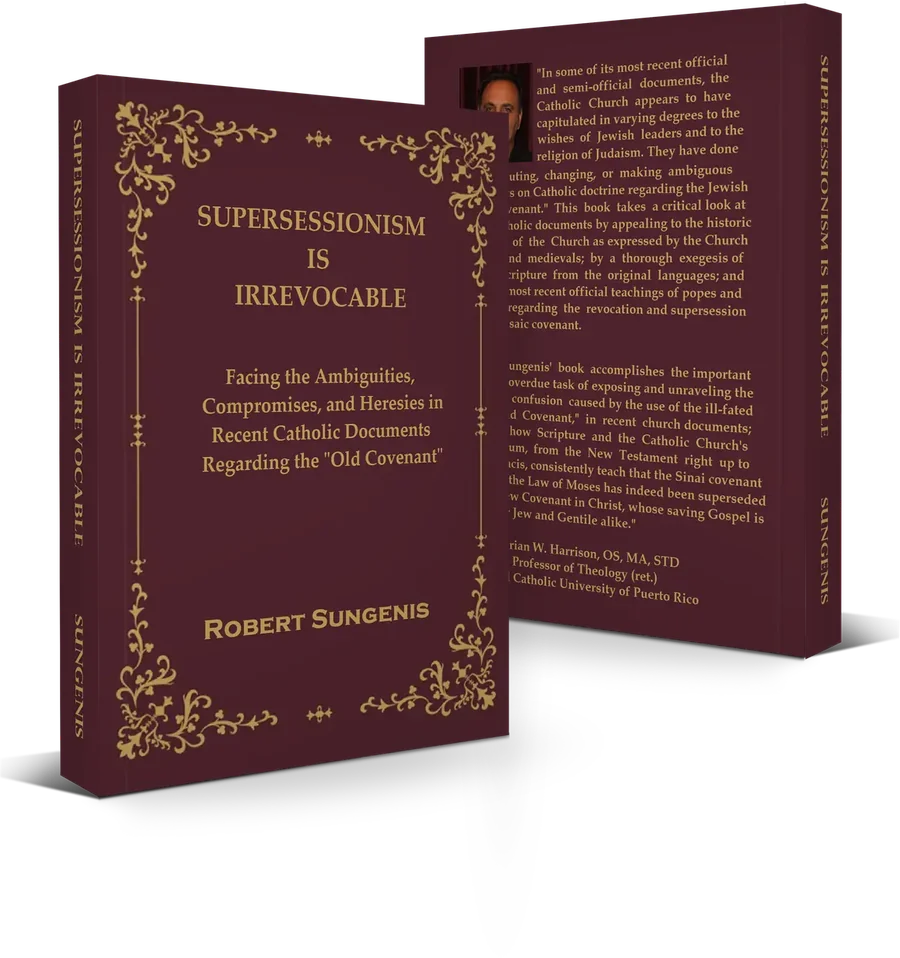
The full account, in his own book
Supersessionism is Irrevocable
Facing the Ambiguities, Compromises, and Heresies in Recent Catholic Documents Concerning the "Old Covenant"
Robert Sungenis, CAI Publishing, 2024, 484 pages
The book tells this whole story with the documents: his letters, Msgr. Malloy's reply, the diocese's email, the vote, the 2019 edition, and a full chapter on the Greek of Romans 9:4-5.
“Finally, allow me to emphasize that it is my love and devotion to the Catholic Church of Jesus Christ that motivates me to write this critique.”
Inside
- The 2006 US Catholic Catechism for Adultsp. 37
- Fr. James Massa and the Pressp. 75
- A Detailed Exegesis of Romans 9:4-5p. 121
- The Addition of Rm 11:29 to ¶839 of the Catechismp. 144
- 1980: John Paul II’s Speech at Mainz, Germanyp. 183
- 2015: Card. Koch: "The Gifts & Call of God are Irrevocable"p. 318
“Robert Sungenis’ book accomplishes the important and long-overdue task of exposing and unravelling the doctrinal confusion caused by the use of the ill-defined term "Old Covenant" in recent church documents, and of showing how the Bible and the Catholic Church's magisterium, from the New Testament right up to Pope Francis, consistently teach that the Sinai covenant based on the Law of Moses has indeed been superseded by the New Covenant in Christ, whose saving Gospel is meant for Jew and gentile alike.”
Sources and notes
Page 131 and the 2008 vote
- USCCB, "Recognitio of Change in Adult Catechism": backgrounder, before and after texts, and press release, August 27, 2009
- Catholic News Service, "Bishops vote to revise U.S. catechism on Jewish covenant with God," August 2008
- Catholic News Service, "Vatican approves U.S. catechism revision on Jewish covenant with God," August 27, 2009
- Code of Canon Law, Canon 212
- Dr. Robert Sungenis, The Old Covenant: Fulfilled Only or Fulfilled and Replaced? (video)
- Dr. Robert Sungenis, Robert Sungenis Live #189, October 25, 2023
- Dr. Robert Sungenis, Supersessionism is Irrevocable (CAI Publishing, 2024), pp. 27-45, 73-83, 121-135
- Dr. Robert Sungenis, Commentary, vol. 4 (Hebrews)
- Dr. Robert Sungenis, "The Old Covenant is Revoked: USCCB Removes Heretical Sentence From Its Catechism" (2008), in the Articles archive
Paragraphs 121, 839 to 840 and 674
- Catechism of the Catholic Church, paragraphs 120-130 (vatican.va)
- Catechism of the Catholic Church, paragraphs 668-677 (vatican.va)
- Catechism of the Catholic Church, paragraphs 811-870 (vatican.va)
- John Paul II, Laetamur Magnopere (1997), promulgating the Latin typical edition
- John Paul II, Redemptoris Mater (1987)
- Dr. Robert Sungenis, "And Thus All Israel Shall Be Saved": The Verse About Israel That Fools Everybody (video, July 10, 2026)
- Dr. Robert Sungenis, Cardinal Schönborn Got This Completely Wrong | Catechism Paragraph 121 Exposed (video, March 11, 2026)
- Dr. Robert Sungenis, Robert Sungenis Live | Supersessionism vs. Dispensationalism (video, April 17, 2025)
- Dr. Robert Sungenis, Why There Will Not Be a Mass Conversion of the Jews (2023), pp. 87-90
- Dr. Robert Sungenis, "Will the Jews Convert in the Future?" (2003), in the Articles archive
- Christoph Schönborn, public biography (Wikipedia), used only to cross-check dates
Rembrandt, Moses with the Ten Commandments, 1659, Gemäldegalerie, Berlin. Public domain. Wikimedia Commons.
Quotations from Dr. Sungenis's videos are taken from their captions, with the spelling of names corrected. Where his recollection on a live show differs from the record (he once gave the vote as 234 to 14), this page follows the bishops' announced figure, as his book does.