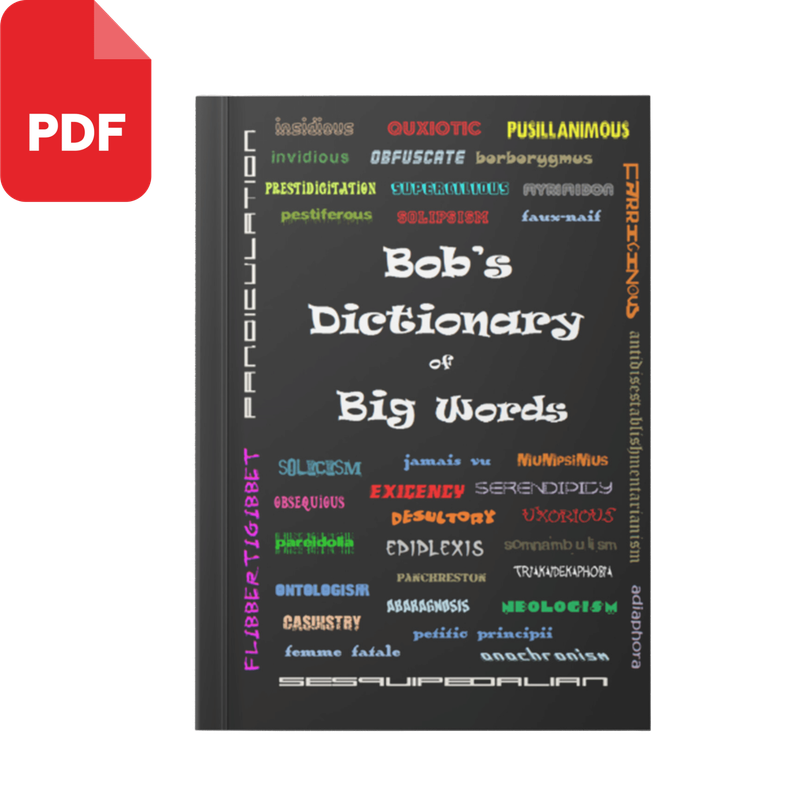
Bob's Dictionary of Big Words
$6.95
In stock · Digital download
Most dictionaries spend their bulk on words you already know. Bob's Dictionary of Big Words does the opposite: it gathers only the sophisticated, precise, and thought-provoking words worth adding to your speech and writing, and leaves out "stop," "go," and the rest. At one extreme sits the Oxford English Dictionary, so vast it runs to 19 volumes and over 3 million words; at the other, Webster's New Pocket Dictionary, just under 400 pages and about 35,000 words. This dictionary holds fewer than 300 pages and about 6,000 words, chosen so they can be learned and remembered rather than merely looked up.
The point is economy. In Webster's Unabridged Third International Dictionary the single word "run," across its many senses and forms, fills almost three pages of eye-straining 5-point type and more than 10,000 words of definition. There is nothing wrong with that, but if you would rather not wade through meanings you already know, this book is for you. It gives words such as solipsism (the theory that the self is the only object of real knowledge, or that nothing but the self exists), invidious (likely to cause ill will or resentment; giving offense as unfair or unjust), laconic (using few words; brief in speech), epagoge (a rhetorical argument by induction), exoteric (able to be understood by the general public), farraginous (made of various materials; jumbled), jejune (flat and uninteresting; barren), and redintegrate (to make whole again; restore to a perfect state).
It also admits a few well-earned exceptions: incisive short words, select slang such as chutzpah (boldness) and "Bob's your uncle" (that is all there is to it), and useful foreign phrases such as ex post facto (done afterward but applied to what came before), fait accompli (a thing already done and so no longer worth opposing), ipse dixit (an assertion resting only on one's own authority), and habeas corpus (an order to bring a prisoner before a judge to test whether he is lawfully held). Most technical, scientific, and legal terms are left out, as are words built from common prefixes (re-, trans-, un-, tri-, super-, non-) whose meaning is plain once you know the root.
A few conventions keep it readable. Each word is given in the single most practical part of speech rather than every form, usually with its Latin, Greek, French, or German root, which often makes the meaning easy to recall. The accented syllable is underlined rather than marked with pronunciation symbols, which tend to clutter the page. The whole is set in a clean Calibri 9-point face, large enough to leave an almost photographic impression of the word and its meaning in the mind.
Note: this PDF is locked. No unauthorized editing or printing.