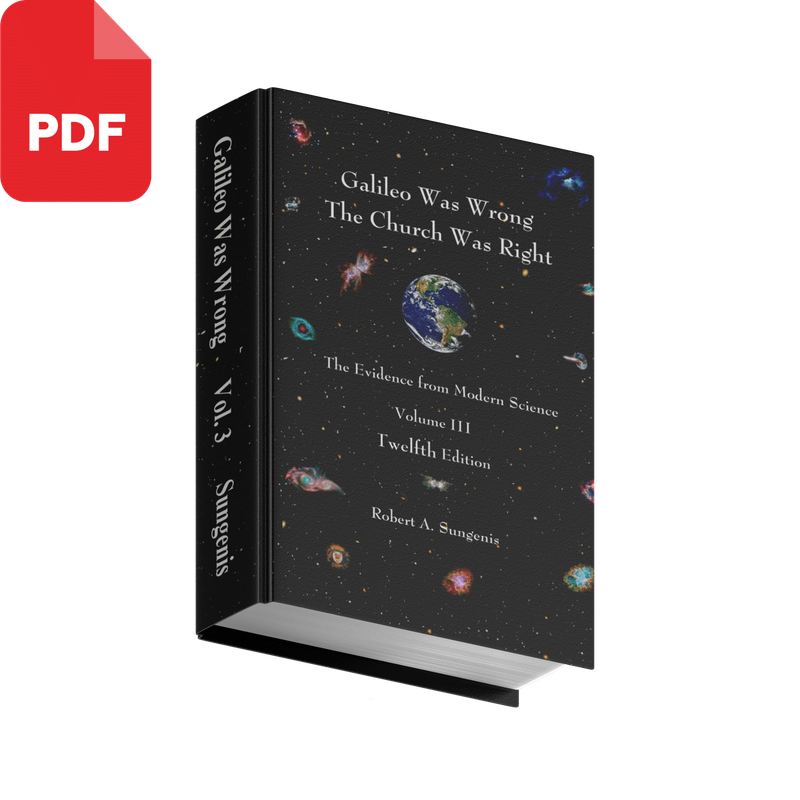
Galileo Was Wrong Vol. 3: The Church Was Right: The Evidence from Church History, 12th ed.
$25.50
In stock · Digital download
The Galileo affair is usually told as a lesson about a Church that stood in the way of science. This third volume of Galileo Was Wrong turns to the record itself. Drawing on physics, astrophysics, astronomy, and the historical documents, Robert Sungenis and Robert Bennett argue that the dispute between Galileo and the Catholic Church was far more than a disagreement over how to read Scripture.
Scientific evidence gathered in the last hundred years, unavailable in Galileo's day, is presented here to show that the Church's position on the immobility of the Earth is not only defensible but offers the most stable model of the universe and the one that best answers the evidence we actually observe in the cosmos.
Readers agree.
There exists no better exposition of the history and science of geocentrism. Very highly recommended and a must for all those interested in the issues surrounding geocentrism today (Gerardus Bouw, Ph.D., Astronomy)
In their over 700-page book, Drs. Sungenis and Bennett make a convincing case for the special and central position of the earth in the cosmos (Vincent Schmithorst, Ph.D., Physics)
Galileo Was Wrong is a work of monumental proportion which ranks, in my opinion, on a par with the meticulous observations of the Danish astronomer, Tycho Brahe, and the tireless efforts of Walter van der Kamp (Neville Jones, Ph.D., Physics)
In their new book, Sungenis and Bennett take no prisoners...Now that the Enlightenment is over, it was inevitable that the system upon which it was based should come in for the powerful critique which Sungenis and Bennett provide. Not inevitable, however, was the brilliant way they provide it (E. Michael Jones, Ph.D., ed. Culture Wars)
Sungenis and Bennett examine the anomalies that arise from the Copernican model...A must read for those who can set aside prejudices and a priori assumptions (Joseph Strada, Ph.D. Aerospace Engineering)
The book Galileo Was Wrong forcefully addresses the history, science, theological, philosophical, and worldview implications of our place in the universe (Russell T. Arndts, Ph.D., Chemistry, LSU)
It is with pleasure that I remand this volume into the hands of the reader (Martin Selbrede, Chief Scientist, Unipixel)
Robert Sungenis and Robert Bennett have done a great service to science and to men of good will. Those who see the universe as the handiwork of the benevolent God need no longer be subservient to fairy tales (Anonymous, Ph.D., MIT)
Galileo Was Wrong is a model for the kind of scholarship we need today: intellectual understanding not as an end in itself, but as a commitment to reality, infused with moral passion, love for the earth, common sense and philosophical sensitivity (Caryl Johnston, M. Ed., Jefferson Medical College)
Across more than seven hundred pages, Robert Sungenis and Robert Bennett take the reader on a tour of science and history that few expect is even possible. Has modern science convinced us of something it cannot prove? Were the Fathers, the Medievals, and the popes and cardinals of the seventeenth century right to read Scripture at face value and hold that the Earth stands still at the center of the universe? The authors lay out facts and figures long kept from public view, and ask only for an open mind.
You will see how modern science documents that the Earth is motionless in space and occupies the center of the universe, and how thoroughly that finding has been kept out of our educational system. You will see how deeply the popes of the seventeenth century were involved in condemning heliocentrism, guiding the process step by step and finally castigating it as formally heretical. You will find the most detailed exegesis of the scriptural data on a geocentric universe ever presented to the public, along with comprehensive documentation of the consensus of the Church Fathers and Medieval theologians, and the statements of modern popes and councils, including Gregory XVI, Benedict XIV, Pius VII, Leo XIII, Benedict XV, the Council of Trent, Vatican I, Vatican II, and a special section on John Paul II and his reexamination of the Galileo case.