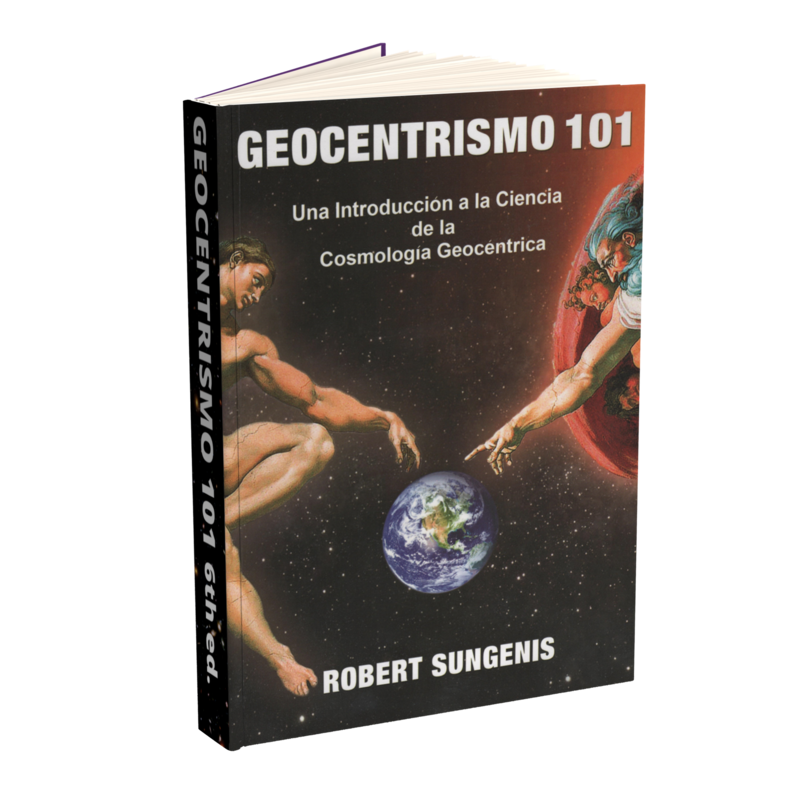
Geocentrism 101: An Introduction into the Science of Geocentric Cosmology - 6th Ed. SPANISH
$19.95
In stock
How do you compress more than five hundred years of science and history into a book of just over 200 pages that still reads as easily as Reader's Digest? That is what Robert Sungenis set out to do in Geocentrism 101: An Introduction into the Science of Geocentric Cosmology, an easy-to-carry paperback on a 6 x 9 frame. Where his three-volume Galileo Was Wrong: The Church Was Right, now in its 12th edition, runs past 2,400 pages, the best of that set has been distilled here into less than a tenth of the size. From CAI Publishing, Inc., it is written for anyone, high school student, college student, or adult, who has wanted to understand what the debate between heliocentric and geocentric cosmology is really about.
The design is meant to invite rather than intimidate. The average page carries about 200 words, against 500 or more in a typical paperback, set in a large 12-point font. There are 450 images, roughly two per page, and many are photocopies of the very book pages from which famous scientists are quoted, so that you can read each quotation in its own context. Of the six equations in the book, only three need explaining, and those are explained in plain language.
An optional flash drive ($39.95) deepens the study considerably. It holds 66 detailed animations, the fruit of five years of work, covering everything from the geocentric design of Stonehenge to stellar parallax to the alignments of the cosmic microwave radiation with our Earth, along with one of the most sophisticated stellariums available, which renders the constellations and planetary movements from an Earth-based viewpoint. It also carries a full-color PDF of the book with all 450 images, PDFs of every CAI book and video on geocentrism, and the two songs from The Principle.
The book reproduces the actual handwritten letters of scientists such as Albert Michelson, Hendrik Lorentz, and George Fitzgerald, obtained after long searches in the microfiche files of the Niels Bohr Library in College Park, Maryland. It also includes a rare photograph of Georges Sagnac, acquired from the Bibliotheque Ulm Lettres et Sciences in France, a genuine find given that no image of Sagnac appears on the Internet. Sagnac performed the famous 1913 experiment understood to have demonstrated the ether and so to have told against Special Relativity, which may explain why Einstein never once cites it. It is an excellent resource for homeschooling families and for any high school or college curriculum that wants students to know the alternative positions in modern cosmology.