Scripted reply
Answering Cool Hard Logic on Geocentrism
Robert Sungenis answers Cool Hard Logic

What was argued
A recorded reply in which Cool Hard Logic's video is played in sections and answered point by point. Cool Hard Logic argued that a fixed Earth would force every star into a yearly ellipse with no force to drive it, and that one half of the cosmic microwave background being warmer shows the Earth and the galaxy are moving. Robert argued that the Michelson-Morley null result fits a motionless Earth, that a rotating universe supplies three real inertial forces which carry the stars around the Earth, and that recent studies find the microwave background dipole is built into the universe rather than caused by motion.
How it ran
- 0:00Introduction: a recorded reply to the tenth video in the Cool Hard Logic series
- 1:15Cool Hard Logic on Tycho Brahe's model and the ether
- 3:21Robert on the ether and the Michelson-Morley experiment
- 33:40Cool Hard Logic on parallax, Doppler shift, and what force could move the stars
- 36:00Robert on stellar aberration and the three inertial forces
- 45:54Cool Hard Logic on Barnard's star and stellar helices
- 48:42Robert on proper motion and the sidereal day
- 56:35Cool Hard Logic on the warmer half of the cosmic microwave background
- 57:40Robert on the CMB dipole and the anisotropy studies
- 1:17:44Cool Hard Logic on the Earth's orbital speed
- 1:18:51Robert on speeds in the geocentric model and general relativity
- 1:37:37Cool Hard Logic: the model is really heliocentric
- 1:38:40Robert on the geometric center and the center of mass
- 1:46:42Cool Hard Logic on the universe oscillating each year
- 1:47:50Robert on precession, nutation, and angular momentum
- 2:01:35Robert's closing answer and sign-off
The key exchanges
Each claim first, then Robert's answer. The time jumps to that moment in the video.
- 3:21
1. Has the ether ever been found
Cool Hard Logic argues that the ether Brahe relied on, a substance said to hold the heavens in place and to move in circles, has never been detected.
Robert answered that ether has been held to exist from the Greeks through Galileo and Newton, since space cannot be literally nothing. He argued that Einstein dropped the ether in 1905 to keep the speed of light constant, then allowed it back in his general theory in 1915.
“The fact is ether not only exists, it was believed to exist by scientists from the Greeks to Galileo to Newton to the present day.”
- 36:00
2. What moves the stars
Cool Hard Logic argues that a fixed Earth would require every star to trace a yearly ellipse, and asks which of the four known forces could move them that way.
Robert answered that the effect is stellar aberration, and that it comes out the same whether the Earth turns in a fixed sky or the sky turns around a fixed Earth. He argued that a rotating universe supplies three further forces that the heliocentrist treats as fictitious.
“The geocentrist has three additional forces that control the celestial bodies in the universe, and they are known as the three inertial forces: namely the centrifugal force, the Coriolis force, and the Euler force.”
- 48:42
3. Barnard's star and proper motion
Cool Hard Logic argues that stars also carry their own space velocities, so in a geocentric model each one would have to trace a skewed helix, as with Barnard's star.
Robert answered that Barnard's star has the largest proper motion of any star and is not typical, since most stars move too little to notice. He pointed to Orion, whose shape has been recognizable since the Book of Job.
“Unless we actually see a star change its position in the sky, there is no proof that any star is moving.”
- 53:07
4. Stars turning faster than the sun
Cool Hard Logic argues that Brahe's model has to make the stars circle the Earth at a slightly different rate from the sun, which makes the model more complicated.
Robert answered that the moving Earth model has the same feature, since the Earth is said to turn in 23 hours, 56 minutes and 4.09 seconds rather than 24. In the geocentric model the stars turn in that same time while the sun drifts back by a little less than one degree a day.
“The answer to this in the Brahe model is that the stars revolve around a fixed Earth in 23 hours, 56 minutes and 4.09 seconds.”
- 57:40
5. The microwave background dipole
Cool Hard Logic argues that one half of the cosmic microwave background is warmer than the other, with a gradation showing that the Earth and the whole galaxy are moving.
Robert answered that this is the CMB dipole, and that studies of quasars and radio galaxies report speeds far above the 371 km/s figure and pointing in different directions. He argued that these results put the dipole down to an anisotropy built into the universe rather than to motion.
“The CMB dipole is not due to motion at all, which is proven by the fact that there are many radiations coming to Earth from many different directions and many different speeds.”
- 1:18:51
6. The 29.8 km per second objection
Cool Hard Logic argues that in the revised model the Earth would still have to pass through space at 29.8 km/s, the very speed geocentrists say it cannot travel.
Robert answered that 29.8 km/s is the sun's retrograde speed against the stars, not a speed the stars travel around the Earth. He cited the 1925 Michelson-Gale experiment, which measured the tangential speed of space at the Earth's surface at 0.465 km/s, a full turn in one sidereal day.
“The speed of 29.8 km/s is how fast the sun travels in its retrograde motion against the stars.”
- 1:37:37
7. Is the model really heliocentric
Cool Hard Logic argues that a universe centered on the sun and still called geocentric is in fact a heliocentric model.
Robert answered that Scripture never places the Earth at the center of the universe, only that the Earth does not move. He argued that the Earth is the dynamic center, the center of mass, while the sun is the geometric center, and that the two are different things.
“It only says the Earth doesn't move and that the sun and stars go around it.”
- 1:47:50
8. The yearly vertical motion
Cool Hard Logic argues that no law of physics has been named that would let the whole universe oscillate by 74 million miles each year.
Robert answered that a rotating sphere whose geometric center is offset from its center of mass will wobble, and that precession, nutation and angular momentum, none of which appear in the four forces listed, account for the vertical and horizontal motion.
“The physics tells us that an unbalanced rotating sphere will oscillate both vertically and horizontally in free space.”
Robert's case in 5 points
- 1
The null result of the 1887 Michelson-Morley experiment is best read as evidence that the Earth is not moving.
29:07 - 2
A rotating universe carries three real inertial forces, the centrifugal, the Coriolis and the Euler, which hold the stars in place as the sky turns around the Earth each day.
37:04 - 3
Recent studies of quasars and radio galaxies point to a microwave background dipole built into the universe rather than caused by the Earth's motion.
57:40 - 4
General relativity itself allows a universe rotating around a fixed Earth, as the work of Thirring, Lense, Born and Ellis shows.
1:24:36 - 5
Geocentrism claims the Earth is the center of mass of the universe while the sun is its geometric center, so a sun centered geometry is no problem for the model.
1:38:40
Closing
Robert closed by repeating that the sun is the geometric center of the universe while the Earth is its center of mass, and that since Scripture says only that the Earth does not move, a sun centered geometry concedes nothing to heliocentrism.
2:03:48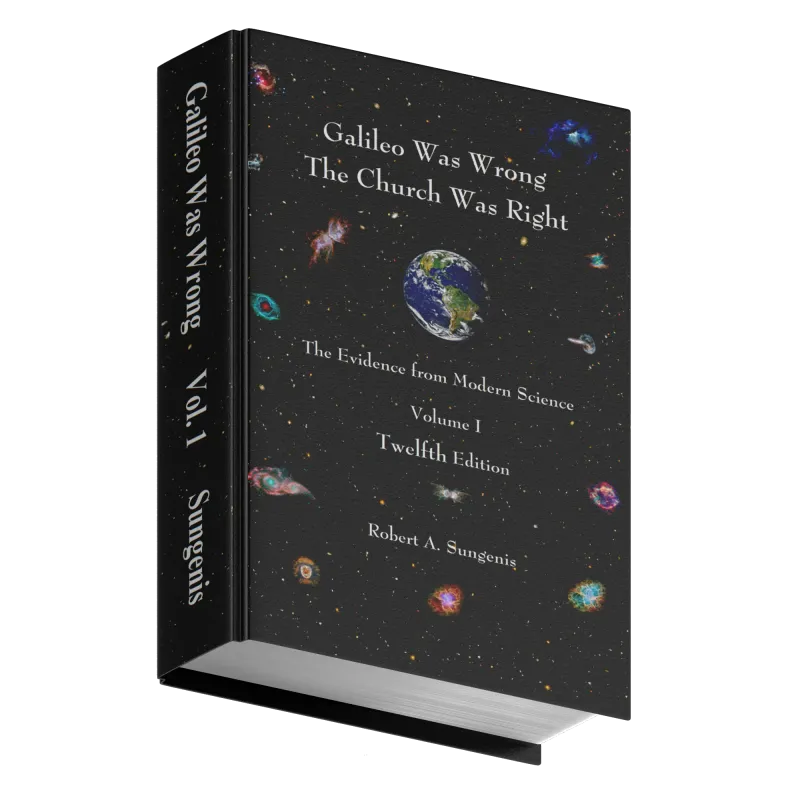
Go deeper: Galileo Was Wrong: The Church Was Right
Volume 1 lays out the evidence from modern science, 12th edition.
Get the book