Geocentrism: Questions & Answers
Explore 86 questions and answers about Geocentrism, answered by Dr. Robert Sungenis.
The Church condemned heliocentrism in 1616 and 1633 for a reason, and the physics of the last 140 years has never produced an experiment that shows the Earth moving. These questions and answers walk through the evidence.
This hub gathers every question I have answered on the position of the Earth in the universe. The short version: no experiment in the history of science has ever detected the Earth's motion through space. Michelson and Morley expected to measure it in 1887 and measured nothing. The follow-up experiments by Michelson and Gale, by Sagnac, and by Airy fit a stationary Earth with a rotating universe at least as well as a moving Earth, and Einstein built relativity precisely to explain away that null result. Relativity itself concedes the point in a different form: if all motion is relative, the Earth-centered frame is as valid as any other, which is why Hawking, Ellis, and Hoyle each admitted in print that a geocentric universe cannot be ruled out by observation.
The modern data adds something the ancients never had. The cosmic microwave background, mapped by three satellites, is aligned with the plane and the equinoxes of the Earth's own orbit. Galaxies and quasars appear in concentric shells around us. Cosmologists call the first result the axis of evil because it points at us.
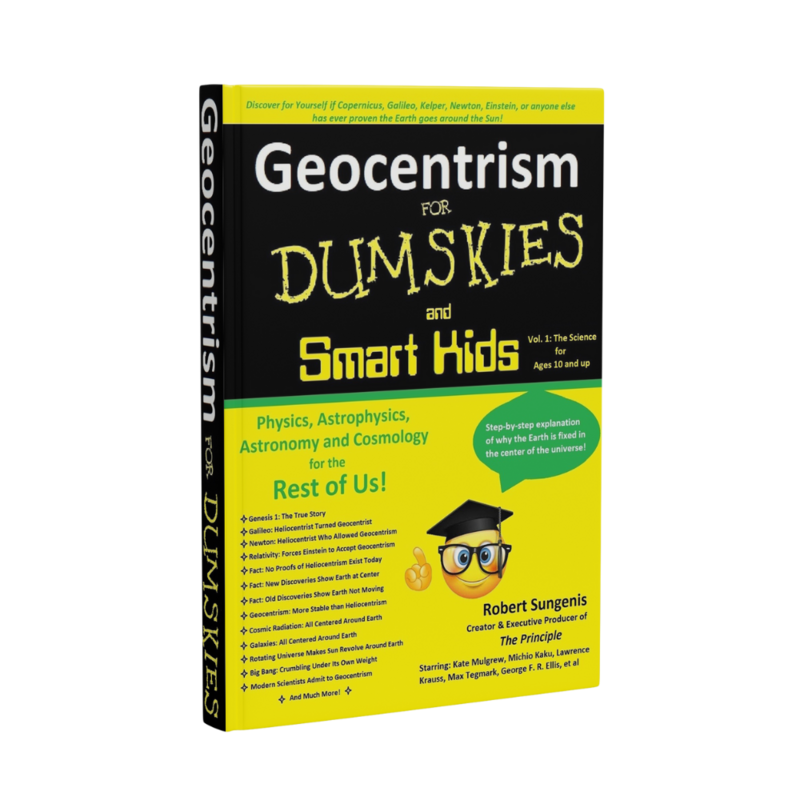
I also hold that this is not a neutral scientific question for a Catholic. The decrees of 1616 and 1633 were issued by the Holy Office with papal approval, they have never been formally reversed, and the Fathers of the Church were unanimous that Scripture teaches a fixed Earth. The Galileo Was Wrong series lays out the science in volumes 1 and 2 and the Church history in volume 3, and the documentaries The Principle and Journey to the Center of the Universe put it on film.
Books on this subject

- How do nuclear clocks work in a geocentric model?
- Is geocentrism Catholic teaching?
- Are there scientists who support geocentrism?
- What is geocentrism?
- What is the ultimate lesson geocentrism teaches us about creation and redemption?
- What does geocentrism teach us about divine immutability and providence?
- How should Catholics respond to modern cosmology (Big Bang, expanding universe)?
- What do critics most often misunderstand about geocentrism?
- What is the theological significance of an Earth-centered universe?
- How does modern physics actually confirm geocentrism rather than disprove it?
- What scientific and philosophical errors led to the dominance of heliocentrism?
- How did the Church's position on heliocentrism change after Galileo, and why?
- How do Scripture and Church tradition support geocentrism?
- What does Einstein's relativity actually say about motion and rest?
- What evidence today supports a geocentric cosmology?
- What role does cosmology play in Catholic theology?
- Why does modern science resist revisiting the question of Earth's motion?
- How did the Galileo affair distort this harmony?
- How do the Fathers and Doctors of the Church defend the compatibility of geocentrism with reason?
- How do the Fathers and Doctors of the Church interpret these passages?
- How does Scripture support geocentrism?
- How does relativity affect geocentrism?
- What scientific experiments prove or disprove Earth's motion?
- What evidence today supports geocentrism?
- Why does the Church no longer defend geocentrism?
- Why is geocentrism rejected today?
- When did geocentrism end?
- When did geocentrism start?
- When was geocentrism disproved?
- When was geocentrism accepted?
- When was geocentrism made?
- Who theorized geocentrism?
- Who proposed geocentrism?
- Who started geocentrism?
- What is the Tychonic system and why does Robert Sungenis favor it?
- Have you ever debated AI like ChatGPT on geocentrism?
- Who was Giovanni Riccioli, and what did he contribute to geocentrism?
- If the earth is stationary, how do engineers calculate spacecraft trajectories and gravity-assist maneuvers?
- How does geocentrism explain claims that the earth once rotated faster, giving a 360-day year?
- Is Aristotle's argument for the earth's centrality a good one?
- If geocentrism is true, would NASA know, and are they concealing it?
- Why do scientists refuse to debate you on geocentrism?
- Has Mercury's perihelion been integrated into the neo-Tychonic model?
- Is heliocentrism a heresy, and can holding it damn a person?
- What journals or scientific missions might confirm geocentrism in the future?
- Are galaxies arranged in concentric shells around Earth?
- What single quantitative test would confirm a stationary Earth while explaining parallax, Doppler shifts, CMB alignment, and tracking?
- If Earth is fixed, does the universe rotate daily, and what about faster-than-light speeds or frame-dragging?
- Why does every country still teach heliocentrism if geocentrism cannot be disproved?
- What does the Hebrew word chug mean in Isaiah 40:22?
- Do objects beyond Saturn move faster than light?
- Does Father Ripperger believe in geocentrism?
- Can Scripture alone prove that the Earth is spherical?
- What progress has been made on carbon-dating research and so-called “Hildegardian metaphysics"?
- Has Galileo Was Wrong been updated in light of the James Webb Space Telescope findings?
- Does the phrase "the heavens declare the glory of God" support geocentrism?
- In geocentrism, do the stars revolve around the sun or around the earth?
- In geocentrism, do the moon landings and spacecraft distances give the game away?
- If the sun orbits the earth daily in the geocentric model, what causes a year?
- If the earth rotates, why don't tall buildings and earthquakes change its spin?
- What is your view of the Tychos model and its rotating, Mars-centered universe?
- How does the Foucault pendulum work in a geocentric universe?
- If the earth doesn't move, how could the Three Gorges Dam slow its rotation?
- Does evidence that the universe is 'flat' disprove geocentrism, which requires a spherical universe?
- If you had the money, which experiment would you perform to test geocentrism?
- What is wrong with the Greek idea of antipodes that Lactantius argued against?
- Do gyroscopes prove that the earth is moving?
- How can the moon move at the same speed in the geocentric and heliocentric systems?
- What is the fastest way to disprove a flat earth?
- Is there anything to the concave Earth theory?
- Does the Hubble tension prove the Earth is at the center of the universe?
- Is the rotating universe like the gears of a clock, and is that why time is so precise?
- What is the single biggest reason you believe in geocentrism?
- Why didn't geocentrism catch on the way flat-earth belief did?
- What is the best flat-earth argument, and how do you respond to it?
- Did Galileo really disprove Ptolemy, or could Ptolemy's model be adjusted and still defended?
- What is the best way to teach geocentrism to young children who already know the accepted model?
- Do you find geocentrism easier to defend than young-earth creationism?
- If the Church's last authoritative statement affirmed geocentrism, why did Pope John Paul II give a speech affirming a non-geocentric universe?
- Why is the moon not full when the sun and moon are on opposite sides of the sky with no object between them to cast a shadow?
- What first caused the earth to be fixed and motionless when it was created?
- How can stellar parallax be explained equally well in the geocentric and heliocentric systems?
- When I discuss geocentrism people get angry without real arguments; will the Church ever boldly embrace it?
- If the earth were moving, would we see great vortexes like the Great Red Spot on Jupiter?
- Which model is more accurate, the Ptolemaic or the Tychonic?
- How does the geocentric model explain the seasons and the changing length of daylight through the year?