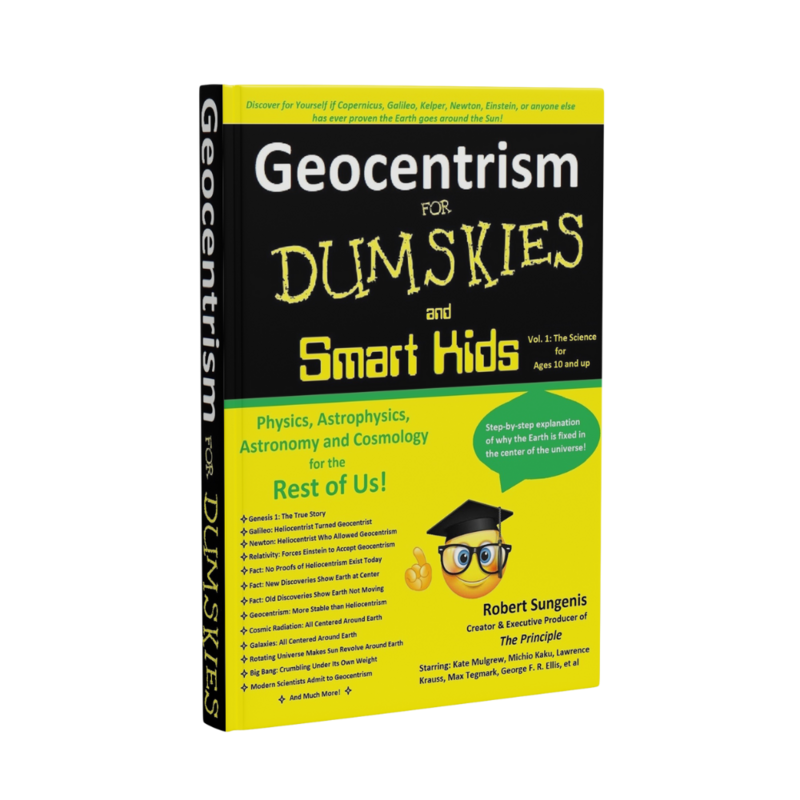
Geocentrism for Dumskies and Smart Kids, 2nd Ed.
$39.95
In stock
Everyone knows the Earth goes around the sun. Or do they? You have likely heard the confident version: the experiments settle it, Newton settled it, even the Church admitted Galileo was right. Yet when you look at what leading physicists, astronomers, and philosophers of science have actually written, the picture is far less certain than the textbooks suggest.
Written to be read by a bright child and to give a thoughtful adult real pause, this second edition lets the authorities speak for themselves. If everyone can be so sure the Earth revolves around the sun, why do these figures state or suggest otherwise?
Physicist Albert Einstein: to the question whether or not the motion of the Earth in space can be made perceptible in terrestrial experiments. We have already remarked that all attempts of this nature led to a negative result.
Lincoln Barnett (foreword by Albert Einstein): We can't feel our motion through space, nor has any physical experiment ever proved that the Earth actually is in motion.
Stephen Hawking: So which is real, the Ptolemaic or Copernican system? Although it is not uncommon for people to say that Copernicus proved Ptolemy wrong, that is not true. One can use either picture as a model of the universe, for our observations of the heavens can be explained by assuming either the earth or the sun to be at rest.
Astronomer Fred Hoyle: We can take either the Earth or the Sun, or any other point for that matter, as the center of the solar system. This is certainly so for the purely kinematical problem of describing the planetary motions. It is also possible to take any point as the center even in dynamics, although recognition of this freedom of choice had to await the present century.
Physicist Hans Reichenbach: It makes no sense, accordingly, to speak of a difference in truth between Copernicus and Ptolemy: both conceptions are equally permissible descriptions. What has been considered as the greatest discovery of occidental wisdom, as opposed to that of antiquity, is questioned as to its truth value.
Physicist Dennis Sciama: Whether the Earth rotates once a day from west to east, as Copernicus taught, or the heavens revolve once a day from east to west, as his predecessors believed, the observable phenomena will be exactly the same. This shows a defect in Newtonian dynamics, since an empirical science ought not to contain a metaphysical assumption, which can never be proved or disproved by observation.
Physicist I. Bernard Cohen: There is no planetary observation by which we on Earth can prove that the Earth is moving in an orbit around the sun. Thus all Galileo's discoveries with the telescope can be accommodated to the system invented by Tycho Brahe just before Galileo began his observations of the heavens. In this Tychonic system, the planets move in orbits around the sun, while the sun moves in an orbit around the Earth in a year. Furthermore, the daily rotation of the heavens is communicated to the sun and planets, so that the Earth itself neither rotates nor revolves in an orbit.
Physicist Arthur Lynch: Descartes is doubly interesting to us in the discussion of Relativity, for at one time when the Inquisition was becoming uneasy about his scientific researches, he gave them a reply that satisfied them. He declared that the sun went around the Earth, and that when he said that the Earth revolved round the sun that was merely another manner of expressing the same occurrence. The movements of the two bodies are relative one to the other; it is a matter of choice as to which we take as our place of observation.
Physicist Hendrik Lorentz: Briefly, everything occurs as if the Earth were at rest.
Physicist Wolfgang Pauli: The failure of the many attempts to measure terrestrially any effects of the earth's motion.
Physicist Henri Poincare: We do not have and cannot have any means of discovering whether or not we are carried along in a uniform motion of translation.
Physicist Ernst Mach: Obviously it matters little if we think of the Earth as turning about on its axis, or if we view it at rest while the fixed stars revolve around it. Geometrically these are exactly the same case of a relative rotation of the Earth and the fixed stars with respect to one another.
Physicist Julian B. Barbour: Thus, even now, three and a half centuries after Galileo's condemnation by the Inquisition, it is still remarkably difficult to say categorically whether the earth moves, and, if so, in what particular sense.
Physicist Albert Einstein: The struggle, so violent in the early days of science, between the views of Ptolemy and Copernicus would then be quite meaningless. Either coordinate system could be used with equal justification. The two sentences, the sun is at rest and the Earth moves, or the sun moves and the Earth is at rest, would simply mean two different conventions concerning two different coordinate systems.
Physicist Isaac Newton: In order for the Earth to be at rest in the center of the system of the Sun, Planets, and Comets, there is required both universal gravity and another force in addition that acts on all bodies equally according to the quantity of matter in each of them and is equal and opposite to the accelerative gravity with which the Earth tends to the Sun. Since this force is equal and opposite to its gravity toward the Sun, the Earth can truly remain in equilibrium between these two forces and be at rest. And thus celestial bodies can move around the Earth at rest, as in the Tychonic system.
Science historian Martin Gardner: The ancient argument over whether the Earth rotates or the heavens revolve around it (as Aristotle taught) is seen to be no more than an argument over the simplest choice of a frame of reference. Obviously, the most convenient choice is the universe. Nothing except inconvenience prevents us from choosing the Earth as a fixed frame of reference.
Philosopher Bertrand Russell: But in the modern theory the question between Copernicus and his predecessors is merely one of convenience; all motion is relative, and there is no difference between the two statements, the earth rotates once a day and the heavens revolve about the Earth once a day.
Astronomer J. L. E. Dreyer: The Earth-centered system is in reality absolutely identical with the system of Copernicus, and all computation of the places of the planets are the same for the two systems.
Physicist Lawrence Krauss: But when you look at the CMB map, you also see that the structure that is observed is, in fact, in a weird way, correlated with the plane of the earth around the sun. Is this Copernicus coming back to haunt us? That's crazy. We're looking out at the whole universe. There's no way there should be a correlation of structure with our motion of the earth around the sun, the plane of the earth around the sun, the ecliptic. That would say we are truly the center of the universe.
Physicist Richard Feynman: I suspect that the assumption of uniformity of the universe reflects a prejudice born of a sequence of overthrows of geocentric ideas. It would be embarrassing to find, after stating that we live in an ordinary planet about an ordinary star in an ordinary galaxy, that our place in the universe is extraordinary. To avoid embarrassment we cling to the hypothesis of uniformity.
Physicist P. C. W. Davies: It has always been realised, however, that a redshift of light can have another cause, gravity. When light climbs away from a massive gravitating object it loses energy, a depletion which shows up as a loss of frequency (colour shift). This explanation for the galactic redshift has always been ruled out because it is asymmetric: light falling towards a mass acquires a blueshift. As we see only redshifts whichever direction we look in the sky, the only way in which this could be consistent with a gravitational explanation is if the Earth is situated at the centre of an inhomogeneous Universe.
Science writer Kitty Ferguson: It is possible to describe the entire universe using any chosen point as the unmoving center (the Earth will do very well) and no one can prove that choice is wrong. No one can prove that the Earth moves.
Astronomer Phil Plait: I have two things to say that might surprise you: first, geocentrism is a valid frame of reference, and second, heliocentrism is not any more or less correct.
Physicist Timothy Clifton: To entertain the notion that we may, in fact, have a special location in the universe is, for many, unthinkable. Nevertheless, that is exactly what some small groups of physicists have recently been considering.
Physicist Max Born: Thus we may return to Ptolemy's point of view of a motionless Earth. This would mean that we use a system of reference rigidly fixed to the Earth in which all stars are performing a rotational motion with the same angular velocity around the Earth's axis. One has to show that the transformed metric can be regarded as produced according to Einstein's field equations, by distant rotating masses. This has been done by Thirring. He calculated a field due to a rotating, hollow, thick-walled sphere and proved that inside the cavity it behaved as though there were centrifugal and other inertial forces usually attributed to absolute space. Thus from Einstein's point of view, Ptolemy and Copernicus are equally right. What point of view is chosen is a matter of expediency.
Edition: 2nd
Hardback: $39.95
Paperback: $29.95
PDF: $15.00
Audiobook (MP3): $15.00