Scripted reply
The Geocentrism Debate
Robert Sungenis answers Robert Carter and Jonathan Sarfati

What was argued
Carter and Sarfati argue that geocentrism was the ruling science of its day, that the Bible's talk of sunrise and sunset is only everyday language about our own point of view, and that Newton's physics gave the first real dynamic model of how the solar system works. Robert answers that the Church's condemnations of 1616 and 1633 were never officially withdrawn, that the Bible's plainer passages always say the sun moves and the earth stays put, and that once Newton's fixed and absolute space is dropped, the forces Newton had to call fictitious become real forces produced by a rotating universe. His case rests on Einstein's general relativity, which he says allows a fixed earth with the universe turning around it, and which he says Carter and Sarfati never address.
How it ran
- P1 0:33How the response is set up
- P1 5:53The Church, Copernicus, and Galileo
- P1 34:33Sunrise, sunset, and what the Bible actually says
- P1 43:30Joshua 10 and the long day
- P1 1:09:28The earth shall not be moved: the Hebrew and the context
- P2 1:06Newton, Mach, and Einstein on rotating frames
- P2 30:24Epicycles: Copernicus compared with Ptolemy
- P2 33:45The church fathers and the early reaction to Copernicus
- P2 51:21Newton's laws and the three inertial forces
- P2 54:37How the geocentric system works
- P3 0:07The inertial forces of a rotating universe
- P3 16:32The speed of light in general relativity
- P3 22:58The ether, taken back in general relativity
- P3 28:23Answering their written paper on absolute geocentrism
The key exchanges
Each claim first, then Robert's answer. The time jumps to that moment in the video.
- P1 5:53
1. Did Christianity end geocentrism
Carter argues that the rejection of an earth-centered universe grew out of Christianity itself, through the astronomical measurements taken for years in the meridian lines of European cathedrals.
Robert answers that the Catholic Church condemned Copernicanism and Galileo in 1616 and 1633 and has never officially retracted those decisions, and that the later softening steps, the 1821 imprimatur for Canon Settele and Galileo's removal from the Index in 1835, were obtained through false claims made to Pope Pius VII.
“In 1616 and 1633 the Catholic Church officially condemned both Copernicanism and Galileo. Since then the Catholic Church has never made an official retraction of those two condemnations.”
- P1 15:55
2. Churchmen encouraged Copernicus
Sarfati says that churchmen encouraged Copernicus to publish, and Carter adds that Copernicus spent night after night measuring the stars and planets until the data fit a sun-centered system.
Robert answers that Luther and Melanchthon, the two highest churchmen of Lutheranism, both opposed Copernicus, and that the picture of Copernicus as a patient observer is a myth, since by Arthur Koestler's count his book contains only 27 of his own observations spread over 32 years.
“Luther calls Copernicus a fool who went against Holy Writ.”
- P1 34:33
3. Sunrise and sunset language
Sarfati argues that when the Bible says sunrise and sunset it is using the same everyday language we all use, describing things from our own frame of reference rather than teaching that the sun moves.
Robert agrees that both sides use such language loosely, but says it only raises the next question: what causes the sunrise. He answers that in over two dozen passages that bear directly on that question, the Bible says the sun moves and the earth does not, and it never says the earth turns.
“No competent geocentrist would use such language to prove the world is geocentric.”
- P1 1:09:28
4. The earth shall not be moved
Sarfati argues that the Hebrew behind "the earth shall not be moved" is the same word used of the righteous and of the psalmist himself, so it does not describe a physically motionless earth.
Robert answers that a figurative use in Psalm 121 does not settle Psalm 93 or 1 Chronicles 16, and that Carter never applied his own rules of context, grammar, and genre to those two passages. He adds that Carter and Sarfati read Genesis 1 literally while reading every geocentric passage figuratively.
“It only proves that a Hebrew word can be used both figuratively and literally, but this is true of almost all Hebrew and Greek words.”
- P2 30:24
5. Epicycles piled on epicycles
Carter and Sarfati argue that the old earth-centered system had to keep adding epicycles after the fact to match each new observation, so it explained what was seen without predicting anything new.
Robert answers that Copernicus ended up with more epicycles than Ptolemy, and that Copernicus overstated Ptolemy's count. He cites Owen Gingerich, who found that the story of endless epicycles grew in the retelling and that the Encyclopaedia Britannica could not produce any source for its version of it.
“Ptolemy's system has 40 epicycles whereas Copernicus ends up with 48.”
- P2 33:45
6. Church fathers and Copernicus
Carter and Sarfati list "church fathers supported heliocentrism" and "Christians supported Copernicus" among their summary points.
Robert answers that the church fathers are normally understood as the Christian writers of the first through seventh centuries, and he quotes Athanasius, Athenagoras, Augustine, Basil, Chrysostom, Cyril, the Gregories, and Irenaeus as all describing a fixed earth at the center. He says the handful of high-ranking supporters Copernicus did have can be counted on one hand.
“Not one of them supported heliocentrism.”
- P2 51:21
7. Newton as a predictive engine
Carter and Sarfati argue that Newton's laws of motion and gravity are the greatest engine of scientific prediction in history, pointing to spacecraft navigation and to the discovery of Neptune from the irregular path of Uranus.
Robert answers that F equals MA by itself will not get a probe to its target: engineers must add the centrifugal, Coriolis, and Euler forces by hand and then treat them as real, even though Newton's system calls them fictitious. He also notes spiral galaxies turning ten times too fast for the same equation.
“F equals MA requires the addition of the three inertial forces, the centrifugal, the Coriolis and the Euler, to get a space probe to go where the engineers want it to go.”
- P3 29:24
8. No dynamic model
In their paper, Carter and Sarfati argue that a geocentric cosmology could be constructed as one allowable reference frame, but that there is no dynamic model behind it, meaning no forces acting as the causes of the motions.
Robert answers that Einstein's general relativity supplies exactly that: in the geocentric version the angular momentum of the rotating universe produces real centrifugal, Coriolis, and Euler forces that hold each body in place as it is carried around the earth.
“The whole basis of general relativity is that dynamic forces in inverted systems are reciprocal.”
- P3 33:50
9. Complexity and prediction
Carter and Sarfati argue that a fully worked out geocentric model would be very complicated, needing terms added almost at random to cover the thousands of variations their own model explains simply.
Robert answers that plotting a geostationary satellite is no harder in the geocentric model, because the inertial forces are already real and already present. He adds that NASA and the Jet Propulsion Laboratory work in earth-centered frames, and that those frames are used to correct the solar barycentric one.
“NASA and the Jet Propulsion Laboratory assume that the universe is geocentric.”
- P3 50:23
10. Are the laws of physics universal
Carter and Sarfati argue that if absolute geocentrism were true the laws of physics would not be universal, since experiments done on earth could not apply beyond the atmosphere, yet everything in space behaves as it does here.
Robert answers that the laws are universal but that one has to start with the right law, since Newton's only hold in an inertial frame while most of the universe is non-inertial. He points again to galaxy rotation, and says Newton had no medium for gravity, no cause for inertia, and no instantaneous gravity.
“Newton's theory of motion is filled with effects without causes.”
Robert's case in 5 points
- 1
On the question of what causes a sunrise, Robert argues the Bible answers consistently that the sun moves and the earth does not, and that it assigns movement to the earth only in earthquakes and at the end of time.
P1 35:34 - 2
Robert argues that Joshua 10 needs both the sun and the moon to stop at once, which stopping the earth's rotation could not do, since the moon keeps its own path around the earth.
P1 58:25 - 3
Robert argues that the forces Newton had to call fictitious are real forces produced by the angular momentum of a rotating universe, which is why Einstein said Newton's system had defects.
P2 5:33 - 4
Robert points to Newton's unpublished Proposition 43, described by Steven Weinberg, in which Newton allows that a resting earth at the center is possible if one further force acts on all bodies equally.
P2 8:53 - 5
Robert argues that because the Coriolis force is twice the magnitude of the centrifugal, the two together give a net inward pull toward the center of rotation, which is what holds the celestial bodies in place around a fixed earth.
P3 12:25
Closing
Robert closes by saying the real weakness of the other side is reading Genesis 1 literally to defend creation while never reading a single geocentric verse the same way, and by avoiding the geocentric side of general relativity. He ends by hoping for a later generation of interpreters willing to take all of Scripture at face value and to question the Copernican outlook, not only the Darwinian one.
P3 1:03:52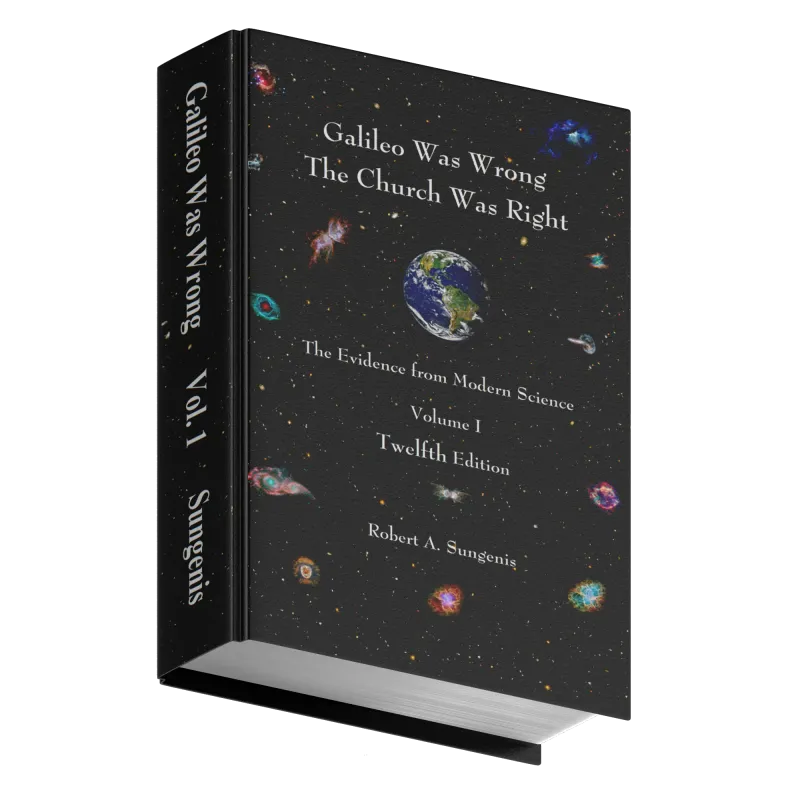
Go deeper: Galileo Was Wrong: The Church Was Right
The three volumes behind this reply: the science, the physics, and the Church history.
Get the set