Live debate
Geocentrism
Robert Sungenis vs. Jackson Roe
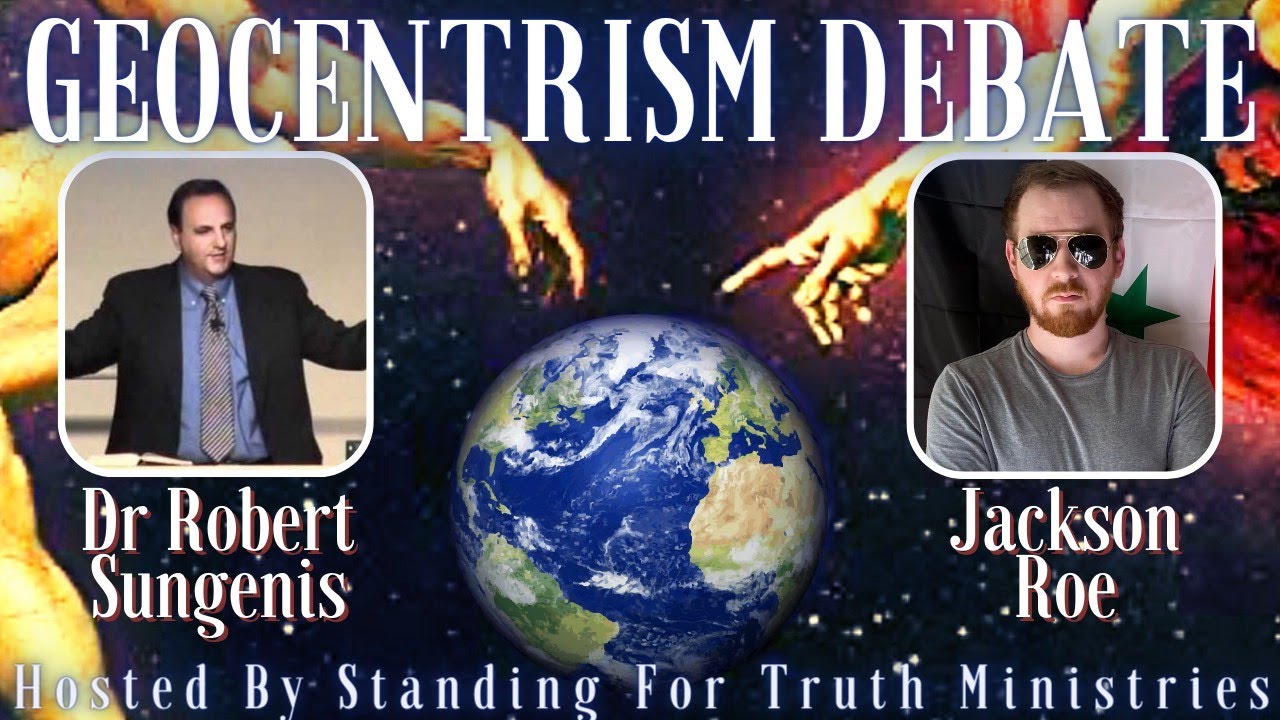
What was argued
Roe argued that interferometer tests, GPS and atomic clock experiments, gravitational lensing, space probe gravity assists and lunar laser ranging all confirm relativity and a moving Earth, and that since the physics works with any body at the centre, placing the Earth there is a choice made for biblical reasons. Sungenis argued that leading scientists from Newton to Einstein, Hawking and Hoyle concede a fixed Earth with the universe turning around it is physically and mathematically valid, and that the evidence (the small ether results, the Michelson-Gale rotation result, and the orientation of the microwave background) points to the Earth as the centre. Both men agreed that relativity lets any body be treated as the centre mathematically, so the real question is which evidence identifies the actual centre.
How it ran
- 0:19Host states the proposition
- 10:18Roe's opening statement
- 20:08Sungenis opening statement
- 35:18Roe's first rebuttal
- 37:38Sungenis first rebuttal
- 47:26Roe's second rebuttal
- 49:42Sungenis second rebuttal
- 56:48Open discussion
- 1:31:56Roe's closing statement
- 1:33:59Sungenis closing statement
- 1:42:06Audience questions
The key exchanges
Jackson Roe's point first, then Robert's answer. The time jumps to that moment in the video.
- 42:25
1. Would the Earth wobble
Roe argued that even a central Earth could not be static, because the mass of the universe turning around it would make it wobble, as stars wobble when planets orbit them.
Robert answered that no authority says so, and that because the Earth sits at the universe's center of mass everything balances out. Like a gyroscope nudged by a finger, a body can wobble while its center of mass stays fixed.
“Everything's going to be balanced out because the Earth is the center of mass.”
- 43:46
2. Why exoplanets orbit stars
Roe asked why every exoplanet we observe orbits its star, while on Robert's view the Sun alone orbits a planet.
Robert answered that those systems are all far from the center of the universe and follow their local physics, as binary stars do. A rotating spherical universe has a center of mass that does not move, and a small Earth placed at that point would stay put while everything else turns around it.
“All those local systems out there are going to be totally different than the system that's at the center of the universe where the center of mass is.”
- 46:19
3. Is light speed constant
Roe argued that the speed of light has never been observed to change, and that light slows in every known medium, so an ether cannot make it travel faster.
Robert answered that light speed is constant only in special relativity's idealized setting without gravity or inertial forces. Einstein said it is not constant in general relativity, and the inertial forces of a rotating universe let it exceed c, as Big Bang cosmologists themselves assume for expansion and inflation.
“Light speed is not constant, it can go any speed depending on the environment that it's in, including gravity and inertial forces and ether.”
- 55:42
4. Voyager and gravity assists
Roe argued that Voyager's course corrections and gravity assists required NASA to know where the Sun is, so either the Sun is the centre or NASA is hiding or faking something.
Robert answered that the neo-Tychonic model places every planet and the Sun in the same positions as the heliocentric map, only with different motions. Probes such as WMAP use the same gravity and the same Lagrange points, which can be calculated in the geocentric system.
“Those planets and the Sun are in exactly the same place.”
- 59:16
5. Lunar reflectors and ether
Roe argued that a Kennedy-Thorndike test run with the Apollo lunar retroreflectors confirmed relativity and ruled out the ether.
Robert answered that interferometers are so sensitive that a moving Moon 240,000 miles away is a poor platform. Every interferometer result was small but positive, and it was called a null only because the experimenters assumed a moving Earth at the outset.
“Every interferometer experiment that was done all had a positive result, it was very small but they were all positive.”
- 1:02:57
6. The Michelson-Gale result
Roe argued that the ether is at best imperceptible, since tests with lead shielding or run underground, including his own, never detected it.
Robert answered that Michelson and Gale in 1925 turned the same kind of apparatus to measure rotation and got a full sidereal result. A geocentrist needs only that one motion, while the heliocentric view needs both rotation and revolution, and the revolution never shows up.
“Yes it's imperceptible, that doesn't mean it's not there.”
- 1:05:30
7. The Chandler wobble
Roe argued that a universe turning around the Earth could account for the daily rotation or for the roughly 430-day Chandler wobble, but not for both.
Robert answered that the Chandler wobble is a precession of the axis tracing a circle, not a second rotation, so there is nothing extra for the turning universe to supply.
“That doesn't mean it's a rotation, it just means the axis is going around.”
- 1:10:08
8. GPS and flying clocks
Roe argued that GPS and the Hafele-Keating flights of atomic clocks east and west prove time dilation and the Earth's rotation.
Robert answered that a clock in a plane sits at a lower gravity potential, which changes how fast a cesium clock ticks, so the result shows gravity's effect on the clock rather than proving time dilation. He added that light between GPS satellites takes different times east to west than west to east, and asked Roe for evidence that a spinning Earth's gravity would cause that.
“You're going to have a lower gravity potential in that plane than you do on the ground.”
- 1:51:45
9. Stars faster than light
Roe argued that stars billions of light years away would have to travel many thousands of times the speed of light to circle the Earth daily, so the model fails.
Robert answered that the stars are not moving through space: the universe itself rotates and carries them, like a record faster at its rim, and general relativity allows that. He noted cosmologists already accept faster-than-light expansion by moving from special to general relativity.
“That's what's traveling faster than the speed of light is the universe itself.”
Robert's case in 5 points
- 1
Einstein, Lincoln Barnett, Stephen Hawking and Fred Hoyle all concede that no experiment has shown the Earth moves and that either the Earth or the Sun can be taken as at rest.
22:42 - 2
Newton himself wrote that the Earth could remain at rest in the centre with the heavens moving around it, provided another force acts equal and opposite to the Sun's gravity.
27:40 - 3
Mach and then Einstein's general relativity made a fixed Earth with a rotating universe mathematically legitimate, and Barbour and Bertotti among others worked out the equations.
30:02 - 4
A fixed Earth explains why interferometers detect a sidereal rotation (Michelson-Gale) but never the 30 kilometres per second revolution around the Sun that heliocentrism requires.
1:04:13 - 5
A century of experiments from Arago and Airy to Michelson, Miller and Joos, together with microwave background data aligned with the Earth and Sun, is evidence that the Earth, and not some other body, is the centre.
1:57:39
Closing
Robert closed with Edwin Hubble, who saw redshift in every direction, recognised that it implied the Earth was at the centre, called that intolerable, and adopted an expanding balloon model with no centre, which Hawking also preferred for reasons of humility rather than science. He argued that the data fits both pictures and that scientists keep the Earth out of the centre because a centred Earth implies Someone put it there Who will one day be our Judge.
1:33:59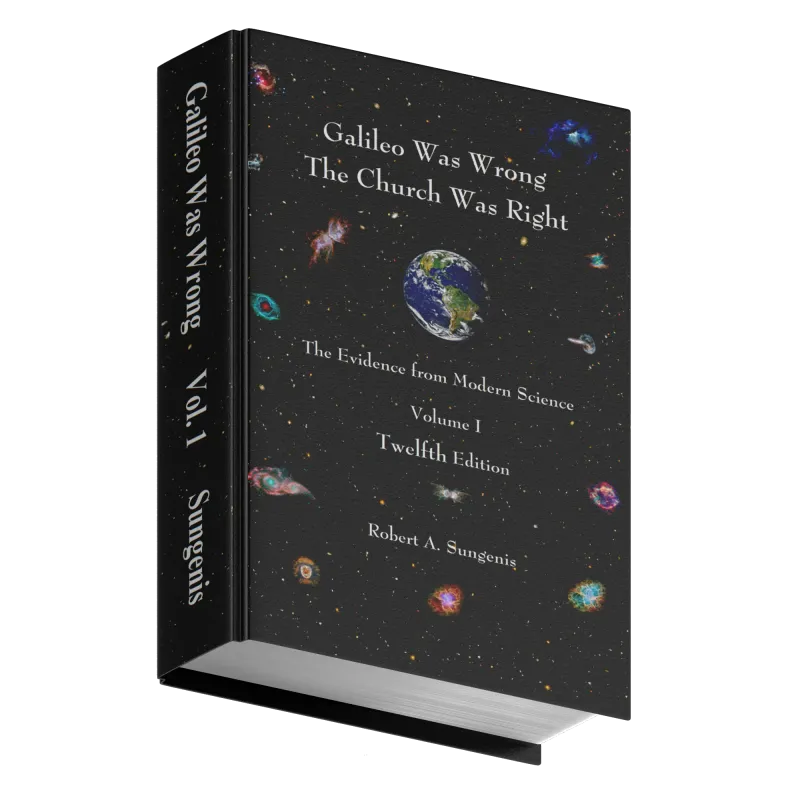
Go deeper: Galileo Was Wrong: The Church Was Right
Volume 1 lays out the evidence from modern science, 12th edition.
Get the book