Live debate
Biblical Cosmology: Flat Earth or Globe?
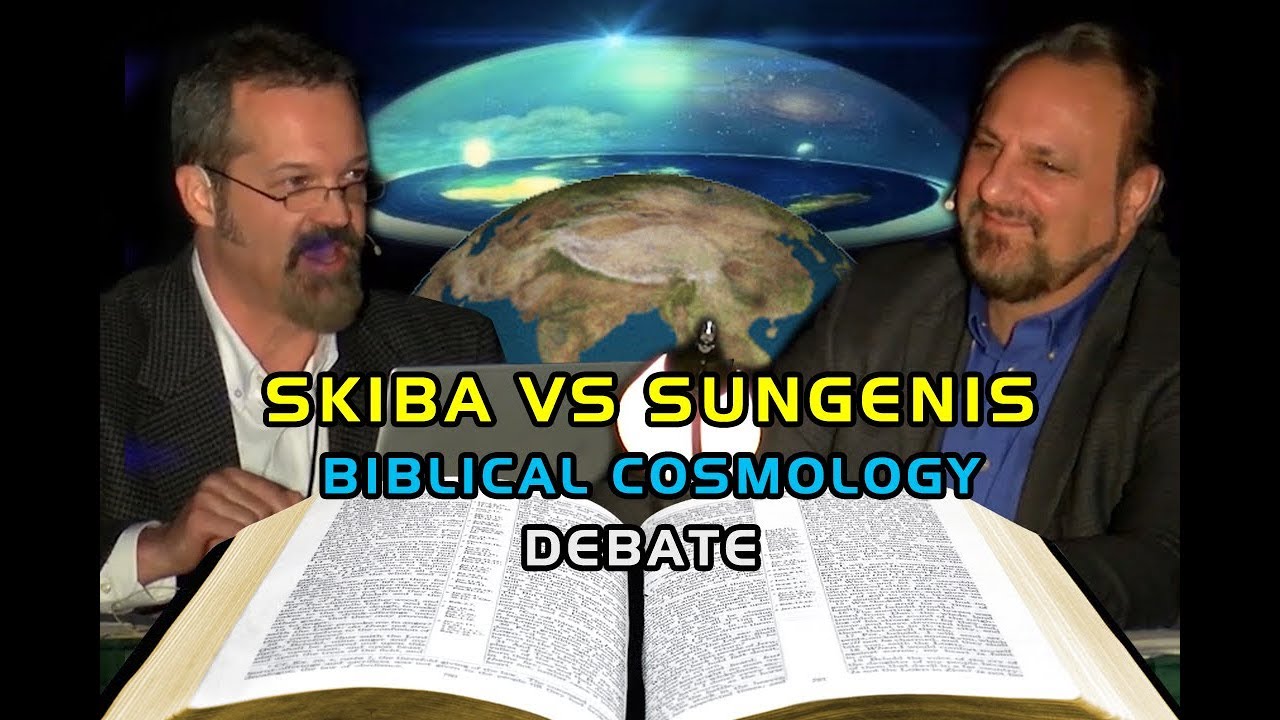
Robert Sungenis vs. Rob Skiba
What was argued
Skiba argued that Scripture, read literally, describes a stationary circular Earth set on pillars under a solid firmament (the Hebrew rakia, rendered stereoma in the Septuagint), with the sun, moon and stars moving inside that dome and destined to fall to the Earth. Sungenis argued that Hebrew has no word for sphere or flat disc, that the same word for circle is used of the heavens, that Genesis 1 places birds and stars in the firmament rather than under it, and that the texts on God's height and the unmeasurable heavens describe a vast universe with a spherical Earth at its center. Both men agreed that the Bible is to be read literally unless it signals otherwise, and that the Earth is fixed and central while the heavenly bodies move.
How it ran
The key exchanges
Rob Skiba's point first, then Robert's answer. The time jumps to that moment in the video.
- 37:04
1. How high is God
Skiba argues that the Bible describes a finite, enclosed system in which the sun runs its circuit from one end of heaven to the other under a dome, which does not fit a heaven extending billions of light years.
Robert answered that Isaiah 40:22 has God seeing people as grasshoppers, which places Him vastly higher than a dome a few thousand miles up, and that Jeremiah 31:37, Psalm 103:11 and Isaiah 55:9 describe heavens too high to be measured.
“This is not a God that's 3,000 miles high.”
- 42:11
2. The circle of the earth
Skiba argues that the Hebrew chug in Isaiah 40:22 means a circle inscribed on the face of the deep, citing scholars such as Schneider, Bratcher and Heiser who say it does not mean a sphere.
Robert answered that Job 22:14 uses the same word for the vault of the heavens on which God walks, and even the flat Earth model makes the heavens a hemisphere, so the word cannot be limited to a flat disc.
“The word kook is not limited to a flat disk in the Hebrew.”
- 1:18:05
3. In or under the firmament
Skiba argues that the prefix bet does not settle the matter, that the birds fly across the face of or toward the firmament, and that the Greek and even the Catholic Bible say they fly under it.
Robert answered that Skiba had himself called bet the prefix of choice for in, that no word for under or below is used in Genesis 1, and that translators who wrote under did so because they could not see how anything could be in a hard dome.
“That prefix is not used in Genesis 1.”
- 1:23:37
4. A circle or a half circle
Skiba argues that God looking down from the north at a globe would see only a half-lit half circle, not a circle, and that Isaiah knew the difference between a ball and a circle.
Robert answered that a circle is an abstract two-dimensional shape that does not decide between a sphere and a disc, and that as the light moves around in 24 hours God sees the whole circle.
“If he's looking at a globe from above why is he not going to see a circle?”
- 1:26:08
5. Stars falling to earth
Skiba argues that Isaiah, Jesus, Peter and John all say the stars will fall to the Earth like figs from a tree, which cannot be literal if stars are distant suns.
Robert answered that the passages use figurative language and the Hebrew means falling toward the Earth, which fits a geocentric universe in which the whole cosmos collapses toward the center at the end.
“It doesn't necessarily mean that these stars are little and will actually hit the earth.”
- 1:30:00
6. Scholars and Mesopotamian cosmology
Skiba argues that many credentialed scholars agree the Hebrews pictured a flat disc under a solid dome with waters above it.
Robert answered that this reading comes from liberal scholarship claiming the Hebrews borrowed Mesopotamian myths, and that Wayne Horowitz's dissertation found the flat Earth with a dome was rare among those cultures, which also held spheres and other shapes.
“This whole idea of the firmament with a dome was some cockamamie idea that was thought up by liberal scholars who had no respect whatsoever for the Bible.”
- 1:52:09
7. Dome on the Vatican website
Skiba argues that the English Bible on the Vatican's own website translates rakia as dome and has the birds fly beneath the dome of the sky, so Robert's own Church agrees with him.
Robert answered that the translation was done by liberal Catholics and is not a dogmatic decree, and that the Douay-Rheims of 1609, the Vulgate and the King James all used firmament.
“Nobody was using dome in traditional Catholicism.”
- 1:57:04
8. Hard yet flexible
Skiba argues that Job 37:18 and the root raka, to beat out like metal, show the firmament is solid, and that calling it both solid and ethereal is mental gymnastics.
Robert answered that the firmament is a hard substance that God hammered out, as metal is beaten into thin gold leaf, so that birds, sun, moon and stars can move in it.
“He hammered it out to make it flexible.”
- 1:58:13
9. The vault of Amos 9:6
Skiba argues that Amos 9:6 speaks of God founding His vault or dome over the Earth, as many translations render it.
Robert answered that the same Hebrew word is used in Exodus 12:22 for a bunch of hyssop and only means something joined together, which fits either model since in his the heavens surround the Earth and are connected to it.
“The earth is in the center, the heavens surround it and the two are connected.”
Robert's case in 5 points
- 1
Hebrew has no word for sphere or globe, and none for a flat disc either, so the shape of the Earth must be deduced from how Scripture uses its words.
34:29 - 2
Texts such as Jeremiah 31:37, Psalm 103:11 and Isaiah 55:9 picture heavens too high to measure, which describes a vast universe rather than a dome a few thousand miles up.
38:16 - 3
Because the word used for the circle of the Earth is also used for the heavens, it is not limited to a flat disc and allows both Earth and heavens to be spherical.
42:11 - 4
Space cannot be nothing, so the firmament is a real substance, so fine that it is both hard and flexible, filling the space where birds fly and the sun, moon and stars move.
55:58 - 5
The Earth is in the center of the universe with everything revolving around it, and it is the apple of God's eye.
59:02
Closing
Robert closed by answering Skiba point by point: the Vatican website translation reflects liberal scholars, Augustine taught a spherical Earth after his conversion, Enoch is not inspired, and Job says the Earth alone hangs on nothing. He argued that the circle God inscribed is the line between light and darkness on a spherical Earth.
1:48:22
Go deeper: Flat Earth Flat Wrong
Robert's full answer to the flat-earth case, from Scripture, the Fathers and the science.
About the book