Live debate
Geocentrism
Robert Sungenis vs. Taylor

What was argued
Taylor argued that geocentrism fails as physics: the ether experiments came back negative, turning every galaxy around the Earth once a day would need unimaginable energy and speeds beyond light, nothing explains why the Earth is not pulled toward the far more massive Sun, and the forces offered in reply were named but never shown to work. Sungenis argued that Mach and Einstein made a fixed Earth with a rotating universe physically equivalent to the reverse, that one initial push and inertia supply the energy, that the centrifugal, Coriolis and Euler forces of the rotating universe hold the stars in place and lock the Earth at its center of mass, and that the Michelson-Morley and Michelson-Gale results fit a fixed Earth better than a moving one. Both agreed that gravity operates within the solar system and that, as a description of positions, the observations can be mapped from either frame; the dispute was over mechanism and which frame is real.
How it ran
- 0:18Host states the proposition
- 11:23Taylor's opening statement
- 26:45Sungenis opening statement
- 42:13Taylor's first rebuttal
- 54:01Sungenis first rebuttal
- 1:05:28Taylor's second rebuttal
- 1:10:37Sungenis second rebuttal
- 1:16:20Open discussion
- 1:54:24Taylor's closing statement
- 1:59:34Sungenis closing statement
- 2:06:20Audience questions
The key exchanges
Taylor's point first, then Robert's answer. The time jumps to that moment in the video.
- 26:45
1. Where the energy comes from
Taylor argues that turning the whole universe around the Earth every day would take astronomical energy with no known source or mechanism, while heliocentrism explains the motions with gravity alone.
Robert answered that the heliocentric model faces the same question about what keeps the Earth moving, and its answer is inertia and momentum. Apply that to the universe: once God pushes it, its angular momentum is conserved and it keeps turning, more steadily than a rotating Earth that has to absorb earthquakes and impacts.
“The same basic question could be asked, where is the energy coming from?”
- 38:43
2. The planetary loops
Taylor argues that in the geocentric picture the planets trace strange loops and reverse direction mid-orbit for no reason, whereas around the Sun they simply orbit.
Robert answered that the loops are not arbitrary: the Sun circles the fixed Earth and the planets circle the Sun, held by the Sun's gravity against their inertia exactly as in the heliocentric model, so the loops are only how those orbits look from Earth.
“When you get to this diagram that Taylor gave us that shows this sort of loopy loop kind of thing, it's not some haphazard thing.”
- 58:36
3. The speed of light limit
Taylor argues that nothing with mass or energy can exceed the speed of light, a limit derived from fundamental physics, so distant galaxies cannot circle the Earth in a day.
Robert answered that the limit belongs to special relativity, which has no gravity or inertial forces. In general relativity speeds depend on the gravitational field, and he later read W. G. Rosser's textbook saying that with the rotating Earth treated as at rest, distant bodies may exceed that speed.
“In general relativity light and mass can go any speed.”
- 1:00:52
4. Center of mass needs rigidity
Taylor argues that a center of mass applies to a single connected rigid body, and the Earth and the galaxies are about as disconnected as objects can be, so the Earth cannot be the center of mass of the universe.
Robert answered that a rigid body makes the calculation easier but is not required, since a rotating sphere of loose gas still has a center of mass. He added that space is not empty, since quantum mechanics has shown a vacuum is not truly nothing.
“You can have a sphere of gas and rotate it and it's going to have a center of mass.”
- 1:03:07
5. Why the Earth is not pulled
Taylor argues that if the Sun has greater mass and gravity, a stationary Earth with no sideways velocity should fall straight into it, and nothing in the geocentric model explains why it does not.
Robert answered that this reasoning stays inside Newton's closed solar system. In the geocentric universe the whole universe transfers its forces through space to the center of mass and locks the Earth there, so the Sun and planets only raise tides rather than move it.
“Space is not empty, it's transferring its forces all the way to the center.”
- 1:14:06
6. Inertia cannot make an orbit
Taylor argues that inertia only keeps a body moving in a straight line, and bending it into an orbit needs a constant sideways acceleration, which is why you cannot throw something into an orbit around yourself.
Robert answered that he never said inertia makes a planet orbit: the Sun's gravity bends a planet's straight-line inertia into a curve. For the stars, the rotating universe itself moves in a curve and carries everything inside it along that curve.
“It's rotating in a curve so obviously it's going to carry everything that's inside of it in a curve.”
- 1:23:12
7. Centrifugal force flings outward
Taylor argues that centrifugal force explains why unattached objects fly off a rotating body in a straight line, so it would scatter the stars rather than hold them in place.
Robert answered that Taylor was leaving out the Coriolis force, which always accompanies the centrifugal force and pulls inward at twice its strength. He compared it to a ball thrown across a spinning carousel that misses its target.
“The Coriolis force happens with the centrifugal force, it's an inward opposite force at twice the magnitude of the centrifugal force.”
- 1:36:34
8. Michelson-Morley's null result
Taylor argues that Michelson and Morley themselves reported their search for the ether as decidedly negative, and every version of ether wind or ether drag was later disproven.
Robert answered that a null result fits equally well with an Earth that is not moving through the ether. The experimenters ruled that out only because they assumed the Earth was moving, and Einstein then removed the ether to keep that assumption.
“They believed that the Earth was moving, that was the fundamental assumption going into that experiment.”
- 1:43:25
9. Michelson-Gale's rotation signal
Taylor argues that under relativity it does not matter whether the Earth or the ether moves, so a rotating ether would produce the same wind as a rotating Earth, and the Michelson-Gale result gives no evidence for geocentrism specifically.
Robert answered that Michelson-Morley found no drift for a revolution around the Sun while Michelson-Gale found a full daily one for a rotation. Heliocentrism needs both, but a universe with its ether turning around a fixed Earth needs only the rotation.
“Geocentrism only needs one, all it needs is a rotation.”
Robert's case in 5 points
- 1
Mach and Einstein showed that a rotating Earth in a fixed universe and a fixed Earth in a rotating universe are physically equivalent, and general relativity's equations must allow the geocentric case or relativity itself fails.
32:47 - 2
The Earth sits at the center of mass of the universe, which does not move, and the centrifugal, Coriolis and Euler forces produced by the rotating universe keep the stars in their positions and the Earth in place.
36:31 - 3
Those same inertial forces, reaching the Earth's surface four thousand miles from the center of mass, are why hurricanes turn opposite ways in each hemisphere and why the Foucault pendulum swings as it does.
37:40 - 4
The Michelson-Gale experiment of 1925 detected a full sidereal rotation against the ether, which he explained as the universe and its ether turning around a fixed Earth once a day.
1:42:13 - 5
The cosmic microwave background's axis lines up with the Sun and Earth ecliptic, and galaxies appear in concentric spheres, which he took as evidence that the Earth, not merely our galaxy, is at the center.
2:39:37
Closing
Robert closed by restating that one push from God starts the universe turning and inertia keeps it going, and that the inertial forces of that rotation hold the Earth at the center of mass while travelling through space just as Taylor allows gravity to do. He argued that Mach and Einstein have reopened a door closed for centuries, making a fixed Earth a viable scientific reading of Michelson-Morley again, and said that is what he came to fight for.
1:59:34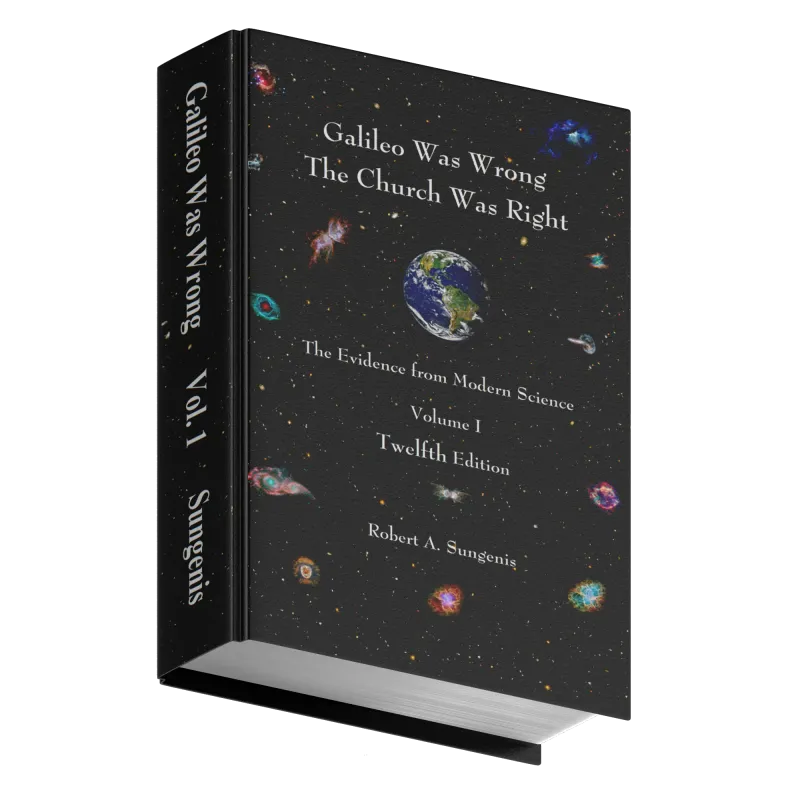
Go deeper: Galileo Was Wrong: The Church Was Right
Volume 1 lays out the evidence from modern science, 12th edition.
Get the book