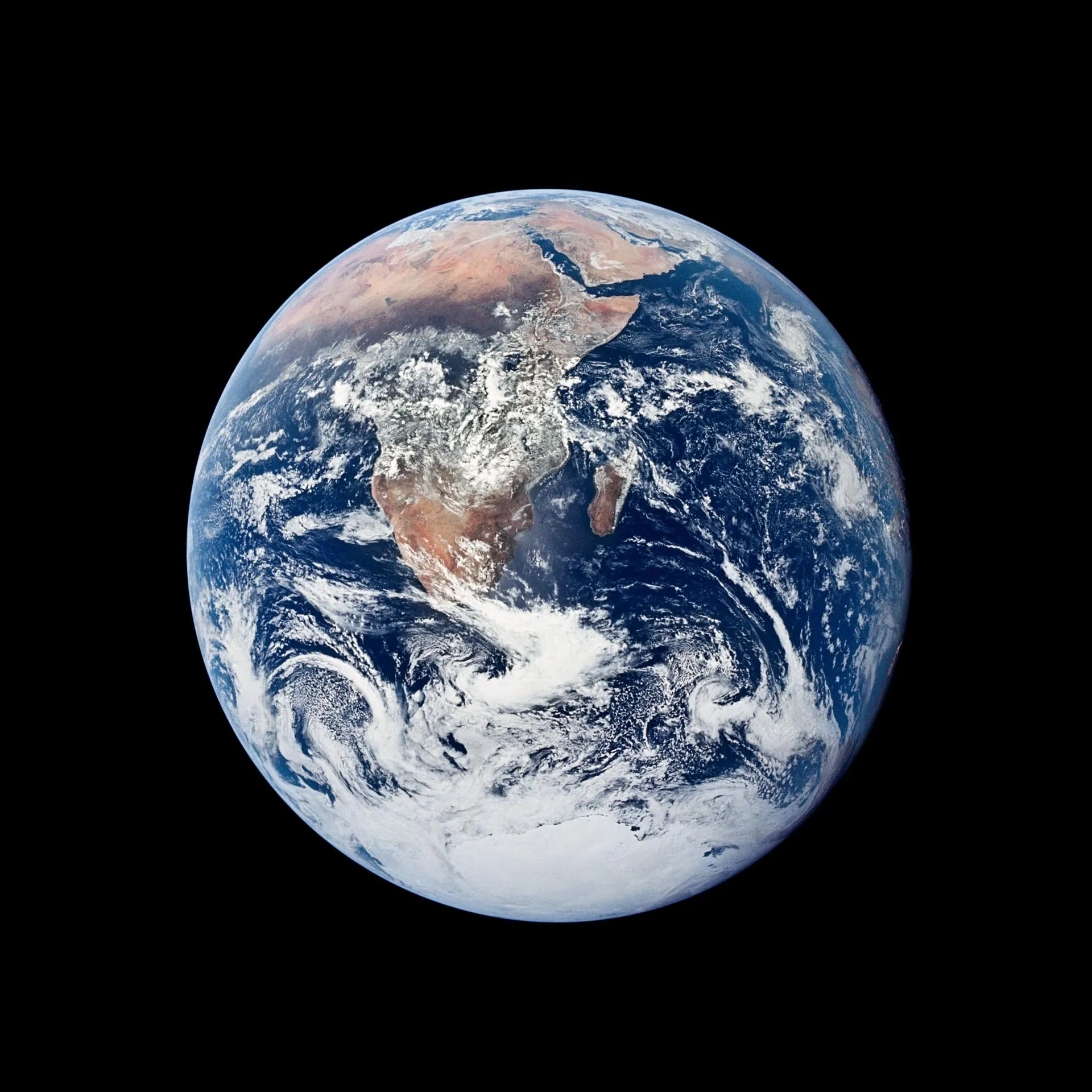
2014 documentary
The Principle
A documentary asking whether the Copernican principle, that the Earth holds no special place, was ever established by evidence.
Directed by Katheryne Thomas · Produced by Rick DeLano and Robert Sungenis · Narrated by Kate Mulgrew

A documentary asking whether the Copernican principle, the assumption that the Earth occupies no special place in the universe, was ever established by evidence or adopted as a philosophical starting point. It interviews working cosmologists and sets their answers against the large-scale observations that have troubled the assumption, including the alignments in the cosmic microwave background.
Trailer

The dispute over participation
- Kate Mulgrew, narrator
- Said publicly that she had been misinformed about the film’s purpose, and that Robert Sungenis’s involvement would have been a dealbreaker had she known of it.
- Lawrence Krauss and Michio Kaku, interviewed
- Both distanced themselves from the film after its release and said their participation rested on a misunderstanding of what it argued.
- The producers, on the narration
- Say they engaged Kate Mulgrew through her New York agent, that she read the script and approved it, signed on 6 May 2013 and recorded on 6 June 2013. They add that she then asked to record an on-camera interview her contract did not require, and praised the material in it. They have published that interview.
- The producers, on the physicists
- Say they told every participant the film covered cosmology including alternative models, and that they named no specific cosmology in any contract, geocentrism and heliocentrism and the big bang alike, so that nobody shaped an answer in advance. They also say they hold signed releases from all contributors, “most certainly including Lawrence Krauss”, and that any suggestion otherwise is “simply a falsehood”.
- The producers, on the timing
- Say the press coverage began in April 2014, roughly six months before the film opened in US theatres that October, so critics reviewed it without having seen it, working from the trailer, which does not use the word geocentrism.
These accounts are irreconcilable and this page does not pretend to settle them. Both are set out so that a reader can see what each party said and weigh it.
The producers answer the press criticism of the film point by point (2014): watch the interview.
The Dan Olson video, answered
In November 2020 Dan Olson (Folding Ideas) released “That Time Geocentrists Tricked a Bunch of Physicists,” a 45-minute video on the making of the film that has passed four million views. Robert answered it in October 2021, claim by claim, in an 86-minute reply. What follows is each of Olson's claims as Robert presents it, then the answer, with the second in the reply where he gives it.

The criticism
Folding Ideas, 2020
45 min

The reply
Robert Sungenis, 2021
1 h 27 min
Olson: the filmmakers tricked a number of astrophysicists into appearing in a documentary arguing that the earth is the center of the universe.
Answer: everyone was told it was a scientific documentary about cosmology including alternative views, and that geocentrism was left out of the contract exactly as the big bang, the multiverse, string theory, and the rest were, so that each participant would react to the ideas during the interview rather than to a label beforehand.
Olson: the filmmakers tricked people into being in the movie, which Robert takes to include the narrator, Kate Mulgrew.
Answer: Mulgrew read the script, approved it, and signed her contract weeks before recording, and that after the session she asked for a separate interview, which her contract did not require, so she could say on camera how much she liked the material.
Olson: the film's executive producer holds a doctorate from a fake university.
Answer: he holds two accredited United States degrees, a bachelor's from George Washington University and a master's from Westminster Theological Seminary, and that Calamus International University is authorized by the country of Vanuatu, which permits such degrees, although it has never sought United States accreditation.
Olson: the producer effectively interviewed himself in his own movie in order to look like an expert.
Answer: Olson interviews himself for most of his own film, that many directors appear in their own documentaries, and that his own appearance runs six minutes of a ninety minute film. He adds that Olson never mentions his book against the flat earth view.
Olson: stellar parallax, first measured in the 1830s and refined ever since, demonstrates that the earth orbits the sun.
Answer: the same shift appears in the geocentric model, where the star field led by the sun swings from one side of the earth to the other over six months on the same radius, and he quotes a University of Illinois physics lecture saying parallax does not decide between the two pictures.
Olson: satellites at the Lagrange points behave as they do because we understand correctly how gravity works on celestial bodies.
Answer: both models produce the same five neutral gravitational points, since the two are mirror images that differ only in which body sits at the center, so the Lagrange points settle nothing either way.
Olson: the 23 year time lapse of the star S2 orbiting the black hole Sagittarius A as showing how well we understand gravity.
Answer: Olson never says how a black hole observation bears on the question, and that modern geocentrism uses ordinary gravity rather than rejecting it, unlike the flat earth writers Olson has been dealing with.
Olson: the film's central point, that the cosmic microwave background marks out an axis running through the earth, is not true, and that the data was massaged to look sharper than it is.
Answer: Olson cites no scientist for this, and quotes Joao Magueijo, Michael Longo, Dragan Huterer, Ashok Singal, and Lawrence Krauss, who describe alignments with the ecliptic and the equinoxes and say the Copernican principle looks to be in trouble.
Olson: geocentrism needs a universe in which consistent physical principles apply to everything we can see except ourselves.
Answer: the same principles and equations apply to the earth and to the rest of the universe, that gravity applies everywhere, and that the earth stays put because it is the center of mass of the system, which by definition does not move.
Olson: if the earth is the fulcrum of the universe then the star field would have to move at absurd relativistic speeds to circle it each day, so relativity would have to be discarded.
Answer: general relativity is what allows those speeds, because a rotating universe is a non-inertial frame, and he quotes William Rosser to the effect that with strong gravitational fields the speeds of bodies and of light are not held to the usual limit.
The full breakdown, with Robert's five-point casePlay the reply
Details
- Released:
- 24 October 2014
- Production:
- Stellar Motion Pictures, LLC
- Featuring:
- Lawrence Krauss, Michio Kaku
- Listing:
- IMDb
Companion booklet
The Principle: Outline and Study GuideThe three strongest objections to a fixed Earth are answered, with live diagrams, in Geocentrism's Three Biggest Objections. The argument the film raises is worked through at length in the geocentrism questions and answers and in the books.