A bishop, priests and scholars on his books
Every quote appears as the original prints it, ellipses included, under the name and title it gives.
In proving from Sacred Scripture the veracity of the Catholic theology of justification, Robert Sungenis leaves nothing to chance, no stone unturned, no concession for any other reasonable argument. We know that an active faith in Christ Jesus presupposes corporal and spiritual works of mercy, that faith implies works. We know that the words we long to hear, 'Well done, my good and faithful servant...come share your Master's joy' (Mt. 25:21), will be spoken to those who have done well. Faith alone is not enough. The Protestant Reformation sowed confusion about the biblical theology of faith and good works, and many today rely on this confusion to defend or excuse a failure to live holy lives of service and goodness. Robert Sungenis has systematically addressed the confusion and demonstrated what we have always known, namely that Sacred Scripture and the Catholic Deposit of Faith are in complete agreement about justification. I applaud this work, and recommend it for all who wish to know how and why the Bible teaches that we are not saved by faith alone.
On Not By Faith Alone. Endorsements from the first edition (1997).
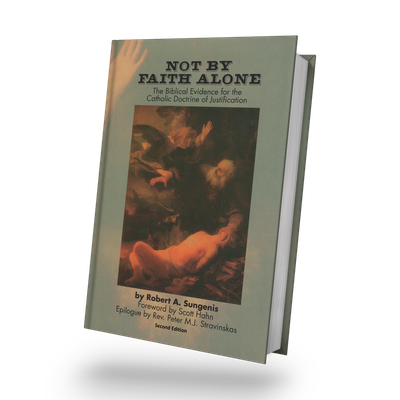
“I am pleased that the important doctrine of Justification has received such a thorough apologia as this book offers. It is especially gratifying to read so clear an account of a matter which has often been sadly confused in the rush of polemics.”
“While this present work is clearly scholarly, it must be distinguished from many other efforts along these lines over the past five centuries. Previous volumes often exhibited an acerbic tone; yet other lacked passion because they had reduced the discussion to blandly academic. Robert Sungenis is not only a competent theologian but a convinced believer who, with the sacred author, holds that God wants all men to be saved, precisely by coming to know the truth (cf. 1 Tim 2:2). But being an intelligent person and one desirous of fulfilling the Second Vatican Council's hope for Christian unity, he has refrained from polemics even while defending and explaining in the most articulate way possible the Church's position on this topic...Robert Sungenis has heard the invitation and responded to the challenge; in doing so, he paves the way for others to follow.”
“Only some books deserve to be called 'seminal' and 'revolutionary.' This is surely one of them. The ecumenical enthusiasm following Vatican II led many of us to view our divisions as rooted in nothing more intractable than misunderstanding. But if Robert Sungenis is right, this optimistic view is itself the result of deep misunderstanding; a failure to face squarely and honestly the hard doctrines of the reformation. Not By Faith Alone pays the reformers the ultimate compliment of taking them at their word; it also renders a real service to anyone who cares deeply about Christian unity. For there can be no such unity apart from the truth. By forcing Catholics and Protestants to take a long second look at the things that still divide us, Robert Sungenis deserves genuine gratitude, and undivided attention.”
“Does the Bible teach justification by faith alone? Ever since the 16th century, the evangelical community has accepted this as fact. Now they have good reason to doubt it. Anyone who will make the effort to study carefully the details of Robert Sungenis' insightful work will make the rather remarkable discovery that open-minded, modern sons and daughters of the Protestant Reformation can no longer hold to both biblical clarity and justification by faith alone without being double-minded. With his characteristic sincerity and comprehensive intensity, Robert Sungenis details the bankruptcy of the man-made system of Protestant theology, especially the Reformed denominations.”
“Not By Faith Alone is a masterful biblical study which makes significant progress in two important areas. First, it advances the Catholic-Evangelical dialogue with its thorough presentation of the issue of justification. Second, it is a classic example of the 'biblical theology' or 'theological exegesis' that is so greatly needed in the Church today.”
“This work represents the first book-length response by an American Catholic to Protestant attacks against the Catholic Church's teaching on faith and justification in more than half a century, perhaps longer, since I am not familiar with a single title written in the 20th century!...If you are a Protestant, this book affords you today's greatest opportunity to judge fairly, for yourself, the solid scriptural grounds for the Church's teachings on justification, and how an informed Bible-Catholic would respond to standard anti-Catholic arguments put forth by many evangelicals today.”
“The notion of 'justification by faith alone' is so alluring that countless good people have been convinced by the (weak) argument in favor of it. Robert Sungenis turns those arguments on their head and shows what the real biblical doctrine is. It may not have quite the pizazz of the position espoused by Martin Luther, but it has one great advantage. It's true.”
“Not By Faith Alone exposes the Reformation formula of sola fide for what it is: a legal fiction, a tragic misunderstanding of St. Paul. With relentless precision, Robert Sungenis examines sola fide in fine detail, showing that it cannot withstand careful biblical, linguistic, historical, and theological analysis.”
“There is no question that justification and salvation are hot topics in the Catholic-Protestant dialog. Proof texts are tossed about and heated words are exchanged. For many Protestants, this is the highest hurdle, not because Catholic teaching is difficult or unbiblical, but because Protestants have too often misrepresented, and therefore misunderstood the Catholic teaching, treating it as a mere caricature of its real substance. Robert Sungenis' book is just what the doctor ordered. It gives a lucid, organized, scholarly, and well-reasoned explanation of the biblical and Catholic view of justification. I find myself turning to this book frequently, not only for quick answers to burning questions, but also for a clear presentation of how Justification has been understood for two thousand years of the Christian faith. Many deviations and corruptions (2 Peter 3:15) have sprouted through the centuries, but Robert Sungenis' book demonstrates the solid, biblical doctrine that has been sustained with unaltered clarity and faithfulness within the Catholic Church. I am grateful for this landmark achievement.”
“This study shows Robert Sungenis to be a theologian and scholar of the first rank. With objectivity, clarity and precision, the author sheds new light on one of the most subtle and difficult issues of the Christian faith. Making meticulous use of Scripture and the primary writings of the Protestant writers themselves, Robert Sungenis exposes the many weaknesses, problems and inconsistencies of the sola fide position. This book is a gold mine of historical detail and theological analysis. Anyone interested in what really is at stake in the Protestant/Catholic discussions over justification can only benefit from this illuminating and intelligent study.”
“Upon reading Robert Sungenis's book, one hopes most fervently that it will be very widely read and studied among those who have espoused Luther's doctrine, and most especially our brethren, the leaders of the evangelicals. This is a major document, noteworthy for its clarity, its exhaustive coverage of the topic, and its punctilious scholarship.”
“Catholic Apologetics has rarely been in more flourishing condition, and this book is one of the foremost proofs of it.”
“Robert Sungenis has written a powerful essay in Catholic apologetics. With clarity and charity, he exposes the countless confusions and contradictions within and between the myriad Protestant theologies of faith and justification, as well as give a solid, biblical defense of the Catholic teaching on justification.”
“One of the most urgent needs among the various Christian traditions in our time is for an honest accounting of the sins and errors of judgment that converged to produce what Lutheran historian Jaraslov Pelikan has called the 'tragic necessity' of the Reformation. By his meticulous analysis, Robert Sungenis contributes substantially to one of the most urgent needs among the various Christian traditions in our time, an honest sorting out of what was really 'necessary' from what was truly 'tragic' in the Protestant Reformation.”
“Robert Sungenis' book is a thorough presentation of the Catholic doctrine of justification from the biblical perspective. It combines a keen knowledge of the original language texts with an historic perspective often lacking in discussions of this type. This book not only deals with the historic debates on the question of justification dating from the 16th century, it is also the first apologetic book to directly challenge the recent writings of Protestant critics of Catholicism such as McGrath, Sproul, Geisler, McCarthy, MacArthur, White, et al. This enlightening and readable book is accessible to both the scholar and the average believer. It is written with sufficient sensitivity and depth of scholarship that both Catholics and non-Catholics will benefit from a careful reading. Anyone interested in Catholic apologetics and sound biblical exegesis needs to read this book.”
“For those who require an exhaustive exposition of the point, the best book I have found is Robert Sungenis' Not By Faith Alone...This reviewer thinks he has successfully made the point he started out to make, and that if one remains a Protestant after reading it (as I do) it will be vastly more difficult to mount his protest on the basis of belief that we are justified by faith alone apart from works...”
“This book may well become the most significant contribution to ecumenical relations between Protestants and Catholics that has appeared in a long time.”
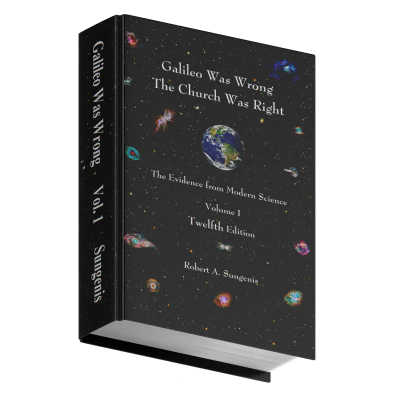
“There exists no better exposition of the history and science of geocentrism. Very highly recommended and a must for all those interested in the issues surrounding geocentrism today”
“In their over 700-page book, Drs. Sungenis and Bennett make a convincing case for the special and central position of the earth in the cosmos”
“Galileo Was Wrong is a work of monumental proportion which ranks, in my opinion, on a par with the meticulous observations of the Danish astronomer, Tycho Brahe, and the tireless efforts of Walter van der Kamp”
“In their new book, Sungenis and Bennett take no prisoners...Now that the Enlightenment is over, it was inevitable that the system upon which it was based should come in for the powerful critique which Sungenis and Bennett provide. Not inevitable, however, was the brilliant way they provide it”
“Sungenis and Bennett examine the anomalies that arise from the Copernican model...A must read for those who can set aside prejudices and a priori assumptions”
“The book Galileo Was Wrong forcefully addresses the history, science, theological, philosophical, and worldview implications of our place in the universe”
“Galileo Was Wrong is a model for the kind of scholarship we need today: intellectual understanding not as an end in itself, but as a commitment to reality, infused with moral passion, love for the earth, common sense and philosophical sensitivity”
“It is with pleasure that I remand this volume into the hands of the reader”
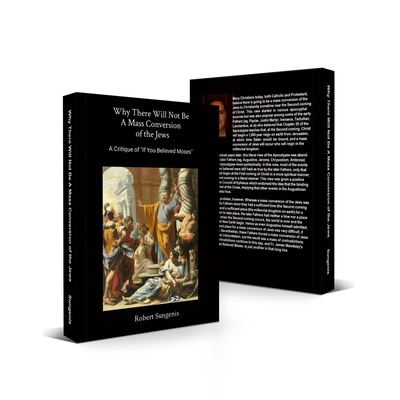
“Since I came back to the Catholic Church and not having been properly catechized before my time as an atheist, it was quite a challenge to find a reliable teacher and defender of the Catholic faith in the mid-2000s. That changed when I discovered the work of Robert Sungenis and Catholic Apologetics International. Dr. Sungenis tackled many of the confusing issues that other popular Catholic authors and apologists did not, for whatever reasons. Some of the most controversial topics of those days, and in many ways still linger today, perhaps even more so, is the issue of the status of the Old Covenant, and the confusing opinions of modern theologians at odds with the classical Catholic view of supersessionism, as well as the idea of the mass conversion of the Jews during the end times. You would think that a traditional author, formed in the ways of classical theology, such as Father Mawdsley, would be on the same page as this book you now have before you, but he isn't. Let Robert Sungenis show us how the Jews play a part in the whole story of salvation, not just the end times.”
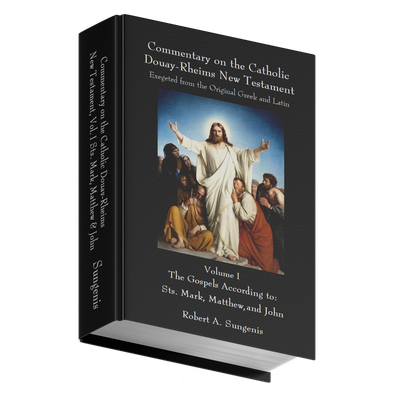
“Thank you for putting all of the time and effort into the project, I truly think your commentaries are the best I’ve ever read.”
About the editions
Each endorsement belongs to the edition named beside it. Where no edition is named, the source did not name one.